
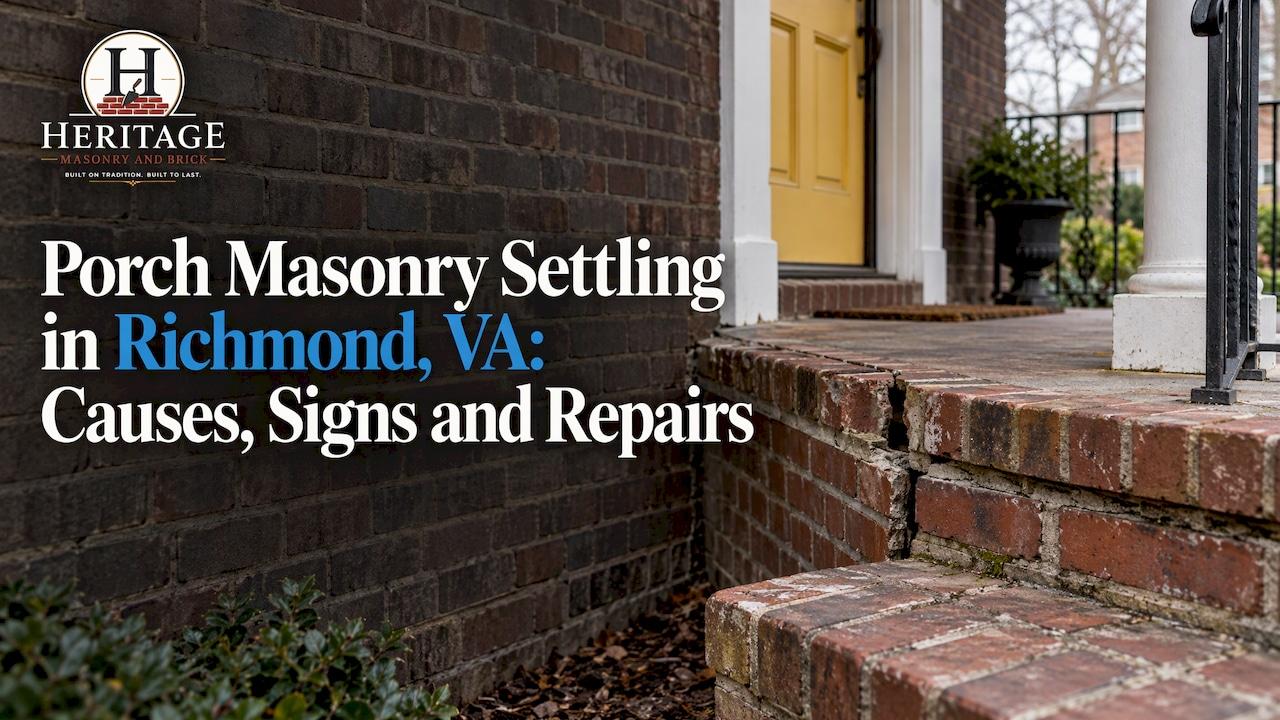
A brick porch settles when the soil or base under it moves, and the brick and mortar above crack as they follow. Small, stable hairline cracks are usually cosmetic and can be repointed. Cracks that grow, steps that tilt, or a widening gap at the house wall mean the support needs attention first, and the brick is repaired after that. If you own a brick porch in Richmond, Virginia, this guide explains what to look for, what causes it and how a mason fixes it so the repair lasts.
TL;DR
- Settling is usually a soil, water or base problem. Brick and mortar show the damage, but they are rarely the cause.
- Stair-step cracks, a gap between porch and house wall, and tilted steps are the signs to watch. Measure them and check whether they change.
- Fix the support and drainage first. Repoint or rebuild the brick second, with mortar matched to the old brick.
- Lime mortar suits older Richmond brick because it is softer and more flexible than modern portland cement mixes.
- We give free estimates in Richmond, with a 5-year guarantee on materials and workmanship.
Table of Contents
- What porch masonry settling looks like
- Why porches settle
- How to tell if it is serious
- The gap between the porch and the house
- How a settling brick porch is repaired
- Why lime mortar matters on Richmond brick
- Drainage: keeping the porch from settling again
- What porch repair costs
- Our approach to porch settling
- Let us look at your porch
- Related brick problems to check at the same visit
- FAQ
- Sources
What porch masonry settling looks like
Settling rarely arrives as one dramatic event. It shows up as a series of small changes that you can easily write off for years. On a brick porch in Richmond, these are the signs we see most often:
- Stair-step cracks that follow the mortar joints diagonally through the brick.
- A gap between the porch slab, steps or brick wall and the house.
- Steps that tilt away from the door, or a landing that no longer sits level.
- Sagging brick courses. Sight along the face of a porch wall and look for lines that dip.
- Loose, hollow or missing brick near the base of columns and step cheeks.
- Doors that stick where the porch meets the house.
These match what building professionals describe. InterNACHI says uneven settlement can cause cracking, and that cracks from it are most likely at corners and next to openings, usually running roughly diagonally along mortar joints. The Geotechnical Institute lists diagonal stair-step cracks in brick, sagging masonry lines and a porch, patio or sidewalk separating from the foundation as exterior signs of soil movement.
Seasonal cracks versus settlement cracks
Not every crack means the porch is sinking. The National Park Service explains that brick walls expand in warm weather and contract in cool weather, which produces cracks that open and close with the seasons. Active cracks are sealed with a flexible sealant, while inactive ones can be pointed.
A seasonal crack opens and closes by a hair and returns to the same width. A settlement crack tends to widen over time, often wider at one end, and is usually joined by a drop in the brick on one side of it.
Why porches settle
Fill soil and compaction
Porches and front steps sit right against the house, where builders backfilled the hole dug for the foundation. A masonry company's technical article notes that stoops and steps are commonly built on fill dirt, which is usually uncompacted and may settle as the soil consolidates. InterNACHI adds that differential settlement happens when a structure sits partly on undisturbed soil and partly on compacted fill, because the two consolidate at different rates.
That explains a common Richmond pattern. The house is fine, and the porch beside it has dropped.
Water
Water is the usual accelerator. Downspouts that discharge at the porch corner, a soft grade that slopes toward the steps, and failed joints that let rain into the core of the porch all wash fine soil out from under the base. Once there is a void, the load above it follows.
Richmond adds a regional factor. A local real estate blog notes that clay soil in the Richmond area swells when wet and shrinks when dry, and that this movement contributes to settling and cracking. The Geotechnical Institute makes the practical point that keeping soil moisture uniform next to and under a structure is the single best thing you can do to reduce shrink/swell effects.
Freeze-thaw and failed joints
The National Park Service lists differential settlement of foundations alongside drying shrinkage, thermal and moisture movement, freeze-thaw cycles, and differential movement between materials as causes of masonry cracking. Once a crack opens, water gets in and freeze-thaw cycles make it wider. Richmond winters freeze and thaw often enough to do this over several seasons.
How to tell if it is serious
There is no single number that separates "fine" from "call someone." Direction of change matters more than size. This Old House notes that cracks that grow or appear suddenly, or that affect doors and windows, are more likely to signal a serious problem.
A simple routine helps:
- Photograph each crack with a tape measure or coin beside it.
- Mark the ends of the crack with a pencil and date them.
- Re-check after a heavy rain, after a hard freeze and after a dry spell.
- Note the pattern. Cracks that appear together in several places are more worrying than one old crack.
A structural engineer is the right professional when you see signs that point beyond the porch. One engineering firm's guidance suggests considering an engineer for diagonal cracks running from doors or windows, stair-step cracks in brick, foundation cracks about 1/4 inch wide or more, cracks that keep growing or return after repair, and new cracks in an old house. If the porch roof or its posts are separating from the house, call right away. Do not stand under a sagging porch roof.
Our role is the masonry. If the cause is structural, we repair the brick and masonry to suit what the engineer specifies. See our structural brick and masonry repairs for what that covers.
The gap between the porch and the house
A gap at the wall is one of the most searched porch problems, and it needs a diagnosis before a fix. There are three common situations:
- A narrow, even joint that was always there. Porches are often built as separate elements with a joint where they meet the house. A flexible, weather-resistant sealant or backer rod keeps water out. Rigid mortar in a joint that is meant to move will simply crack again.
- A gap that is widening. The porch is moving away from the house. Filling it hides the symptom. Measure it, find out why the base is moving, and stabilize the support first.
- A gap with a void or cold space beneath. Water has probably been running in for some time. Look for soil loss, damp brick, white salt deposits and a porch slab that rings hollow when tapped.
From our work on Richmond porches, the gap is also where water starts. Open joints at the house wall feed rain straight into the porch core. That is why we look at the flashing, the grade and the joints around the porch at the same visit.
How a settling brick porch is repaired
The order of work matters. The National Park Service advises that structural repairs precede minor or cosmetic ones. For a settling porch, that means:
- Stop the water. Redirect downspouts, fix the grade so it slopes away from the porch and repair open joints.
- Stabilize the support. Depending on the cause, this could mean replacing washed-out fill with compacted base, rebuilding the porch foundation or lifting a slab. An engineer may specify the approach.
- Rebuild what has moved. Step cheeks, risers, columns and walls that have shifted are taken down and relaid course by course.
- Replace damaged brick. Cracked or spalled units are cut out and replaced with brick that matches in size, color and texture.
- Repoint. Failed mortar joints are raked out and refilled with mortar matched to the original.
Slab lifting
For a concrete porch slab, homeowners often hear about lifting with polyurethane foam. HomeGuide reports that foam jacking costs $8 to $25 per square foot, with a typical 150-square-foot patio or porch at $1,200 to $3,800, and that many contractors set a minimum job fee of $300 to $700 or more. A slab lift fixes the level of a slab. It does not repair cracked brick walls, columns or step faces above it, and it does not address where the water is coming from. A brick porch with brick steps usually needs masonry work as well.
When repointing is enough
If the porch is stable and the cracks have not moved over a full year of seasons, repointing is often the right repair. Brick that is sound with failing joints is what tuckpointing and repointing are for. Our guide to what tuckpointing means explains the process, and when to repoint brick covers urgency.
When rebuilding is the better choice
If steps have rotated, brick faces have separated from the core, or courses have dropped, repointing over the problem will not hold. Those sections are taken down and rebuilt on a sound base. Our brick steps and step repair work covers that, and our guide to brick walkway repair shows how we handle paving that has sunk.

Why lime mortar matters on Richmond brick
This is the part of porch repair that gets overlooked most. The mortar you use to rebuild and repoint decides how the brick ages for the next fifty years.
Much of the brick in Richmond's older neighborhoods, including the Fan District, the Museum District and Monument Avenue, was laid in lime-based mortar. Lime mortar is softer and more breathable than modern portland cement mortar. It lets moisture move out through the joints, and it can flex slightly with seasonal movement. When joints wear, they wear before the brick does, and that is by design: a joint is easier and cheaper to repoint than a brick is to replace.
The National Park Service warns that more damage is often done to historic brick by improper pointing than by almost any other treatment. Hard mortars with a high portland cement content are less permeable than the surrounding brick. Combined with differential movement, they often cause the brick itself to deteriorate, or to deteriorate faster. The NPS also recommends matching the color, hardness and permeability of the existing mortar, and having the work done by professionals familiar with historic masonry techniques.
On a settling porch this matters twice. The porch is already moving, so the joints need to give a little. And the porch has often been patched before, sometimes with a hard gray cement that is now chewing up the edges of the brick.

What a lime mortar mix is
Lime mortar is made from lime putty or hydrated lime, sand and water. Sand grading and color are chosen to suit the original joints. The strength is selected to be softer than the brick, so the mortar takes the wear. We test and match for color, texture, joint profile and strength rather than reaching for a bag of standard mortar mix. If you want to see how the matching works, read our guide on how to match mortar to brick and why historic mortar analysis is a useful step before repointing.
Matching the brick
Old Richmond brick is not the same as new brick from a building supply yard. It can differ in size, texture, firing color and how much water it absorbs. Replacing a few damaged units with the wrong brick makes a repair obvious and can trap moisture in the surrounding wall. We match the existing brick as closely as possible so the porch looks like one structure, and we use the traditional methods that old brick was built with. Our overview of masonry restoration methods for historic brick in Richmond goes deeper.
Drainage: keeping the porch from settling again
A porch that was repaired without fixing the water will usually settle again. Check these first:
- Downspouts that end at or near the porch. Extend them well away from the porch and the house.
- Grade. The soil next to steps and porch walls should slope away from the masonry, not toward it.
- Gutters. Overflowing or clogged gutters dump water along the foundation line. This explainer on gutters and foundation protection shows how roof drainage ties into the ground below.
- Open joints and cracks that let rain into the porch core. These are sealed or repointed.
- Lawn irrigation that soaks the same strip of soil every day.
HomeGuide puts drainage improvements to prevent future settling at roughly $500 to $2,000 or more, which is often a small fraction of the cost of a second repair.
What porch repair costs
Every porch is different, so we give a written estimate after seeing the work. For general context, HomeGuide's 2026 masonry cost guide reports the following national averages, including materials and labor:
| Type of work | Typical national cost |
|---|---|
| Repointing and fixing small sections of a brick porch | $1,500 to $3,000 |
| Replacing a few bricks | $10 to $30 per square foot |
| Full replacement of an average 50 to 100 sq ft porch | $3,500 to $8,000 |
What moves a price up or down:
- The cause. A porch that needs a new base costs more than one that needs repointing.
- Access. Steep lots and tight side yards slow the work.
- Brick matching. Historic or unusual brick takes more effort to source.
- Mortar type. Lime mortar and careful color matching are a deliberate choice, not a shortcut.
- Extent. Steps, columns, walls and the porch floor can be different jobs on the same porch.
We do not publish set prices, because we would need to see the porch. We do offer free estimates, require no deposit, and ask for payment on completion.
Our approach to porch settling
We start every porch visit with one question: why did it move? Most settling we see in Richmond comes down to water and a poorly prepared base, and the cracked brick is only what shows.
That is why we do not reach for a tube of cement and a trowel. We look at the grade, the downspouts and the joints, then repair the support before the brick. A repair that ignores the cause is a repair you pay for twice.
When we do repoint, we use traditional lime mortar matched to the existing joints, and we match the brick we replace. It is slower than patching with whatever is in the truck. It is also how old brick was meant to be repaired, and it is why the work blends in and lasts for decades.
Thomas
Let us look at your porch
Heritage Masonry & Brick is a family of traditional masons in Richmond, VA, with over 25 years in the trade. We repair brick porches, steps, walkways, chimneys and foundations, and we match the existing brick and mortar on every job. Our work comes with a 5-year guarantee on materials and workmanship.

If your porch is cracking, tilting or pulling away from the house, request a free estimate on brick repair or call 804-324-6304 today. If you own a historic home, our page on historic brick repair in the Fan and Museum District describes how we work in those neighborhoods.
Related brick problems to check at the same visit
A settling porch is often one symptom of how water moves around the whole house. While we are on site, we look at:
- Foundation brick and piers. Our guide to brick foundation repair and the one on crawl space brick piers explain what we check.
- Parging. Cracked or missing coating at the base of a brick foundation lets in moisture. Read about parging a brick foundation.
- Walkways and patios. Sunken brick paving often shares the same cause as the porch. See our brick patios and walkways page.
FAQ
How much does it cost to fix a settling porch?
It depends on the cause. National averages for brick porch work run from $1,500 to $3,000 for repointing and small repairs, up to $3,500 to $8,000 for full replacement of an average porch, according to HomeGuide. A porch that needs a new base or drainage work adds to that. We give free estimates in Richmond once we have seen it.
How much settling is acceptable?
Hairline cracks that do not change are generally treated as minor. Inspectapedia describes cracks under 1/16 inch as trivial movement, and cracks of about 1/4 inch or more, or signs of recent or repeated movement, as reasons for expert assessment. Growth over time matters more than any single measurement.
How do you fix a gap between a porch and a house?
First find out whether it is a designed joint or a widening gap. A stable joint is sealed with a flexible sealant, and a widening gap means the support must be corrected before anything is filled. Bring in a mason, and an engineer if the porch roof or posts are involved.
Can brick porch settling be repaired without rebuilding?
Sometimes. If the base is stable and the brick is sound, repointing with matched lime mortar may be all that is needed. If steps have rotated or courses have dropped, those sections are rebuilt on a sound base so the repair does not fail again.
Sources
- Common Problems with Brick Masonry, National Park Service
- Inspecting Visible Masonry, InterNACHI
- Soils and Settlement, InterNACHI
- Shrink/Swell Soils, Geotechnical Institute
- Foundation Settling vs. Foundation Problems, This Old House
- Why Your Brick Stoop and Steps are Failing
- When Should A Homeowner Call A Structural Engineer?
- Evaluate Foundation Damage or Movement, Inspectapedia
- How Much Does Masonry Work and Brick Repair Cost?, HomeGuide
- How Much Does Polyjacking Cost?, HomeGuide
- Foundation Problems in Richmond VA Homes
- How Gutters and Roofing Work Together to Save Your Foundation