
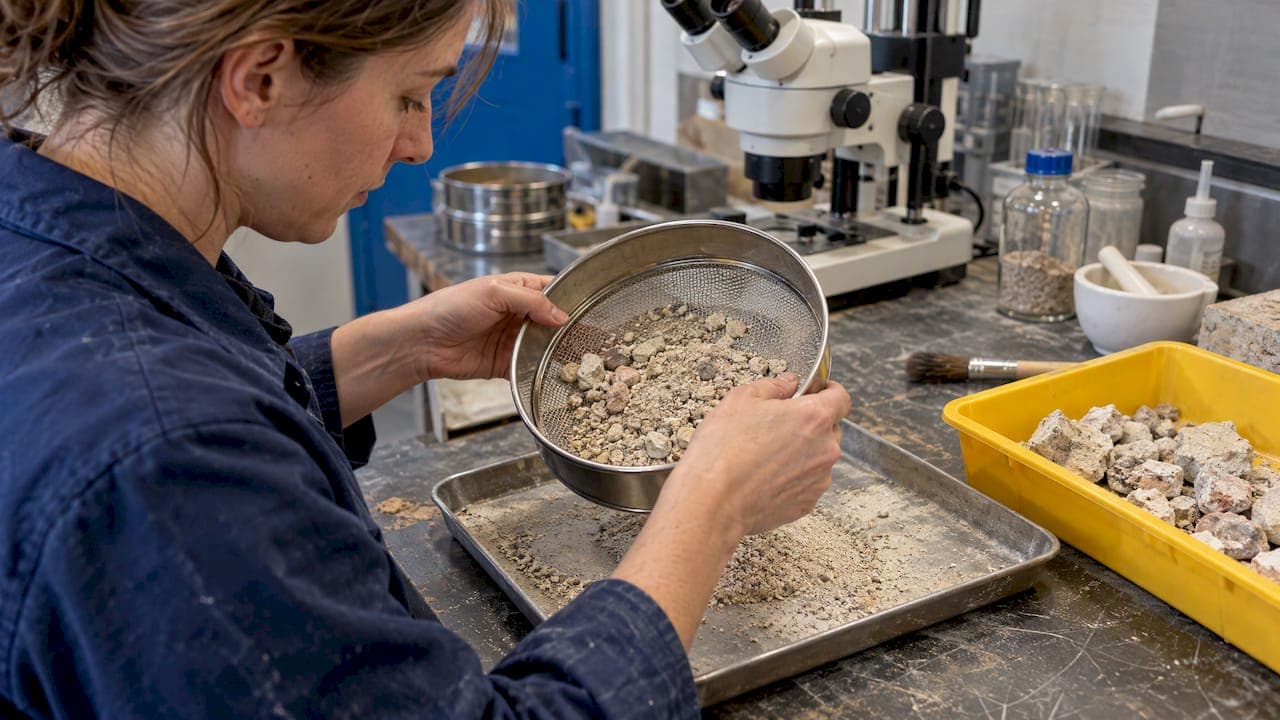
Historic mortar analysis is the process of examining the original mortar in an older building to find out what it is made of, how hard it is and how it looks, so a repair can match it. The results tell a mason what binder (usually lime), what sand and what color to use. For a Richmond rowhouse or a Fan District brick home, that match is what keeps the repair from damaging the brick around it.
This guide explains what the analysis involves, what a lab can and cannot tell you, when a skilled mason can match mortar by eye, and how lime mortar fits into the picture. We are Heritage Masonry & Brick, a family-run Richmond, VA masonry company, and we work with these questions on historic brick every week.
TL;DR
- Mortar analysis identifies the binder, the sand and the proportions of the original mix, so replacement mortar is as soft or softer than the historic mortar and never harder than the brick.
- A lab test is not required for every project. Many Richmond repointing jobs can be matched by a skilled mason who studies unweathered mortar. Buildings of special historic significance justify lab work.
- Most 18th and 19th century brick was laid in lime and sand. Modern bagged mortar is high in Portland cement and can cause cracking and spalling in old brick.
- In Richmond's historic districts, check with the city's Commission of Architectural Review before you start. We can build a sample panel so everyone sees the match first.
Table of Contents
- What historic mortar analysis actually measures
- How the testing is done
- Do you need a lab report, or can a mason match it?
- Why lime mortar matters for old brick
- Why bagged mortar is the wrong tool
- Matching the color and texture, not just the chemistry
- Richmond: historic districts and the review process
- Our perspective: analysis serves the repair
- Getting your Richmond brick assessed
- FAQ
- Sources
What historic mortar analysis actually measures
Mortar is a mix of a binder, aggregate (sand) and water, sometimes with additions. In old buildings, the binder is typically lime. Analysis breaks the sample down into those parts and describes each one.
The Virginia Department of Historic Resources describes the goal as examining the original mortar for composition, texture and strength so a compatible replacement can be chosen. In practice, a thorough analysis answers these questions:
- Binder type. Is it lime, natural cement, Portland cement or a blend?
- Sand. What color, grain size, shape and gradation? Sand makes up most of the mortar's volume, so it drives the color and texture of the joint.
- Proportions. How much binder to sand? Traditional mortar was made from lime putty and local sand, generally at one part lime putty to three parts sand by volume.
- Additions. Crushed shell, brick dust, clay, pigments and even animal hair all appear in historic mortars, according to the same National Park Service brief.
- Hardness and permeability. How strong and how vapor-permeable the original is, since the new mortar must match or be softer.
Researchers can run the analysis on the whole sample, or on the binder and aggregate separately. That is why a lab report often reads like a recipe, with percentages and a description of the sand.
How the testing is done
The National Park Service explains that laboratory methods such as acid digestion, microscopy and X-ray diffraction can identify ingredient proportions. Each method answers different questions.
Acid digestion
A small piece of mortar is dissolved in dilute acid. The lime binder dissolves, and the sand is left behind. The sand can then be washed, dried, sieved and compared by color and texture. NPS notes this is a simple, rapid and cost-effective way to get sand information, though it tells you less about the original binder than advanced instrumental methods.
Microscopy and X-ray diffraction
Thin-section microscopy shows how the binder, sand and any additions sit together. X-ray diffraction identifies the minerals present. Research on characterizing historic lime mortars describes them as a blend of natural and man-made materials, which is why the study usually needs several techniques together.
Physical testing
Some projects also test hardness or compressive strength. A study of strength tests on mortar from bed joints of heritage buildings in Cracow is not needed for a typical home, but it shows how widely old mortars vary from building to building.
Do you need a lab report, or can a mason match it?
This is the question we hear most. The honest answer: it depends on the building.
NPS says laboratory analysis is not always mandatory. A non-technical, visual evaluation of the masonry and the existing, unweathered mortar can often give a skilled mason enough to create a compatible mix. For properties of special historic significance, a lab analysis can add useful data on the sand source and binder.
| Situation | Likely approach |
|---|---|
| Typical Richmond rowhouse, localized repointing | Mason's evaluation of unweathered mortar, followed by a sample panel |
| Large facade or multiple matching joints across a block | Mason's evaluation plus sample panels, possibly acid digestion for sand |
| Landmark or high-significance building, or a dispute about the original mix | Laboratory analysis, interpreted by a mason |
| Mortar already replaced with hard cement in earlier repairs | Sample from the unweathered original mortar, not the later patch |
A lab report is also only part of the answer. Conservation scientists working on RILEM technical committees stress that laboratory results should be combined with the experience of skilled craftspeople. Weather during construction, water content and curing all shaped how the original mortar performed, and a lab number cannot capture that. Another paper on analytical science versus practical experience in lime mortar repair reaches the same conclusion: both contribute to diagnosing mortar failure and designing the repair.
Why lime mortar matters for old brick
The point of analysis is to avoid one mistake: putting a hard mortar into a soft wall.
Historic brick, particularly the softer, lower-fired brick common in older Virginia buildings, absorbs and releases moisture and moves with the seasons. The mortar is designed to be the sacrificial part of that system. Preservation guidance from the Virginia Department of Historic Resources calls for replacement mortar composed of lime and sand, with Portland cement (ASTM C-150 Type I) limited to no more than 20 percent of the cementitious material, if used at all.
When a mortar is harder than the brick, the brick takes the stress. Water cannot escape through the joint, so it leaves through the brick face instead. Over time you see:
- Spalling, where the face of the brick flakes off
- Cracks that run through bricks rather than along joints
- Dark, damp patches and efflorescence (white salt deposits)
- Joints that look sharp while the brick around them erodes
NPS puts the rule plainly: new mortar must be as vapor permeable and as soft or softer than the historic mortar. It also notes that assuming harder is better is a common error.
What lime mortar is
Lime mortar uses slaked lime as its binder rather than Portland cement. Lime putty is made by slaking quicklime with water, and traditionally the putty was left to mature before use. The mortar sets slowly by drying and by absorbing carbon dioxide from the air. It stays relatively soft and flexible, and it lets moisture move through the joint.
Three features matter to a Richmond homeowner:
- Softness. Lime mortar flexes with the wall and sheds stress before the brick takes it.
- Breathability. Moisture in the wall can escape through the joints, which is where you want it to go.
- Self-healing tendency. Small hairline cracks in lime joints can close up as the lime redissolves and recrystallizes with moisture. That is one reason old lime-mortar walls last so long.
We use traditional lime mortar on historic work. Where analysis shows the original mix also had some natural cement or small amounts of Portland cement, the replacement follows that finding, within the limits preservation guidance sets.
Why bagged mortar is the wrong tool
Premixed bagged mortars are convenient. They are also formulated for modern, hard, fired brick and high-strength construction. The state guidance says to avoid them for historic masonry because their high Portland cement content makes them too hard and impermeable for older, softer brick.
Ask any contractor who bids on your historic brick:
- Will the mortar be custom mixed to match, or bought in a bag?
- What is the binder, and in what proportion to sand?
- Will you see a sample panel before the whole wall is done?
- How will old mortar be removed, by hand or with a grinder?
That last question matters. Electric grinders are faster, but they commonly chip the edges of historic bricks, and that damage is permanent. Careful hand raking protects the units. The same state guidance warns against the "quick fix" products that promise easy answers, such as synthetic caulks and coatings. These often trap moisture and speed up deterioration. The Smithfield, Virginia design guidelines say the same: water-repellent and non-historic coatings on masonry often make moisture problems worse.
Soft, crumbling mortar is not always a failure. NPS notes that mortar is meant to be softer than the brick, and you should repoint only joints that are open, cracked or eroded, not an entire wall of sound mortar.
Matching the color and texture, not just the chemistry
Analysis is about performance, but a repair also has to look right. Sand drives most of the color. Binder color, pigments and aging add to it. Joint profile, tooling and width complete the match.
That is why we match three things on a historic wall:
- Composition. Binder and sand proportions, from analysis or evaluation.
- Appearance. Color, grain and texture of the cured mortar. Fresh mortar looks different from weathered mortar, so we test small patches and let them dry.
- Joint style. Width, depth and tooling, copied from the original joints that have not been altered.
Our earlier guide, how to match mortar to brick, walks through the visual side in more detail. If your concern is price, see our breakdown of repointing costs in Richmond and of tuckpointing costs and mortar match.
Cleaning comes last, and it needs care. Preservation guidance says to clean masonry only when necessary. Chemistry matters here as well: acids and alkaline cleaners act differently on different residues, as this explanation of removing grout haze safely shows. On historic brick and lime mortar, we test any cleaner on a hidden spot first, because a product suited to modern cement can attack lime.
Richmond: historic districts and the review process
If your home sits in one of Richmond's old and historic districts, such as the Fan District, the Museum District or along Monument Avenue, mortar choices are not only a technical question. The City of Richmond's Commission of Architectural Review (CAR) oversees exterior work in these districts. The city's Old and Historic District guidelines say a property's historic character should be retained and that features should be repaired rather than replaced where possible.
The city's homeowner's guide to the Commission of Architectural Review says a Certificate of Appropriateness application and approval process usually takes 30 to 60 days, while smaller projects, such as in-kind replacements and repairs, can be approved administratively without going to the full commission. Confirm with the city which category your project falls in before you schedule work.
Sample panels help here. A small test area, with the mortar and joint style shown on your actual brick, makes it easy to show reviewers and neighbors what will be done. Our guide on avoiding CAR delays with sample panels explains the process, and our overview of historic brick restoration covers the wider repair-first approach.

Our perspective: analysis serves the repair
We have worked on historic brick in Richmond for more than 25 years, and our view is simple. The analysis is a tool, not the goal. The goal is a wall that sheds water, moves with the seasons and looks like it has always looked.
Here is how we approach it:
- Look at the wall first. We read the brick, the joints and the pattern of water damage before deciding what to test. A failing joint often points to a roof, gutter or flashing problem, which no mortar can fix.
- Sample from the right place. We take mortar from protected, unweathered joints, not from a patch someone made in the 1980s.
- Use lab work when it pays for itself. For landmark-level buildings or unclear histories, we support a lab analysis. For most homes, a careful evaluation and sample panel give the same result with less delay.
- Mix by hand, rake by hand. We use traditional lime mortar and hand tools for removal, so the brick edges survive.
- Stand behind it. We offer a 5-year guarantee on materials and workmanship, with no deposit required. You pay upon completion.
The less we change on a historic wall, the better it performs. The best repair is the one nobody notices.
— Thomas
Getting your Richmond brick assessed
If you have crumbling joints, water coming through a wall or a historic facade that needs a match, we can evaluate the mortar, recommend whether lab analysis makes sense and build a sample panel before the full job. See our repointing and tuckpointing service for how the work runs, or our brick repair page if bricks themselves are damaged. Estimates are free. Call 804-324-6304 today.
FAQ
How much does historic mortar analysis cost?
The price depends on the lab and on how many samples and methods you need, so we do not quote a number here. Simple acid digestion is the lowest-cost option and mainly tells you about the sand. Advanced methods give more on the binder and cost more. Ask for a quote from a materials lab, and ask your mason whether an evaluation would be enough.
Is historic mortar testing the same as mortar analysis?
The terms are often used together. Testing usually refers to physical tests like strength or hardness, while analysis covers composition: binder, sand and proportions. A full project may use both, and results work best when a mason interprets them.
Can I use regular mortar mix on my old brick house?
We advise against it. Standard bagged mortars are usually high in Portland cement and can be harder than old brick. Virginia preservation guidance says to use lime and sand, with Portland cement limited to no more than 20 percent of the cementitious material, if used at all.
Should I repoint the whole wall if some mortar is crumbling?
Not necessarily. Preservation guidance says to repoint joints that are open, cracked or badly eroded and to leave sound mortar alone. A mason can mark the joints that need work after inspecting the wall.
Do I need approval before repointing in a Richmond historic district?
In an old and historic district, exterior work generally goes through the city's Commission of Architectural Review. In-kind repairs can be approved administratively, but check with the city about your specific project before work begins.
Sources
- Repointing Mortar, Virginia Department of Historic Resources
- Preservation Brief 2: Repointing Mortar Joints in Historic Masonry Buildings, National Park Service
- Rilem TC 203-RHM: Repair mortars for historic masonry, testing of hardened mortars
- Lime mortars for masonry repair: analytical science and laboratory testing versus practical experience
- Characterization of historic lime mortars, University of Texas
- Smithfield, Virginia design guidelines: Building Materials
- City of Richmond Commission of Architectural Review Homeowner's Guide