
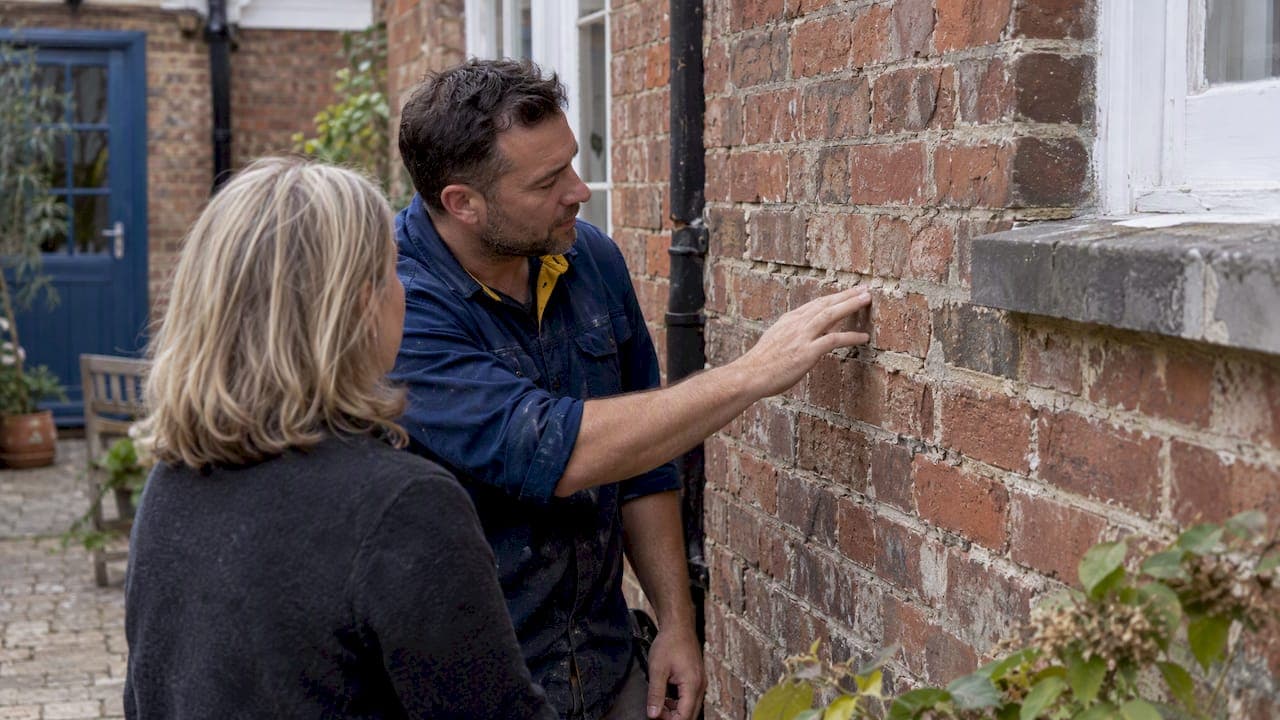
Type N mortar is the right starting point for most above grade brick repair and repointing jobs, since it balances strength and flexibility for everyday walls and chimneys. Type S belongs in foundations, retaining walls, and other spots carrying heavier loads or below grade exposure. Type N reaches roughly 750 psi at 28 days, while Type S reaches about 1,800 psi. Older or softer masonry often calls for something gentler still.
TL;DR:
- Follow the structural engineer’s, local code’s, or project drawing’s mortar specification whenever it differs from general guidance, before ordering materials.
- For packaged mortar, use the bag’s water and yield instructions rather than applying the traditional Type S recipe, because manufacturers use different preblended proportions.
- On older or softer brick, test existing mortar or a small trial patch before repointing; a harder, less permeable mix can damage brick faces.
- Mix only what you can place within 30 to 45 minutes; mortar can lose workability and bond strength even while it still looks wet.
- Probe existing joints and check gutters, grading, and brick faces for moisture signs, since water problems can cause damage regardless of mortar selection.
Table of Contents
- How Type N and Type S Mortar Compare
- Which Mortar Fits Your Project
- Mixing Ratios and Following Product Instructions
- Why Stronger Mortar Can Damage Older Masonry
- What ASTM, BIA, and Manufacturer Data Sheets Say
- Pre-Repointing Checks and Questions to Ask a Mason
- Our Take on the Strength Question
- How We Help You Choose and Apply the Right Mortar
- FAQ
- Sources
How Type N and Type S Mortar Compare
The two mortars differ in strength, flexibility, and how they handle water during the mix and the set. ASTM C270 sets the property spec minimums that manufacturers build their bagged products around, and those numbers tell most of the story.
- Compressive strength: Type N reaches a minimum of 750 psi at 28 days, while Type S reaches 1,800 psi.
- Water retention: both types must hold at least 75% water retention under ASTM C270, which keeps the mix workable long enough to set brick properly.
- Air content: manufacturer tables show Type N allowing up to 14% air in some cementitious mixes, versus a 12% ceiling for Type S, a difference that affects workability more than durability.
- Flexibility: Type N's lower strength gives it more give under seasonal movement, which is part of why it works so well above grade.
- Composition: packaged mixes blend Portland cement, hydrated lime, and sand in proportions tuned to hit these strength targets, rather than following a single universal recipe.
Which Mortar Fits Your Project
Matching mortar to the job starts with where the brick sits and what it carries. Above grade walls and chimneys rarely need the extra strength of Type S, while anything touching soil or bearing significant load usually does.
- Type N suits above grade veneer, general repointing, and most residential chimneys.
- Type S suits foundations, retaining walls, below grade applications, and reinforced masonry carrying higher lateral loads.
- Engineered specs override defaults: when a structural engineer, local code, or project drawing calls for a specific type, that instruction takes precedence over general guidance.
A mason inspecting a home for repointing will usually confirm which category the project falls into before opening a single bag.
Mixing Ratios and Following Product Instructions
Traditional proportion specs describe Type S as roughly 1 part Portland cement, 1/2 part hydrated lime, and 4½ parts sand, an expression of the broader 2:1:9 proportion equivalence used in the trade. Packaged masonry cement products, however, come pre-blended to hit the same strength target through different ingredient ratios, so the bag's own instructions govern mixing water and yield rather than the generic recipe.
- Start with the water amount printed on the bag, not a fixed ratio from memory.
- Mix to a consistency that holds its shape on a trowel without slumping.
- Adjust slightly for temperature and humidity on the day of the pour.
- Wear gloves and eye protection, since both lime and cement are caustic to skin and eyes.
Pro Tip: Mix only what you can place in 30 to 45 minutes; mortar that sits too long loses workability and bond strength even if it still looks wet.
Why Stronger Mortar Can Damage Older Masonry
Historic and softer brick were built to flex and breathe, and the mortar joint was meant to wear out first. That is the principle behind "sacrificial mortar": a joint softer than the brick around it absorbs seasonal movement and lets moisture escape, rather than trapping it inside the masonry unit.
- Lime-rich or lower-strength mortars accommodate movement and reseal hairline cracks through carbonation over time.
- A mortar harder or less permeable than the surrounding brick forces moisture to find another way out, often through the face of the brick itself.
- Before any large repointing job on older masonry, a mortar analysis or small trial patch reveals whether the existing joint is lime-based or cement-based.
A mortar analysis before large repairs is the single most reliable way to avoid mismatched strength, since visual inspection alone rarely reveals whether old mortar is lime-rich or cement-heavy.
What ASTM, BIA, and Manufacturer Data Sheets Say
ASTM C270 sets the property-spec minimums that every bagged mortar product is measured against, and it specifically cautions that field-sampled mortar strength should not be used to judge compliance with those lab figures.
- The Brick Industry Association recommends Type N for most normal exterior above grade brickwork, with Type S as an acceptable alternative in specific cases.
- BIA's broader principle is to choose the lowest compressive strength that still meets the project's requirements, rather than defaulting to the strongest option available.
- Manufacturer data sheets, including QUIKRETE's product line, are the authoritative source for mixing water, yield, and application notes for each specific bagged mix.
Pre-Repointing Checks and Questions to Ask a Mason
Before any mortar goes into a joint, a few checks save a lot of rework. We walk every project through these steps before quoting repointing or structural repairs.
- Probe existing joints with a screwdriver tip to find soft, crumbling mortar versus sound material.
- Test a small patch area with the proposed mortar mix and let it cure before committing to the full wall.
- Inspect brick faces for spalling or moisture staining, which often points to a mismatched mortar higher up the wall.
- Trace moisture paths, including gutters and grading, since trapped water causes more damage than mortar choice alone.
- Ask a prospective mason how they match existing mortar color, texture, and strength, and whether the work follows ASTM C270 specifications.
Pro Tip: Ask whether the quote includes a workmanship guarantee; a mason confident in the mortar match usually backs the work for years, not months.
For readers comparing moisture management across exterior materials more broadly, fiber cement and vinyl siding carry similar below grade exposure tradeoffs worth understanding before a renovation.

Our Take on the Strength Question
The instinct to reach for the strongest mortar on the shelf is understandable, but it works against the brick more often than for it. Choosing the lowest strength that meets your project's requirements protects the masonry and usually costs less in materials and labor. For historic or already failing brick, a short professional assessment before repointing prevents a mistake that can take decades to show up.
— Thomas
How We Help You Choose and Apply the Right Mortar
Choosing between Type N and Type S is only half the job. Getting the color, texture, and strength to actually match your existing brick is where repointing succeeds or fails, and that match comes from experience working on Richmond's older housing stock as much as it does from a spec sheet.

We offer:
- Brick repointing and tuckpointing with mortar matched to your home's existing joints, not a generic bag average.
- Brick repair for spalling, cracking, or moisture damage tied to a mismatched mortar.
- Structural brick and masonry repairs where load-bearing walls need engineered mortar strength.
- Chimney repair addressing one of the most common above grade mortar failure points.
We provide estimates at no cost, and we stand behind our work with a workmanship guarantee. If you want a second opinion on mortar type before a repair goes wrong, request a free assessment and we will walk the joints with you before any work begins.
FAQ
What is the difference between Type S and Type N mortar mix?
Type N reaches a minimum of 750 psi at 28 days and suits most above grade brickwork, while Type S reaches 1,800 psi and suits foundations, retaining walls, and other load-bearing or below grade work. The higher strength in Type S comes from a different proportion of cement to lime in the mix.
Does Type N mortar breathe?
Yes, Type N's lower strength and higher lime content let it flex with seasonal movement and allow moisture to pass through more readily than a harder mix. That permeability is part of why it suits above grade brick and older masonry better than stronger alternatives.
What type of mortar is best for tuckpointing?
Type N is the standard choice for tuckpointing most residential brickwork, since it matches the flexibility of the original mortar joints. On historic or softer masonry, a lime-rich mortar softer than Type N may be a better match, which is why testing existing mortar before a full repointing job matters.
What is the recommended mix ratio for Type S mortar?
A common proportion-style recipe for Type S is about 1 part Portland cement, 1/2 part hydrated lime, and 4½ parts sand. Packaged masonry cement products are pre-blended differently to hit the same strength target, so the instructions on the bag or the project spec should always take priority over this general ratio.
Sources
- How to choose the right mortar: Type N, S, M, O, K - The Home Depot
- Type N vs Type S mortar - MortarCalculator
- QUIKRETE masonry cement, Type S product data
- Preservation Brief 2: Repointing Mortar Joints in Historic Masonry Buildings - NPS