
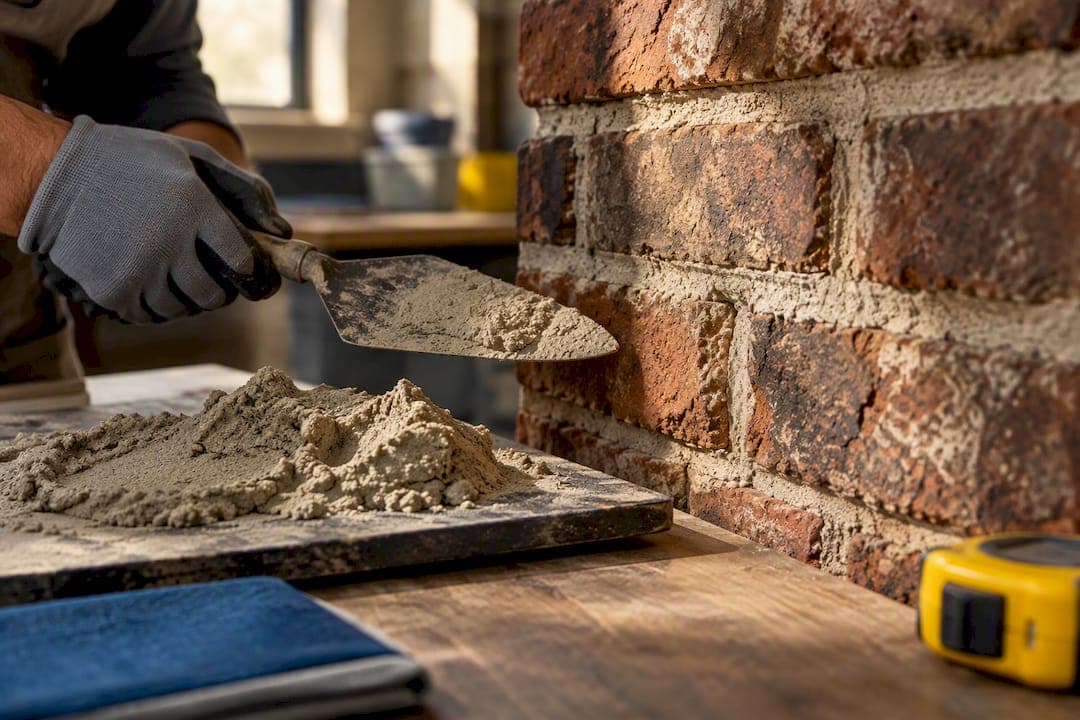
Richmond homeowners typically pay between $3 and $20 per square foot for brick repointing, with chimneys and hard to reach walls running higher because of scaffolding. A small chimney job often costs a few hundred to a few thousand dollars, while a full wall can cost several thousand dollars depending on mortar matching and access. Your best move is to schedule a free on-site estimate so a mason can price your specific brick, mortar joints, and scaffolding needs.
TL;DR:
- Repointing in Richmond ranges from $3 to $20 per square foot, with historic homes and chimney projects typically costing more due to mortar matching and scaffolding.
- Jobs involving more than 25% of a wall's mortar damage usually warrant full wall repointing for better cost efficiency over repeated spot repairs.
- Ask contractors to provide a mortar sample patch and a detailed, itemized estimate to prevent costly mismatches or scope changes later.
- Repointing inside historic districts requires a Certificate of Appropriateness, especially for visible exterior work, and can add time to the project schedule.
- Ancillary costs like debris removal, scaffolding, and permit review can increase the total expense by 20 to 40 percent above the base repair costs.
Table of Contents
- What Does Repointing Cost in Richmond, VA?
- How Do Contractors Price a Repointing Job?
- When Does Spot Repointing Make Sense vs. a Full Wall?
- Do You Need a Permit or Certificate of Appropriateness in Richmond?
- What's the Real Total Cost, Including Cleanup and Extras?
- What Payment Terms Should You Expect From a Richmond Mason?
- Why Mortar Matching Matters More Than Most Homeowners Realize
- Get a Free Repointing Estimate From a Richmond Mason
- Sources
- FAQ
What Does Repointing Cost in Richmond, VA?
Prices vary by the type of surface, how high the work sits, and whether the mortar needs a custom color match. Nationally, repointing runs about $3 to $20 per square foot, and Richmond's mix of pre-1930s brick homes and historic commercial buildings tends to push jobs toward the higher end of that range when hand-tooling and mortar matching are involved.
Here's how that breaks down for common Richmond projects:
- Small chimney repointing: roughly $500 to $1,500, depending on chimney height and roof access.
- 8-foot by 10-foot wall section: commonly $500 to $1,600 for standard brick, more for stone or decorative pointing.
- Spot repairs (a few damaged joints): often billed as a flat minimum, frequently $300 to $600, rather than by square footage.
- Stone foundations: usually priced at the higher end of the range because of irregular joint widths and slower hand work.
Most Richmond masons set a job minimum. Crews commonly charge $50 to $125 per hour for small tasks, and many will not dispatch a truck for anything under a set minimum fee, even if the actual repair takes less than an hour. That minimum covers travel, setup, and cleanup, not just the mortar work itself.
How Do Contractors Price a Repointing Job?
Reputable masons rarely hand you a single number pulled out of thin air. They price by unit, then add line items for anything that changes the scope.
Expect a bid built from a few common pieces: a per square foot or linear foot rate for the mortar joints themselves, a separate scaffold or lift charge if the wall exceeds safe ladder height, and a mortar matching fee if your brick needs a custom sand and lime blend. The National Park Service's contracting guidance recommends this kind of itemized, unit-price structure specifically so owners can see what happens to the total when scope shifts mid-project.
Pro Tip: Ask every contractor for a written sample patch before committing to the full job. A two-foot test area shows you the actual mortar color and joint profile, which prevents a costly redo if the match looks wrong once the scaffolding comes down.
Before you sign anything, run through this checklist at the estimate:
- Ask what mortar mix they plan to use and why it matches your brick's age and hardness.
- Request a small sample patch before full mobilization.
- Confirm the workmanship guarantee in writing, not just verbally.
- Verify the contractor's license through the Virginia Department of Professional and Occupational Regulation before any deposit changes hands.
- Get the schedule and any scaffold rental fees spelled out separately.
Access is usually the single biggest swing factor in a quote. Jobs above 8 feet often add 20 to 40% to labor and equipment costs once scaffolding enters the picture, which is why two quotes for the same square footage can look wildly different.
Treat a few patterns as warning signs rather than minor quirks. A contractor who won't put the mortar formula in writing, who pushes hard Portland cement on a pre-1940s brick home without explaining why, or who refuses any form of written guarantee is telling you something about how the rest of the job will go.
When Does Spot Repointing Make Sense vs. a Full Wall?
Spot repointing works well when damage is scattered and limited, think a handful of crumbling joints near a downspout or a single section where a past gutter leak did damage. If less than roughly a quarter of the wall's mortar shows real deterioration, patching those specific joints is usually the more economical path, and a competent mason can often finish in a single visit without renting scaffolding.
The math flips once damage spreads. When 25 to 50% of a wall's mortar has failed, full-wall repointing tends to cost less per square foot than repeated spot visits, because the scaffolding and mobilization costs get spread across far more linear feet of work. Paying for a lift setup three separate times to patch three separate problem areas rarely makes financial sense compared to doing the whole wall once.
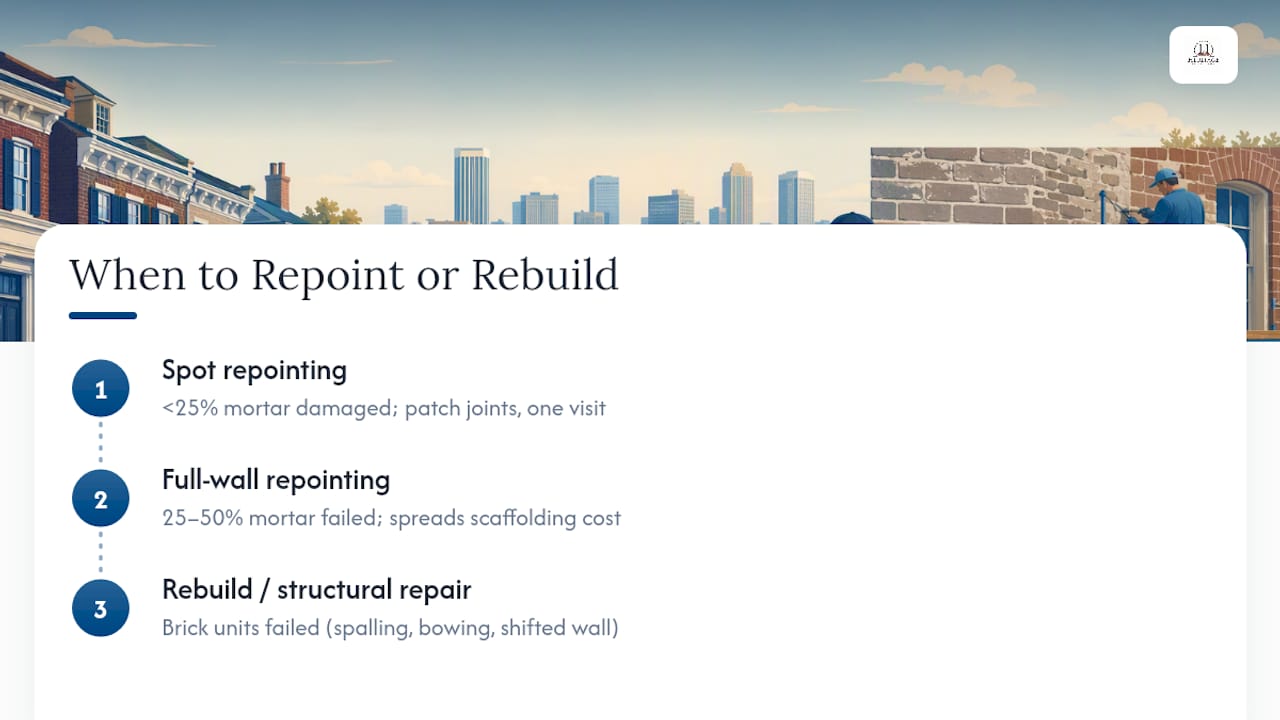
Rebuilding, rather than repointing, only enters the conversation when the brick units themselves have failed, not just the mortar. Spalling brick faces, structural bowing, or a wall that has shifted out of plane point toward structural repair rather than a mortar fix. No amount of new mortar corrects a brick that has already lost its face to moisture damage.
If you're unsure which category your home falls into, that's exactly what a free estimate is for. A mason walking your property can tell within minutes whether you're looking at a spot job, a full wall, or something more structural.
Do You Need a Permit or Certificate of Appropriateness in Richmond?
If your home sits inside one of Richmond's designated Old and Historic Districts, exterior masonry work isn't just a matter of picking a contractor and starting. The Richmond Commission of Architectural Review issues Certificates of Appropriateness and sets guidelines for exterior alterations in those districts, and repointing visible facades often falls under its review depending on the scope and visibility of the work.
This isn't a rule designed to slow homeowners down for no reason. Mortar color, joint profile, and tooling style all affect how a historic block reads visually, and the commission's guidelines exist to keep block-by-block character intact as individual owners repair their homes over time.
Before you assume your project needs sign-off, ask two questions: is your property inside a designated district, and is the work visible from a public right of way? A rear-yard patio wall usually draws far less scrutiny than a front facade facing a historic street. Your contractor should be able to tell you whether your address falls inside district boundaries, and a mason with Richmond experience will typically know the process for submitting a Certificate of Appropriateness application if one is required.
Separate from historic review, confirm your contractor holds an active Virginia license. The DPOR Board for Contractors maintains licensing records, and checking before you sign takes a few minutes and protects you if something goes wrong mid-project.
What's the Real Total Cost, Including Cleanup and Extras?
The per-square-foot rate almost never tells the whole story. Ancillary costs can add a meaningful percentage to your final invoice, and Richmond homeowners are often surprised by which line items show up.
Debris removal is one of the most commonly overlooked costs. Old mortar has to be ground or chiseled out before new mortar goes in, and that generates dust and rubble that needs bagging and hauling. Reputable contractors typically include basic cleanup in their quote, but ask specifically whether disposal fees are bundled or billed separately, especially on larger jobs that generate multiple dumpster loads of debris.
Scaffold rental, if your project needs it, is usually a multi-day charge even if the actual mortar work only takes one day. Weather delays can stretch that rental period, which is worth asking about upfront rather than discovering after the fact.
If your project touches a designated historic district, factor in potential review time for a Certificate of Appropriateness, which can add days or weeks to your start date depending on the commission's meeting schedule. That's a scheduling cost more than a dollar cost, but it affects when your project actually finishes.
Putting these pieces together, a straightforward wall section might run close to its base square-footage quote, while a chimney with scaffolding, mortar custom-matched to century-old brick, and full cleanup could land 20% to 40% above the raw material and labor number once every line item is added.

What Payment Terms Should You Expect From a Richmond Mason?
Most reputable Richmond masonry contractors structure payment around project milestones rather than asking for the full amount upfront. A typical arrangement includes a modest deposit to schedule the work and secure materials, a progress payment at roughly the midpoint for larger multi-day jobs, and a final payment due once the work is complete and you've had a chance to inspect it.
Deposits usually fall in a reasonable percentage of the total contract, enough to cover initial material costs and secure your spot on the schedule, not the entire project cost. Be cautious of any contractor asking for full payment before work begins. That's rarely standard practice in masonry and often signals a business more focused on collecting money than finishing the job to your satisfaction.
Your written contract should spell out the payment schedule in plain terms: what triggers each payment, what happens if weather delays push the timeline, and what recourse you have if the finished work doesn't match what was promised. This is also where a workmanship guarantee matters most. A contractor willing to put a multi-year guarantee in writing is telling you they expect the work to hold up, and that guarantee should be referenced directly in your contract, not just mentioned verbally at the estimate.
Ask for a copy of the signed contract before any deposit changes hands, and keep it. If a dispute ever comes up, that document is your primary protection.
Why Mortar Matching Matters More Than Most Homeowners Realize
Most cost guides treat repointing like a commodity: measure the wall, multiply by a rate, done. That framing misses the variable that actually determines whether your repair lasts twenty years or fails again in five: mortar hardness.
National Park Service preservation guidance is clear that mortar should be softer than the surrounding brick, not harder. Older Richmond brick, especially anything predating the mid-20th century, was often fired at lower temperatures and is softer than modern brick. Pack it with hard Portland cement and you've created a mortar joint that's stronger than the brick itself. Moisture that used to escape through the mortar now gets trapped, and the brick face starts spalling instead. That's a repair that creates a bigger problem than the one it was hired to fix.
This is why a free estimate should include a real conversation about your specific brick, not just a quick measurement. Heritage Masonry & Brick backs its work with a 5-year workmanship guarantee precisely because getting the mortar formulation right the first time is what makes that guarantee possible to offer. If a contractor can't tell you what's in their mortar mix, keep asking until you find one who can.
If you take one thing from this: get the mortar match right before you worry about the price per square foot.
— Thomas
Get a Free Repointing Estimate From a Richmond Mason
Many reputable Richmond masons offer prices backed by workmanship guarantees and mortar matched to a home's actual brick, not a generic mix pulled off a shelf. That combination is what keeps a repointing job from becoming a repeat expense five years down the road.

Whether you're dealing with a handful of crumbling joints or a full facade that's overdue for attention, the team handles brick repointing and tuckpointing, general brick repair, and chimney repairs across Richmond, with over 25 years of hands-on masonry experience behind every estimate. If your damage looks more structural than cosmetic, the structural repairs team can assess that on the same visit.
Call 804-324-6304 today to schedule your free on-site estimate, or visit Heritage Masonry & Brick to see the full range of services before your next brick project gets any worse.
Sources
- NPS Preservation Brief: Repointing mortar guidance
- Repointing or Tuckpointing Cost (HomeGuide)
- Virginia Department of Professional and Occupational Regulation — Contractors
FAQ
How Much Does Repointing Cost Per Square Foot in Richmond?
Richmond repointing typically falls in the national range of $3 to $20 per square foot, with chimneys and scaffolded walls trending toward the higher end. Mortar matching for historic brick can push costs up further, which is why a site-specific estimate beats any flat average.
Is Spot Repointing Cheaper Than Repointing a Whole Wall?
Spot repointing is usually cheaper when damage is limited to a small area, since it avoids scaffolding costs entirely. Once 25 to 50% of a wall's mortar has failed, full-wall repointing often becomes more cost-effective because setup costs get spread across more work.
Do I Need a Permit to Repoint Brick in Richmond?
Standard repointing usually doesn't require a building permit, but properties inside Richmond's Old and Historic Districts may need a Certificate of Appropriateness from the Commission of Architectural Review for visible exterior work. Check with your contractor or the commission before starting if your home sits in a designated district.
What Does Heritage Masonry & Brick Charge for a Free Estimate?
Heritage Masonry & Brick offers free, no-cost estimates for repointing and masonry repair projects in Richmond. Pricing for the actual repair work depends on square footage, access, and mortar matching, and is provided after an on-site assessment.
How Long Does a Typical Repointing Job Take?
A small spot repair often finishes in a single day, while a full wall or chimney can take several days depending on scaffolding and curing time. Weather matters too, since mortar cures best between about 40°F and 95°F, which can push scheduling toward spring or fall in Richmond.