
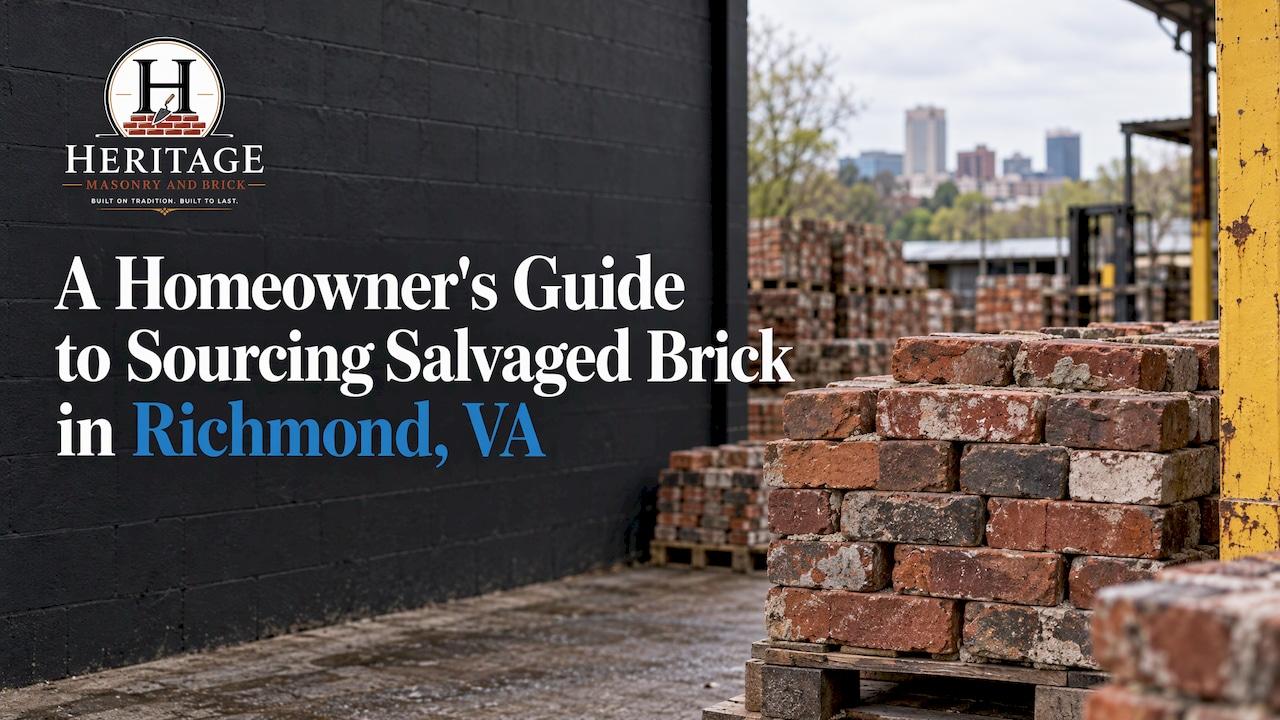
Salvaged brick comes from demolished buildings, lifted street paving and old industrial sites, and the best source for a repair is the one that matches the brick already on your wall. In Richmond, where so many homes date from the 1800s and early 1900s, that match decides whether a repair blends in and lasts or starts failing in a few winters. We are traditional masons in Richmond with more than 25 years in the trade. We match existing brick and mortar on every repair, so the sourcing question starts with your wall, not with a pallet price.
TL;DR
- Salvaged brick is sold as street pavers, building brick, firebrick and thin brick. Each suits a different job, and only some suit structural repair.
- For historic brick, a replacement should match the original in size, color, texture and porosity. A harder or denser brick can damage the old wall around it.
- Judge a batch by tapping, measuring, checking for cracks, salts and spalling, and asking where the brick was recovered.
- Lime mortar is the right partner for old brick. Modern Portland cement mortar can trap moisture and break soft historic units.
- Richmond owners get the best result by having a mason identify the brick and mortar first, then source to match.
Table of Contents
- Where salvaged brick comes from
- Where to look in the Richmond area
- Why matching comes before buying
- Which salvaged brick suits which job
- How to judge a batch before you commit
- Estimating quantity and total cost
- Lime mortar: the other half of the match
- Richmond properties: what to check first
- Who this is for, and who it is not
- Perspective
- Get the match right with Heritage Masonry & Brick
- FAQ
- Sources
Where salvaged brick comes from
Salvaged brick is also called reclaimed or antique brick. It is taken from a building or street that is being taken apart, cleaned of old mortar and sorted for reuse. The source affects how the brick behaves.
- Street brick. Street bricks lifted when cities resurface old roads tend to be denser and more uniform because they were made to carry vehicle loads. They are a natural fit for patios, walkways and driveways.
- Building brick. Brick from demolished houses and factories shows more variation in color, size and markings. That variety is part of the appeal on a wall, but it also means each batch needs sorting.
- Firebrick. Reclaimed firebrick suits fireplaces, pizza ovens and hearth repairs once it has been checked for cracks and spalling. Spalling is the face of the brick flaking or popping off.
- Thin brick. Slices cut from old brick, used for interior walls and backsplashes rather than load-bearing work.
The same source notes that salvage yards often sell mixed grades: grade A for structural use, and grades B and C for accents or garden work. Ask which grade you are looking at before you plan a use for it.
Where to look in the Richmond area
Richmond has a deep local supply of old brick because so much of the city was built from it. Owners typically find salvaged brick through a few types of outlets:
- Architectural salvage yards and building-material reuse stores. A directory of Richmond-area salvage sources lists several yards and reuse stores in the city, and hours vary, so call ahead.
- Reclaimed-materials processors that handle old brick, cobblestone and other salvaged masonry.
- Wholesale suppliers that ship Old Chicago and St. Louis red brick into Virginia.
- Used-material listings and demolition sites, where brick can be free or cheap but arrives uncleaned, unsorted and undocumented.
A ready supply is not the same as a right match. The yard can tell you the brick is old. It cannot tell you whether it will sit correctly in a Fan District rowhouse wall laid in the 1890s. That judgment is a mason's job, and it is the step most people skip.
Why matching comes before buying
Old brick was fired at lower temperatures than most modern brick, and it is usually softer and more porous. Richmond's humid summers and freeze-thaw winters push moisture through a wall constantly. In a healthy historic wall, the mortar is the softer, sacrificial part. It takes the wear and the brick lasts.
Put a much harder brick into that wall and the balance flips. Moisture and movement now concentrate on the old units next to it. Preservation guidelines are direct about this. The City of Redlands' historic design guidelines say replacement units should match the existing in type, color, texture, size, shape, bonding pattern and compressive strength. They also warn against modern "antiqued" brick for patching historic masonry because it is typically much harder.
A brick masonry conservation handbook from Eastern Michigan University adds that replacement brick should closely match in size, color, texture and porosity, and that the best replacements for preservation work use the same raw materials and manufacturing methods as the original.
Bricks were also rarely shipped far in the old days. Because of that, matching a home's original brick usually means tracking down the local manufacturer and the regional projects that maker supplied. For Richmond that points to Virginia and Mid-Atlantic reclamation, not a pallet from a distant state that happens to be the right red.
We go deeper on this in our guide to matching old brick the right way.
Which salvaged brick suits which job
| Project | What to look for in salvaged brick | Notes |
|---|---|---|
| Patio or walkway | Dense, uniform street or paver brick | Made for traffic; consistent thickness makes laying easier |
| Garden wall or freestanding wall | Dense building brick such as Old Chicago | Strong outdoors; sort for cracks and soft units |
| Repair to a historic wall | Brick matched in size, color, texture and porosity | A mason should confirm the match before the brick is laid |
| Chimney or fireplace | Sound firebrick or hard building brick, checked for spalling | Chimney brick should never be reversed |
| Interior feature wall | Thin brick cut from old brick | Decorative, not structural |
On chimneys, the conservation handbook above is specific: brick should never be turned around and reused with the inner face out, because the inner faces are likely contaminated with salts. That is one reason chimney work is best handled by a mason. See our chimney repair page.
How to judge a batch before you commit
When a yard or supplier offers you a batch, these checks separate usable brick from fill.
- Ask where it was recovered. Brick from a building, a street or a factory behaves differently. A good seller can tell you the origin and original use.
- Look at the whole batch. A reclaimed-brick checklist says to check cracks, spalling, leftover mortar, dimensions across several bricks and consistency of appearance.
- Tap a few bricks. A clear ringing sound indicates a solid brick, while a dull thud can mean cracking inside.
- Look for white salt deposits. The same guide suggests soaking a sample for 24 hours to see whether efflorescence, the white powder left by salts, appears.
- Measure at least 10 existing bricks on your wall to get average length, width and height. Then compare the salvage brick to that average, ideally within a few millimeters.
- Compare color in daylight, both wet and dry. Brick that matches in the yard can look different on the wall.
- Plan to blend. Mixing bricks from several pallets as they are laid avoids visible banding.
Not every demolished building yields usable brick, and good suppliers set aside batches that are too soft or damaged for garden edging or fill. If a pallet is mostly that grade, it is not a bargain for a wall.
Cleaning and storing salvaged brick
Clean old brick with a stiff brush and mild detergent. Power washing and acid cleaners can damage the surface of soft historic brick, so keep them away from it. Store unused brick on pallets, off the ground and under cover, so it does not take on moisture before it is laid.

Estimating quantity and total cost
Salvaged brick is rarely cheaper once everything is counted. Price per brick varies widely with size, condition and age. One 2026 cost overview shows reclaimed brick ranging from about $0.50 to $4.00 each, with delivery, sorting and cleaning adding to the total. Treat figures like that as a rough range, not a quote, and confirm with the seller.
To estimate quantity:
- Measure the area to be repaired or built in square feet, and subtract openings.
- Ask the seller how many bricks they count per square foot for the size you are buying, since old brick sizes vary.
- Add an allowance for cuts, breakage and bricks you will reject. Salvaged brick needs a larger allowance than new.
- Buy it all at once. A second batch rarely matches the first.
Then compare the full picture, not only the pallet price: freight, minimum order, how much is usable, cleaning, and what the seller will do about returns or shortages. The cheapest pallet that leaves you short or mismatched is the most expensive one.
Lime mortar: the other half of the match
Salvaged brick is only half the repair. The mortar around it matters just as much, and for old brick the right mortar is lime.
Historic Richmond brick was laid in lime-based mortar. Lime mortar is softer and more flexible than modern cement mortar, and it lets moisture move out through the joint instead of through the brick. Lime-based mortar matches the flexibility and breathability of old bricks, while modern Portland cement can trap moisture and cause older bricks to break.
That is why we repoint with traditional lime mortar. A few points that matter to an owner:
- Joints should be softer than the brick. If the mortar is harder, the brick becomes the sacrificial part, and faces start to flake.
- Color and texture matter. Mortar color comes from the sand and the lime, and the joint profile has to follow the original. We cover this in our guide to matching mortar to brick.
- Analysis helps. On older properties, mortar analysis shows what the original mix contained before any repointing starts.
If your joints are loose, crumbling or letting water in, see our repointing and tuckpointing service.
Richmond properties: what to check first
If you own a historic brick property in the Fan, Museum District, Church Hill or along Monument Avenue, run through this before any brick is bought.
- Is replacement needed at all? Many damaged faces can be repaired, and a wall often needs repointing, not new brick. Read whether spalling brick can be repaired and our historic brick restoration guide.
- Is moisture the cause? Replacing brick without stopping the water just brings the damage back. Brick moisture testing and a facade inspection find the source.
- Are there hidden sources? The Redlands guidelines suggest that when units are no longer made, you can try architectural salvage or relocate original units from concealed areas of the building.
- Is the brick matched, not just similar? Size, color, texture and porosity all have to line up.
- Is the bond pattern preserved? The way bricks are laid is part of the wall's character.
We work throughout Richmond, and our historic brick repair in the Fan and Museum District page covers those neighborhoods.
Who this is for, and who it is not
This guide is for Richmond homeowners, property managers, agents and builders who need brick repaired or built and want it to match and last. If you are weighing a patio, walkway, step or retaining wall in new salvaged brick, the same rules apply: dense, uniform brick for ground-level use, and a laying plan that suits the brick's thickness and absorption.
Perspective
Every week in Richmond, someone finds a pallet of old brick and assumes the hard part is done. In our experience, the hard part is the wall. Old brick is not one product. Each wall has its own size, its own porosity and its own mortar, and the repair has to respect all three.
We match the existing brick and mortar on every repair, and we use traditional lime mortar and the methods old brick was built with. That approach is why our work blends in and lasts for decades, and it is why we are glad to look at the wall before any brick is bought.
Our 5-year guarantee covers materials and workmanship. We ask for no deposit, and payment is due when the work is complete.
Thomas
Get the match right with Heritage Masonry & Brick
We repair brick on homes and businesses across Richmond: water getting in, loose or crumbling joints, cracked walls, worn steps and chimneys. We also build new brick steps, patios and walkways. Estimates are free, there are no deposits, and you pay on completion. Our work carries a 5-year guarantee on materials and workmanship.

To have us look at your brick, start with our brick repair page, or call 804-324-6304. For a new patio or walkway, see brick patios and walkways. More articles are on our masonry advice page.
FAQ
Can I use salvaged brick to repair my historic Richmond home?
Yes, when it matches the original in size, color, texture and porosity. Brick that is much harder than the original can damage the old wall around it. A mason should confirm the match before the brick is laid.
Is salvaged brick good for patios and walkways?
Dense, uniform street and paver brick works well, because it was made for traffic. Sort out cracked or soft units, and lay the brick on a proper base. We build new brick patios and walkways in Richmond.
What mortar should I use with old brick?
Lime-based mortar. It matches the flexibility and breathability of old brick, while hard Portland cement mortar can trap moisture and break older units. We repoint with traditional lime mortar.
How do I know how much brick to order?
Measure the area in square feet, subtract openings and ask the seller for the count per square foot for that brick size. Add an allowance for cuts and rejects, and order everything at once so the color stays consistent.
Can I reuse brick from my chimney?
Brick in chimneys should not be turned around and reused, because the inner faces are likely contaminated with salts. Have chimney brick assessed by a mason.
Sources
- Chief Bricks: how reclaimed bricks are sourced, sorted and cleaned
- Antique brick: types, uses and sourcing
- Reclaimed brick buying guide
- How to tell if reclaimed bricks are suitable for reuse
- How to match old bricks
- City of Redlands historic architectural design guidelines
- A Handbook on Brick Masonry, Eastern Michigan University
- Architectural salvage yards in Richmond, Virginia
- Cost of old bricks in the U.S., 2026