
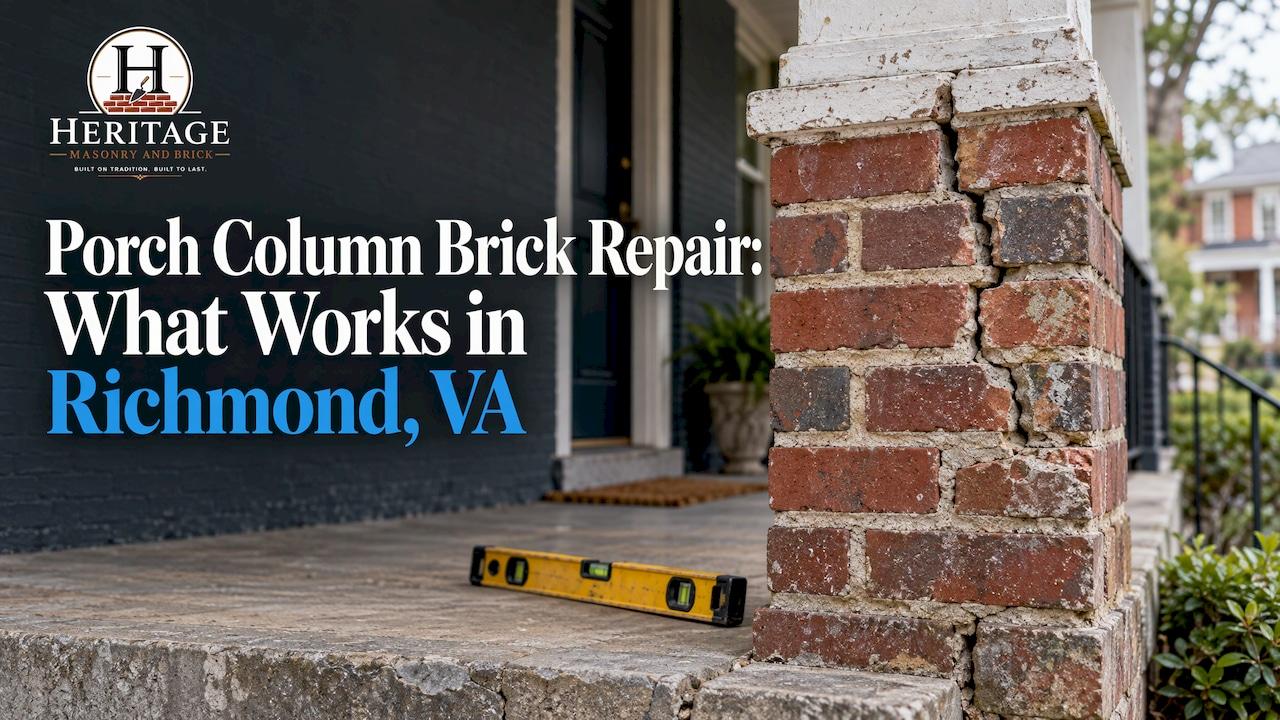
A brick porch column that is cracked, crumbling or out of plumb needs to be repaired by a mason who finds out why it is failing, then fixes the brick and the mortar with materials that match the original. In Richmond, where so many porches sit on 100-year-old brick, that means lime mortar, matched brick and a fix for the water or movement behind the damage. At Heritage Masonry & Brick, we repair porch columns across Richmond, Virginia, and we offer free estimates.
TL;DR
- Small surface problems, such as a few eroded joints or one spalled brick, are repairable by repointing and replacing individual bricks.
- Cracks wider than about 2 mm (0.075 in.), cracks running through several bricks, or a column that leans point to a structural cause that must be found first.
- Old Richmond brick needs a lime-based mortar. A hard, modern cement mortar can damage the soft brick it was meant to protect.
- Water is behind most column damage: failing gutters, bad grading, open joints and missing caps.
- We offer free estimates, a 5-year guarantee on materials and workmanship, no deposits and payment on completion.
Table of Contents
- Why porch columns fail
- How to read the damage on your column
- Repairing the brick itself
- Repointing a porch column
- Why lime mortar matters on Richmond brick
- Leaning, settling or bulging columns
- Stop the water, and the column lasts
- What affects the cost of a column repair
- Our view on porch columns
- Getting your porch columns repaired in Richmond
- FAQ
- Sources
Why porch columns fail
A brick column is a small, tall stack of bricks that carries the porch roof and takes weather on every side. It has no wall behind it to share the load and no sheltering overhang at its lower half. That makes it the first part of a porch to show age.
The National Park Service lists the signs to look for in brick masonry: cracking, spalling, bowing, leaning and mortar deterioration, with causes that include differential foundation settlement. On a column, these usually come from one of four sources:
- Open or eroded mortar joints. Water enters the joint, soaks into the column and freezes. Richmond sees freeze-thaw cycles every winter, and each cycle widens the gaps.
- Spalling brick. The face of the brick flakes or peels off. It often happens when water is trapped in the brick, or when the wrong mortar or a coating holds it there.
- Foundation movement. If the footing under the column settles, the column cracks or tilts.
- Roof load and thrust. Gutters that overflow, a sagging porch beam or roof loading that has shifted can push on the column from above.
The first job is working out which of these you have. A repair that treats the symptom and ignores the cause will fail again.
How to read the damage on your column
Walk around each column once a season. The Brick Industry Association recommends periodic inspections, preferably each season, and gives clear thresholds for when a problem is more than cosmetic.
| What you see | What it usually means | Next step |
|---|---|---|
| Sandy, recessed or missing mortar | Joints worn by weather | Repointing |
| One or a few bricks with flaking faces | Spalling from trapped moisture | Replace the bricks, fix the water source |
| Hairline cracks following the mortar joints | Minor movement or shrinkage | Repoint and keep watching |
| Crack wider than 2 mm (0.075 in.) | Possible structural issue | Professional investigation |
| Crack running through several bricks | Possible structural issue | Professional investigation |
| Widespread spalled brick | Possible structural issue | Professional investigation |
| Column leaning, bulging or stepped cracks near the base | Settlement or load problem | Structural assessment before any repair |
The last four rows come from the same guidance: cracks over 0.075 in. (2 mm), cracks through multiple brick units or widespread spalled brick are signs of structural issues that generally warrant investigation by a professional engineer. If your column leans or the porch roof above it looks uneven, do not stand under it or lean on it while you wait. Keep people away from the porch and call us for an assessment.
Why the cause comes first
A conservation reference on masonry investigation makes a simple point: before a defect is repaired, someone should establish why the masonry moved, including whether the cause is ground-related or roof thrust. The same source notes that investigation can show whether movement is still active or happened long ago, and that a structural engineer may monitor a structure over time.
For a homeowner, that means a leaning column is not a repointing job until someone has confirmed the footing is stable. If it is, repair and rebuilding are straightforward. If it is not, the footing is addressed first.

Repairing the brick itself
When only some bricks are damaged, you do not need to rebuild the column. Damaged bricks can be replaced by carefully removing the mortar and brick, cleaning out the opening and setting a replacement brick in fresh mortar.
That sounds simple, and it is where most poor repairs go wrong:
- Chiseling too hard. Cutting out a brick with power tools can crack its neighbors. Careful hand removal protects the bricks you want to keep.
- Wrong replacement brick. Modern bricks are harder, smoother and more uniform than the soft, hand-struck or early machine-made bricks used in older Richmond homes. A mismatched brick looks like a patch and also sheds water differently.
- Wrong mortar. A replacement brick set in a hard cement mortar forces the old brick to do the work of absorbing moisture, and the old brick suffers.
On every repair, we match the existing brick and mortar so the work blends in, and we use the traditional methods old brick was built with. When a column has only a few failed bricks, we replace those and leave the rest of the column in place. For more on when brick can be saved, see our guide on whether spalling brick can be repaired or needs replacement.
Repointing a porch column
Repointing, also called tuckpointing, means removing worn mortar from the joints and packing in new mortar. It is the most common repair on a porch column, because the joints take the brunt of the weather. If you want the terminology explained, our article on what tuckpointing means covers it in plain language.
A good repointing job follows a clear sequence:
- Remove the old mortar by hand. A municipal masonry restoration guideline calls for removing deteriorated mortar to a depth of 2 to 2.5 times the joint width. On a typical 3/8-inch joint, that is roughly 3/4 inch deep. Too shallow, and the new mortar pops out within a few winters.
- Clean the joints. Dust and loose grit stop new mortar from bonding.
- Dampen the brick. Dry brick pulls water out of fresh mortar too fast and weakens it.
- Pack the joint in layers. Deep joints are filled in stages so the mortar cures evenly.
- Tool the joint to match. The profile, whether flush, concave or struck, should follow the original.
- Cure slowly. Lime mortar needs protection from hot sun, wind and hard frost while it sets.
Skipping step one is the usual shortcut: smearing new mortar over old, crumbling joints. It looks fine for a season and then falls away. Our brick repointing and tuckpointing service does the full sequence, joint by joint. If you are weighing how urgent your joints are, our guide to when to repoint brick shows the urgency levels.
Why lime mortar matters on Richmond brick
Many of the porches in the Fan District, the Museum District and along Monument Avenue were built when lime mortar was the standard. Lime mortar is softer and more porous than modern Portland cement mortar. That is a feature, not a flaw. In an old wall, moisture needs to leave through the mortar joints, not through the brick faces.
The same restoration guideline states it is vital to use lime-based mortars for older masonry to ensure compatibility and permeability, and that the new mortar should match the original in strength, composition, color and texture.
Here is what that looks like in practice:
- Lime mortar is the sacrificial part. The joint is meant to be the softer, replaceable element. Over decades it wears and is repointed, and the brick survives.
- Hard cement mortar reverses that. The brick becomes the weaker element. Water that cannot escape through the joints is pushed into the brick face, which then flakes and spalls.
- Lime mortar tolerates small movement. A column that shifts slightly with the seasons can accommodate that in lime joints, where rigid cement tends to crack.
- Color and texture matter as much as strength. The sand in the mix sets the look of the joint. We match it so the repair does not announce itself from the street.
The National Park Service guidance on historic masonry follows the same principle: repairs should retain mortar joint size and tooling, masonry-unit size, texture and pattern, and masonry color. Matching is not decoration. It protects the wall.
If you want to understand how matching works, our preservation-first guide to matching mortar to brick walks through it, and our article on the right mortar mix for chimney joints shows the same logic on another exposed brick structure.
Leaning, settling or bulging columns
This is where urgency changes. A column that has moved needs a plan, not a patch.
A sound approach looks like this:
- Find the cause. Check the footing, the downspouts and the ground around the base. Check whether the porch beam or roof is pushing on the column.
- Decide whether movement is active. An old, stable lean is a different problem from a column that is still shifting.
- Stabilize the support. If the footing has failed or settled, it is addressed before bricks are touched.
- Rebuild the affected section. Where the column has leaned past the point of safe repair, we take down the brick, clean and keep what is reusable, and rebuild with matching material and lime mortar.
- Reconnect to the porch structure. The rebuilt column must carry the beam above it properly.
Where an engineer's review is warranted, as the thresholds above show, it comes first. Our structural brick and masonry repairs cover cracked walls and rebuilds of this kind, and our Brick Repair service handles the surface work that follows.
Be careful with fixes that seem cheaper in the short term. A column filled with poured concrete, caulked over a wide crack or covered in a coating may look finished, yet it can hide a problem and trap water inside the masonry.
Stop the water, and the column lasts
Most porch column repairs fail for one reason: the water source was never fixed. The guidance on historic masonry is direct: maintain roofs, gutters and downspouts in good repair, make sure the ground slopes away from walls, and avoid non-historic waterproof or water-repellent coatings that can trap moisture inside masonry.
A few habits keep a repaired column in good shape:
- Clean gutters twice a year, and check that downspouts discharge away from the column base.
- Look at the cap. Caps, copings and sills are the parts that may require periodic inspection and repair, and neglecting them can lead to deterioration of the wall below.
- Keep soil and mulch below the base. Splash and trapped damp raise moisture in the lowest courses.
- Skip sealers that form a film. The Brick Industry Association says water repellents should not replace flashing and weeps, and that only repellents that allow water vapor to pass, such as siloxanes and silanes, should be used on exterior brickwork.
- Watch the rest of the porch envelope. Siding, trim and porch roofing all send water toward the columns. This overview of how siding controls moisture intrusion helps explain where water gets in around a porch.
What affects the cost of a column repair
We do not publish fixed prices, because two columns on the same street can need very different work. These factors move the price most:
- Scope: a few bricks and joints, a full repoint of the column, or a rebuild from the footing up.
- Height and access: a tall column or one wedged against railings and steps takes more time and often more setup.
- Brick matching: salvaged or matched historic brick takes more sourcing than standard units.
- Mortar work: hand raking joints and mixing lime mortar to match is slower than machine-cutting and using premixed cement.
- Cause of the damage: a footing or roof-load problem adds work beyond the brick.
- Number of columns: repairing all columns in one visit is more efficient than returning for each.
A free estimate shows what your columns need. We have a cost-focused article on Richmond tuckpointing costs and mortar matching if you want to see how we think about it.
Our view on porch columns
Porch columns are small, but they are the part of a house people see every day. We find that columns on older Richmond homes usually fail for the same reason: someone patched them with something harder than the brick.
Our approach is built on traditional lime mortar and on matching the existing brick and mortar, so the repair belongs to the house. That is how old brick was built, and it is how it lasts.
We would rather replace three bricks and repoint a column properly than rebuild it, and we would rather rebuild it properly than cover a problem. Repair first, replace last. That is the approach we describe in our guide to historic brick restoration.
Every job comes with a 5-year guarantee on materials and workmanship. There are no deposits, and you pay when the work is complete.
Thomas
Getting your porch columns repaired in Richmond
Heritage Masonry & Brick is a family of traditional masons in Richmond, VA, with over 25 years in the trade. We repair brick on homes and businesses, including porch columns, steps, walkways and chimneys, and we specialize in historic brick restoration across the Fan, the Museum District, Monument Avenue and surrounding neighborhoods.

For columns, we match the brick and mortar, repoint with lime mortar and rebuild where repair is no longer enough. Estimates are free. Call 804-324-6304 or see our brick repair page to get started. If your property is in the Fan or Museum District, our page on historic brick repair in the Fan and Museum District explains how we work on those homes. Property managers with several porches or entrances can have them assessed in one visit.
FAQ
How do I fix a leaning brick porch column?
First find out why it leans: a settled footing, roof load or water damage. A leaning column should be assessed before anyone repairs it, and no one should stand under the porch roof in the meantime. Once the cause is dealt with, the column is rebuilt with matching brick and lime mortar. We assess columns in Richmond for free.
Can I repair just a few bricks, or does the whole column need rebuilding?
If the damage is limited to a few spalled bricks and worn joints, the column can be repaired in place. Damaged bricks are carefully removed and replaced, and the joints are repointed. Rebuilding is for columns that have leaned, bulged or cracked through multiple bricks.
What mortar should be used on an older brick column?
A lime-based mortar matched to the original in color, texture and strength. Lime is softer and lets moisture escape through the joints instead of the brick. This protects older, softer brick from spalling.
How often should porch columns be inspected?
Once a season is a good routine. Look for open joints, flaking brick, new cracks, a loose cap and any lean. A crack wider than about 2 mm or one that runs through several bricks is worth a prompt call.
Sources
- Common Problems with Brick Masonry, National Park Service
- Maintenance of Brick Masonry, Brick Industry Association Technical Note 46
- Masonry Restoration Guidelines
- Masonry Structures: Structural Investigation and Assessment
- Materials: historic masonry guidance
- What Is Spalling Brick, and How Do You Deal With It?
- How Siding Controls Moisture Intrusion