
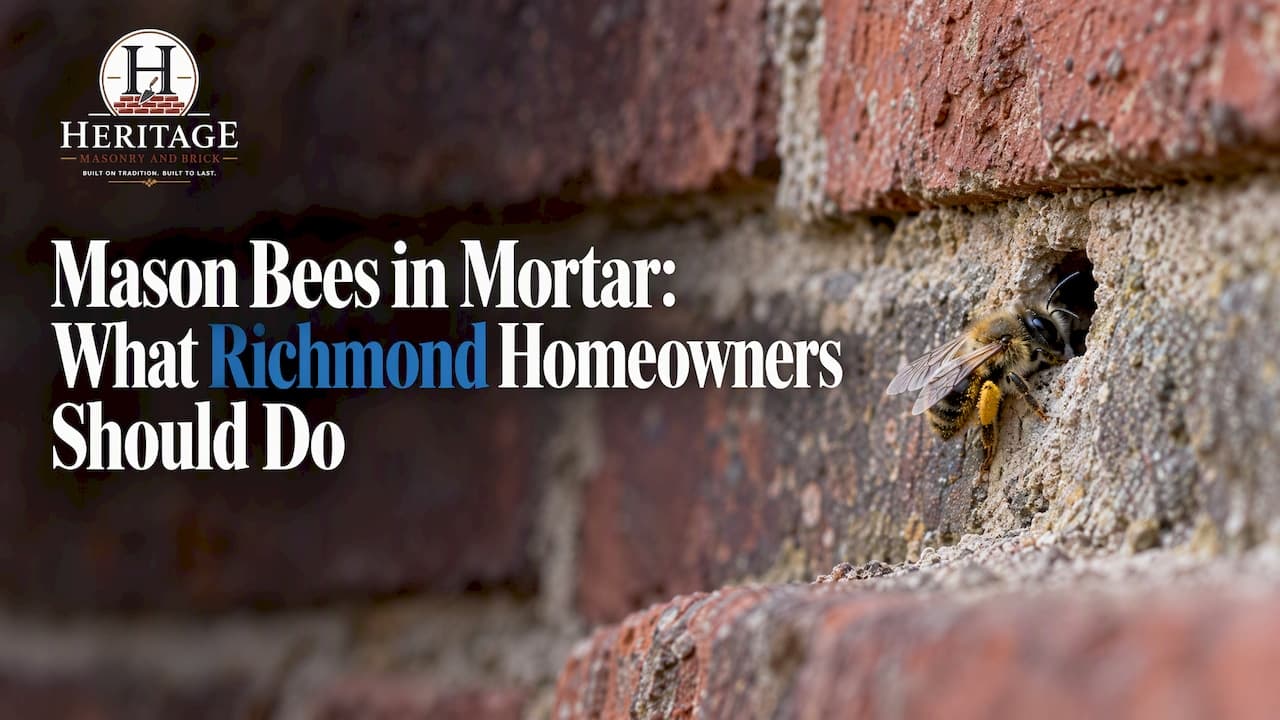
Small round holes in the mortar joints of your brick wall, and bees coming and going from them, usually mean solitary bees have found a soft spot. Most of the time the bees themselves are harmless and the damage is cosmetic. The real question is why the mortar was soft enough to nest in. In Richmond, Virginia, where so many homes carry 100-year-old brick and original lime mortar, the answer is nearly always the same: the joints are aging and need repointing with the right mortar.
This guide explains how to identify the bees, when the damage matters, what a safe response looks like, and how to repair the wall so the problem does not return.
TL;DR
- Mason or masonry bees are solitary bees that nest in small holes in soft mortar, soft brick and stone. They are not a hive and do not sting the way a swarm does.
- Research from Virginia Tech indicates solitary bees mostly enlarge existing holes and that their damage is usually cosmetic. Many holes, loose mortar and fresh brick flakes mean it is time to act.
- Bees are a symptom. Failing joints, often too soft or too hard for the brick, are the cause.
- Repointing with a compatible lime mortar, matched to the original brick, closes the nesting sites for good.
- Heritage Masonry & Brick offers free estimates in Richmond, VA, and a 5-year workmanship guarantee.
Table of Contents
- What mason bees in mortar look like
- Do the bees create the holes or just use them?
- How much damage do bees in mortar cause?
- What to do about bees in your wall
- Why the mortar mix matters so much
- Choosing a mason for historic brick in Richmond
- Our perspective: treat the wall, not just the bees
- How Heritage Masonry & Brick can help
- Preventing bees from coming back
- FAQ
- Sources
What mason bees in mortar look like
Masonry bees, also called mortar bees, are solitary. Each female digs or finds her own nesting hole instead of living in a colony. According to The SPAB, a UK building conservation charity, they nest in the ground and occasionally in walls, mortar joints, soft bricks and stone, and they look similar to honeybees. In the UK the species most often discussed is the red mason bee (Osmia rufa). American species differ, but the nesting behavior in brick walls is similar enough that the same repair logic applies.
Here is what you will typically see on a wall:
- Round holes in the joints, roughly pencil width, often clustered in one area.
- Bees hovering and landing on the wall in warm spring weather, entering and leaving individual holes.
- Fine mortar dust or small crumbs on the sill, step or ground below.
- Mud plugs at the hole entrances. The SPAB notes that each egg is placed in a cell with pollen and nectar and usually sealed with mud.
The wall's orientation matters too. Guidance from Rochdale Borough Council in the UK says these bees favor sunny, south-facing elevations. If your south or west wall in Richmond has holes and the north side has none, that fits the pattern.
Mason bees, carpenter bees and wasps
Not every hole in a wall belongs to a mason bee. Carpenter bees bore into wood, such as fascia, porch rails and eaves, not mortar. Mud dauber wasps build mud tubes on the surface. If the holes are in the mortar joint itself, and the surrounding bricks are intact, mason bees or another solitary bee is the likely tenant. If you are unsure, a photo of the wall and the holes is enough for a mason to give you a first opinion.
One more look-alike is worth ruling out: small openings at the bottom of a brick wall are often deliberate. Those are weep holes, which let moisture escape from behind the brick. The article on the role of weep holes explains why they exist, and our own guide on inspecting and maintaining weep holes in brick shows how to tell them from damage. Do not fill a weep hole because you assume a bee is using it.
Do the bees create the holes or just use them?
This is the part many homeowners get backwards. Bees do not eat mortar, and they rarely start from solid, sound material. The Virginia Tech research found that masonry bees often use pre-existing crevices, although some may be able to burrow into soft material. Other solitary bees using brick mortar holes are simply expanding holes that were already there.
In practice, that means a bee-riddled wall tells you something about the mortar:
- It has cracks, voids or gaps where the joint has pulled away from the brick.
- It has eroded, sandy or powdery texture from decades of freeze-thaw cycles, rain and sun.
- It is softer than it should be, often because of weak original mix or moisture damage.
If the wall had tight, sound joints, there would be little for the bees to use. Treat the bees as a warning light for the wall's condition, not as the disease.
How much damage do bees in mortar cause?
The same Virginia Tech source notes that solitary bees using holes in brick mortar are efficient pollinators and that most of the time the damage is cosmetic. A few holes in a joint on one wall are not an emergency. You do not need to panic or strip the wall.
There are cases where the situation changes. The SPAB lists signs that action is needed:
- Numerous nesting holes across the wall.
- Many bees milling around the wall.
- Excavated mortar visible around the entrances.
- Small flakes of newly broken brick or stone on the ground below.
The last sign is the one to take seriously. Fresh brick flakes mean the masonry itself is soft or spalling, and that is a moisture problem, not just a bee problem. Water entering open joints can freeze and thaw in Virginia winters, widen the gaps, and make more room for the next season's bees.
A quick check you can do from the ground
Look at the wall in morning sun. Note how many holes there are, whether they are in the mortar or in the brick faces, and whether any joints are visibly recessed or crumbling. Gently touch a joint with a key. If the mortar scratches away easily or comes out in sand, the joint has reached the end of its life. Our guide to DIY tests, urgency levels and contractor questions for repointing walks through this in more detail. If chunks of brick are loose or the wall looks bowed, read what a crumbling brick wall means and what to do first and call a mason before the next heavy rain.
What to do about bees in your wall
Most solitary bees are active for a short spring and early summer window, and they are beneficial pollinators. That shapes a sensible, low-risk plan.
During the nesting season
If the number of bees is modest and the wall is otherwise sound, you can often wait. Avoid spraying insecticide into the holes. It does not fix the mortar, it can leave you with dead material inside the wall, and it harms pollinators you probably want in your garden.
Do not block the holes while bees are still inside. Eggs have been laid in sealed cells, and the SPAB explains that new adults emerge the following year. Plugging the entrance during the season can trap bees in the wall or push them to dig a new route through weaker material.
Rochdale Borough Council suggests that artificial nesting boxes on or near walls can help entice bees away and prevent recolonization. A simple bee house on a fence or shed gives them a better option than your south wall.
After the season: repair the joints
The lasting fix is mortar repair. The Rochdale guidance recommends cleaning out affected mortar joints to a depth of 15 mm (about 5/8 inch) and repointing in summer or autumn. It also says the new mortar should not be too strong for the bricks or stone, but hard enough to discourage bees. It adds that a wetter-than-usual mix can help a mortar gun fill galleries and burrows. This is UK council guidance, but the principle is sound for any older masonry: fill the voids fully with a compatible mortar.

For most Richmond homeowners, that means timing the work for late summer or fall, when the bees have finished and the weather is still warm enough for mortar to cure well. If you have a bee problem this spring, book the estimate now and plan the repair for after the season.
Why the mortar mix matters so much
This is where repairs go right or wrong, and it is where we spend most of our time on Richmond jobs.
Older brick, including the soft, hand-molded brick found throughout the Fan District, Museum District and along Monument Avenue, was laid with lime-based mortar. Lime mortar is softer and more breathable than modern, cement-heavy mixes. It lets moisture move out through the joint instead of through the brick. When a joint wears, it wears in place of the brick. That is the design.
Put a hard, high-cement mortar into those joints and the relationship reverses. Water that used to escape through the mortar gets trapped, and the brick face takes the freeze-thaw damage instead. Spalled brick faces, once lost, cannot be repaired the way a joint can. Our article on Type N vs Type S mortar explains why stronger is not better for older brick.

What a good repointing mortar does
A well-chosen repointing mortar should:
- Be softer than the brick, so the joint is the sacrificial part of the wall.
- Match the original in color, texture and tooling, so the repair does not stand out.
- Fill the joint fully, with no voids or hollow pockets a bee can use.
- Be hard enough to discourage nesting, without being so hard that it damages the brick.
That last balance is the same one the Rochdale guidance describes. The lime mix does it well on historic brick, which is why traditional lime mortar is the foundation of our repair work.
Mortar analysis on historic buildings
On older homes, guessing the mix is a risk. Federal historic rehabilitation specifications say that historic mortar analysis should characterize the aggregate and the binder-to-aggregate ratio and help select a replacement mortar mix (ACHP, Department of Defense rehabilitation treatment measures). In plain terms, you look at what is in the wall now, including the sand, which drives the color, and the lime-to-sand ratio, and you design the new mortar to behave like it. We explain what that process tells you in historic mortar analysis before repointing, and how to match color and texture in matching mortar to brick.
Choosing a mason for historic brick in Richmond
Bee repairs are small jobs that are easy to do badly. A joint that is raked out too deep, cut with the wrong tool, or filled with the wrong mortar can leave the wall worse than before. The same federal specification says work on historic properties must conform to the Secretary of the Interior's Standards for the Treatment of Historic Properties, and that masons should ideally have at least ten years of experience with historic mortars, repairs and repointing.
If your home is in one of Richmond's historic districts, ask any contractor:
- Have you repointed historic brick, and can I see photos of finished work?
- What mortar will you use, and how will you match the existing color and joint profile?
- How deep will you cut out the joints, and with what tools?
- What does your guarantee cover, and when do I pay?
Homeowners with a historic exterior may also have local review requirements for visible changes. If you are in a designated district, check with the City of Richmond before work begins.
Our perspective: treat the wall, not just the bees
We are a family-run company, and we have spent over 25 years repairing brick in Richmond. When a homeowner calls about bees in the mortar, we almost never find a bee problem alone. We find a wall whose joints have been neglected, sometimes patched decades ago with a hard gray mortar that was too strong for the brick, sometimes simply worn out.
Our approach is consistent. We look at the brick first, because the brick tells us what mortar belongs there. We match the existing brick and mortar closely, and we use traditional lime mortar for lasting repairs. We rake the joints to a proper depth, fill them completely, and tool them to match the old profile. The result is a wall that sheds water the way it was built to and gives bees no soft spot to start from.
We also do not treat the bees as villains. They are pollinators, and they are usually finished for the year by the time we are on the scaffold. Our advice is simple: leave them alone while they nest, give them a bee house if you like, and repair the wall once they are gone.
— Thomas
How Heritage Masonry & Brick can help
If your Richmond home has bees in the mortar, we can inspect the wall, tell you honestly whether the damage is cosmetic or structural, and price the repair. Our brick repointing and tuckpointing service covers joint repair with mortar matched to your existing masonry. If the inspection finds broken or spalled brick, our brick repair work replaces damaged units with matching brick, and our structural masonry repairs address bowing, cracking or movement.
What you can expect from us:
- Free estimates
- A 5-year guarantee on materials and workmanship
- No deposit required, with payment upon completion
Call 804-324-6304 today to schedule your free estimate, or visit our Masonry Advice page for more homeowner guides.
Preventing bees from coming back
After the repair, a few habits keep the wall tight:
- Inspect joints once a year, ideally in fall, on south and west walls first.
- Watch for early signs: sand on the ground, hairline gaps where mortar meets brick, or recessed joints.
- Keep water away from the wall. Clear gutters, direct downspouts away from the foundation and trim back plants that hold moisture against the brick.
- Keep weep holes open so moisture can leave the wall.
- Offer an alternative: a bee house on a nearby fence gives the bees a place to nest that is not your mortar.
Repointing is not a once-and-done job, but properly done lime mortar joints can last for decades, and each inspection catches small problems when they are cheap to fix.
FAQ
Are mason bees dangerous?
Mason bees are solitary and not aggressive. They do not defend a colony the way honeybees or wasps do, so stings are rare. Still, avoid blocking holes or poking at nests, and keep children and pets away from the wall during the nesting season.
Do mason bees damage brick or only mortar?
Mostly the mortar, and mostly cosmetically. Virginia Tech research found that solitary bees tend to enlarge holes that were already there and that most of the time the damage is cosmetic. If you see fresh brick flakes below the wall, the brick itself is deteriorating and a mason should look at it.
Can I fill the holes myself?
Not while bees are using them, because that can trap bees inside. Once the season is over, small holes can be filled, but the surrounding joint is probably worn too. Fill with the wrong mortar and you can stress the brick. For historic Richmond brick, a mason should match the mortar.
When is the best time to repoint a wall that had bees?
UK council guidance recommends repointing in summer or autumn, after the nesting season. In Richmond, that usually means late summer through fall. Book your estimate early, since good masons fill their schedules before the season ends.
Sources
- Masonry bees, The SPAB
- How to identify and control masonry bees, Rochdale Borough Council
- Virginia Tech research on solitary bees in brick mortar
- Program Comment for Department of Defense Rehabilitation Treatment Measures, ACHP