
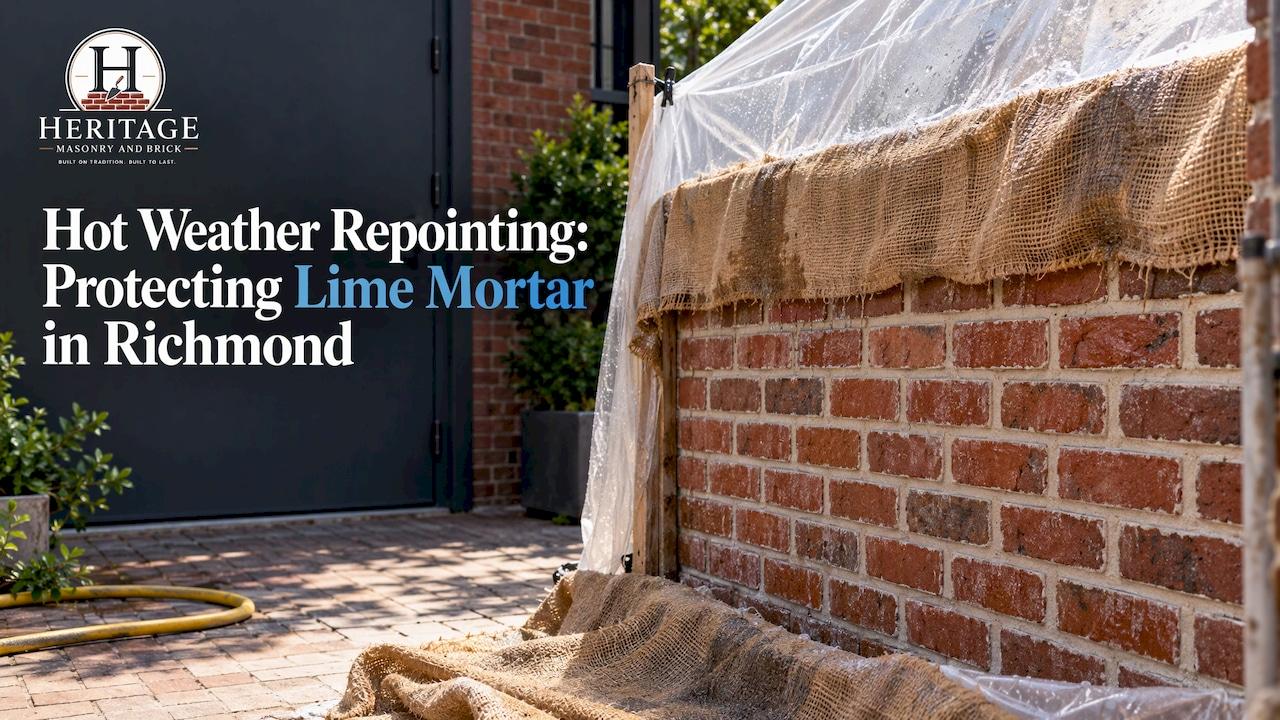
Repointing in hot weather works when the mortar is kept from drying too fast. Richmond summers regularly push brick walls well past the temperatures mortar likes, so the difference between a joint that lasts decades and one that crumbles in a few years is how the mason shades, dampens and cures the work. Lime mortar, the traditional material for the old brick in the Fan, the Museum District and along Monument Avenue, is especially sensitive to this, and it rewards a crew that knows the routine. At Heritage Masonry & Brick, we are a family of traditional masons in Richmond with over 25 years in the trade, and lime mortar repointing is the center of our work.
TL;DR
- Federal specifications say pointing should not be done above 100°F, or above 90°F with wind over 8 mph.
- Heat and wind pull water out of mortar before it can cure, which weakens the bond and the joint.
- Good hot-weather work means shade, damp brick, small fresh batches and at least 72 hours of damp curing.
- Lime mortar for older Richmond brick should be softer than the brick, and it forgives less if it dries too fast.
- Our repointing carries a 5-year guarantee on materials and workmanship, with no deposit and payment on completion.
Table of Contents
- Why heat is hard on fresh mortar
- The temperature limits that matter
- How a good crew works in the heat
- Why the mortar mix matters even more in summer
- When to schedule repointing in Richmond
- Our point of view
- Repointing with Heritage Masonry & Brick
- FAQ
- Sources
Why heat is hard on fresh mortar
Mortar needs water for two jobs. Cement-based mortar uses it to set. Lime mortar uses it to harden slowly by carbonation, a process in which the lime absorbs carbon dioxide from the air and turns back into a stone-like material. The National Park Service explains that lime mortar left to dry too rapidly suffers reduced carbonation, poor adhesion and poor durability, which is why misting and burlap covering are prescribed for the first days.
Hot, sunny or windy conditions do the opposite of what fresh mortar needs. The sun-warmed brick also acts like a sponge: if it is dry, it pulls water out of the mortar the moment it goes into the joint. The result is a joint that looks fine on day one and shows hairline cracks, powdery faces or gaps along the brick edges later.
The temperature limits that matter
The General Services Administration, which sets repointing specifications for federal historic buildings, says pointing should not be performed when ambient temperature exceeds 100°F, or when surface and air temperature exceed 90°F with wind over 8 mph. The same specification says not to point less than 24 hours after rain, or when rain is expected within 6 hours of installation.
The National Park Service gives a gentler working range: wall temperatures between 40 and 95°F prevent freezing and excessive evaporation. It also says repointing is best done in shade, away from strong sunlight. A 2024 Delaware masonry repair specification goes further and bars applying mortar to surfaces at 90°F or above, requiring artificial shade and windbreaks.
The practical reading for a Richmond homeowner: a July afternoon with a south-facing wall in full sun is the wrong time to repoint, even if the air feels merely warm. Brick surface temperature runs higher than air temperature. A mason who checks the wall, not just the forecast, protects your money.
| Source | Heat guidance |
|---|---|
| GSA specification | No pointing above 100°F, or above 90°F with wind over 8 mph |
| NPS Preservation Brief 2 | Wall temperatures of 40 to 95°F, work in shade |
| Delaware 2024 spec | No mortar on substrates at 90°F or above |
| Vieux Carré guidelines (2015) | Best between 40 and 90°F for at least two days after installation |
The Vieux Carré Community Foundation's masonry guidelines set that last window for historic New Orleans brick, and it applies equally well to old brick anywhere.
How a good crew works in the heat
Hot-weather repointing is a set of habits more than a single trick. Here is what the routine looks like and where it goes wrong.
1. Follow the shade
GSA directs contractors to work on the shady side of the building or schedule work for cooler evening hours. On a Richmond rowhouse that means starting on the east face in the morning and moving west later, rather than working a wall straight through. On large projects the NPS suggests modifying scaffolding to provide shade. The common failure is finishing a sunny elevation because it was next on the list.
2. Dampen the joints, not drown them
GSA requires joints to be rinsed so they are damp but free of standing water before pointing, and in hot or windy weather walls and joints should be wet several times. A Michigan State University-published brick masonry handbook notes that bricks should be dampened so they do not absorb moisture from the mortar. Skipping this step is the most common cause of mortar that looks dusty and weak a few weeks later.

3. Mix small batches and keep materials cool
GSA limits the useful life of mortar to 1½ hours after mixing, reduced to 30 minutes in hot weather, and prohibits retempering. For lime mortar, GSA's guidance allows a spray bottle to replace only the water lost to evaporation, with all mortar used within two hours of gauging and a shorter limit on warmer days. The Masonry Industry Council's hot weather guide adds practical measures: keep sand piles damp, use cool mixing water and flush mixers and boards with cool water, and keep mortar below 120°F.
The failure here is a crew that mixes a large batch to save time and keeps adding water to a stiffening pile.
4. Pack deep joints in layers
Joints deeper than ¾ inch should be pointed in lifts, each compacted and allowed to become thumbprint hard before the next, according to the GSA specification. Tooling too early smears the mortar. Tooling too late, in heat, risks a crust over a soft core. Judging thumbprint hardness takes experience, because heat shortens the window.
5. Cure damp for at least 72 hours
This step decides whether the work lasts. GSA requires curing mortar in a thoroughly damp condition for at least 72 consecutive hours, including weekends and holidays, using wet burlap and plastic sheeting with periodic hand misting. The NPS adds that misting can begin as often as every hour and be gradually reduced to every three or four hours over the first three days. Plastic should be tented out from the wall rather than pressed against it, so air can still move.
This is the step most often dropped because it means returning to the job after the mortar is already in. It is also why a contractor's guarantee matters in summer work.
Why the mortar mix matters even more in summer
High-lime mortars harden rapidly as they lose water, the NPS notes, so they are less forgiving of a hot day than a stiff cement mix. That is not a reason to reach for cement. It is a reason to use lime correctly.
Older Richmond brick, much of it soft and fired at lower temperatures, depends on a mortar softer than the brick. The NPS explains that a mortar stronger than the brick will not give, so stress is relieved through the bricks, causing cracking and spalling. Historic mortars were purposely soft so walls could expand and contract with the seasons, and high-lime mortars can self-heal by resealing hairline cracks, a property lost with hard cement mortar.
What lime mortar actually is
Lime mortar is a mix of lime and sand with water. The NPS glossary says repointing mortar for most pre-20th-century buildings should ideally be only lime and sand, with white portland cement replacing up to 20% of the lime for workability. GSA specifies high-plasticity hydrated lime, which resists drying during curing, and white cement to prevent efflorescence, the white salt bloom that can stain brick.
The NPS ranks ASTM mortar types by strength, from Type M at 2,500 psi down to Type O at 350 psi and Type K at 75 psi, plus straight lime and sand Type L. For historic brick the choice sits at the soft end. We explain the trade-offs in our guide to Type N versus Type S mortar, and how we approach color and texture in matching mortar to brick. Where a wall's original mix is unknown, historic mortar analysis tells you what the first masons used.

Moisture is the whole story
Moisture control does not end when the joints are filled. Homeowners often wonder whether to wash brick afterward. How mortar reacts to water and cleaning is worth understanding, and this guide to how brick mortar responds to washing is a good place to see why fresh lime joints should be left alone while they cure.
When to schedule repointing in Richmond
Richmond has hot, humid summers, so the best windows are usually spring and fall, when wall temperatures sit in the 40 to 95°F range the NPS describes. That does not mean summer work is off the table. Water getting in, loose bricks and crumbling joints cannot always wait, and deferred maintenance can lead to crisis-level repairs that favor inappropriate treatments. Deteriorated joints also let moisture in, and freeze-thaw cycles worsen cracking and spalling.
Signs that a joint needs attention, according to the NPS, include disintegrating mortar, cracks in joints, loose bricks, damp walls or damaged plaster. The NPS also warns that the cause, such as a leaking roof or settlement, must be fixed first or the repointing is wasted. Our article on when to repoint brick covers urgency levels, and the guide to spalling brick repair covers faces that have already flaked.
Chimneys deserve a note: they sit fully exposed to sun and wind, so summer repointing up top needs the same shade and curing discipline. See our notes on chimney mortar joints.
Our point of view
Heat is not the enemy of a good repointing job. Rushing is. On Richmond's older brick we use lime mortar because it moves with the wall and lets moisture out, and we plan summer work around the wall, not the calendar: shade first, damp brick, fresh batches and curing after we finish.
We match the existing brick and mortar so the repair blends in, and we use the traditional methods old brick was built with. That is why we stand behind the work with a 5-year guarantee on materials and workmanship, no deposit up front and payment on completion.
Thomas
Repointing with Heritage Masonry & Brick
We repoint homes and businesses across Richmond, including the Fan District, the Museum District and Monument Avenue. Our brick repointing and tuckpointing service covers lime mortar joints, matched to your existing brick, with free estimates. For older neighborhoods, see our page on historic brick repair in the Fan and Museum District, or call 804-324-6304.

FAQ
Can brick be repointed in hot weather?
Yes, with precautions. Federal specifications bar pointing above 100°F, or above 90°F with wind over 8 mph, and call for shade, damp brick and 72 hours of damp curing. A mason who follows those steps can work through a Richmond summer.
How long should fresh mortar stay damp?
GSA requires at least 72 consecutive hours of damp curing, including weekends and holidays. The NPS suggests burlap covering for the first three days with regular misting.
Is lime mortar a good choice for older Richmond brick?
Yes. The NPS says repointing mortar must be no harder than the historic mortar and softer than the brick units. Lime mortar is breathable and flexible, so it protects soft old brick.
How often does brick need repointing?
It depends on the mortar, exposure and workmanship, so there is no single number. Watch for crumbling joints, cracks, loose bricks and damp walls, and have a mason look at them.
Sources
- Repointing historic masonry | GSA
- Preparing Lime Mortar For Repointing Masonry | GSA
- NPS Preservation Brief 2: Repointing Mortar Joints
- NPS Preservation Brief 2 (reprint)
- NPS Glossary of Historic Masonry Deterioration Problems
- NPS Preservation Brief 47: Maintaining the Exterior
- Delaware masonry repair specification, 2024
- Vieux Carré masonry and stucco guidelines, 2015
- Masonry Industry Council hot weather construction guide
- A Handbook on Brick Masonry
- How brick mortar responds to washing