
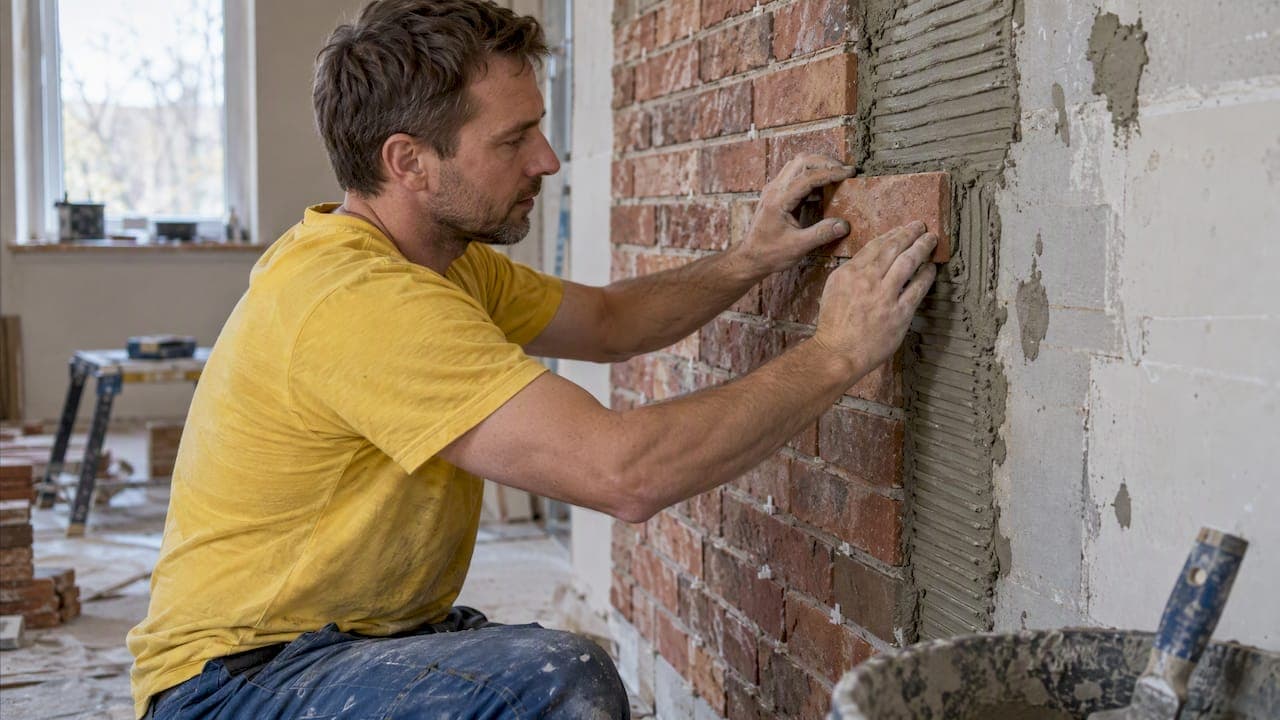
A thin brick overlay is a layer of real brick, sliced to roughly 1/2 to 1 inch thick, adhered to an existing wall. It can give a tired wall a new face at a lower weight and cost than full-size brick. It works only when the wall underneath is sound, dry and properly prepared. On historic brick in Richmond, it is usually the wrong answer, and a repair is the better one.
Below we cover what the system is, what it costs, where it fails, and the Richmond rules that decide whether you can use it at all.
TL;DR
- Thin brick is real brick cut thin and adhered to a backup wall. It is a decorative finish, not a structural material.
- Professional installation typically runs $8 to $25 per square foot, depending on complexity, local labor rates and materials.
- Most failures trace to moisture. Exterior walls need a water-resistive barrier and a drainage path.
- In Richmond's Old and Historic Districts, covering original unpainted brick is typically prohibited, and any visible change needs a Certificate of Appropriateness.
- If your brick is damaged, repointing or localized replacement almost always beats covering it. Call 804-324-6304 for a free estimate.
Table of Contents
- What a thin brick overlay is
- What a thin brick overlay costs
- How a thin brick overlay fails
- Richmond's historic districts change the answer
- Thin brick overlay or repair: how to decide
- Our perspective: repair the brick you have
- Patios, steps and walkways
- Questions to ask any contractor before an overlay
- Get a free estimate on your brick
- FAQ
- Sources
What a thin brick overlay is
Thin brick units are made from clay, like standard brick, but cut or formed much thinner. Most common products run about 1/2 to 1 inch thick, and lightweight systems weigh under 15 pounds per square foot. That is why people choose them: they can go on walls that could never carry a full brick course, including interior feature walls, fireplace surrounds and some exterior retrofits.
Technically, thin brick is an adhered veneer. It is bonded to the wall with mortar or adhesive rather than tied back with metal anchors like a traditional brick veneer. The Brick Industry Association's technical notes describe several methods: thick set, thin set, modular panels and prefabricated panels.
The word "overlay" also covers a second use. Thin brick pavers can be laid over an existing concrete patio, step or walkway to change its look. That is a different job from a wall overlay, and we cover it below.
What a thin brick overlay costs

No two walls are alike, so treat these as ranges, not quotes. HomeGuide reports professional installation of thin brick veneer at roughly $8 to $25 per square foot as of 2026. Material alone for a do-it-yourself job runs about $4 to $12 per square foot. Labor alone typically falls between $4 and $15 per square foot. A full house exterior can exceed $36,000.
What moves the number:
- Surface preparation. Removing paint or sealer, patching, or adding lath and a weather barrier can cost as much as the brick.
- Openings and corners. Windows, doors and corner units all add cutting and flashing work.
- Access. Second stories and tight lots slow crews down.
- Brick selection. Color-matched, blended or tumbled units cost more than plain modular.
The cheapest overlay is the one you do not need. A repointing job or a few replaced bricks often costs far less per square foot than covering a whole wall, and it keeps the original masonry.
How a thin brick overlay fails
The brick itself rarely fails. The system behind it does. The most common cause of failure is poor moisture management. Model codes and the TMS 402 standard require exterior adhered veneer to go over a water-resistive barrier with a means of drainage, unless the assembly has been tested and shown to resist wind-driven rain. Without that path, water gets trapped, the mortar bond weakens and the backing wall can be damaged. The Brick Industry Association technical note also calls for flashing at openings and weep holes so moisture can escape.
The second common failure is poor surface preparation. Over painted masonry, the veneer is only as strong as the paint it sits on. General Shale's technical bulletin addresses code compliance for adhered thin brick, and industry practice is to strip prior paint, sealants and surface treatments, typically by sandblasting or chemical treatment, before bonding. Skip that step and the whole veneer can pull away as the paint lets go.
Watch for these warning signs after installation:
- Hairline cracks that follow the mortar joints.
- Bricks that sound hollow when tapped.
- White powder (efflorescence) or damp patches on the face.
- Any unit that has lifted or fallen off.
Cracking or detachment is often a sign of moisture entering behind the system and needs a masonry professional to investigate promptly. Well-installed systems are commonly described as lasting 30 to 50 years with maintenance limited to checking joints and keeping seals watertight.
Richmond's historic districts change the answer
If your home is in the Fan, the Museum District, along Monument Avenue or in another city-designated district, the first question is not cost. It is permission.
Richmond's Commission of Architectural Review (CAR) governs exterior changes visible from the public right-of-way. Its Homeowner's Guide explains that a Certificate of Appropriateness (COA) is required for this kind of work. Full reviews typically take 30 to 60 days, while administrative approval for small repairs can take one to three days. Applications need a description of current conditions, the proposed work and specification sheets for new materials.
Covering historic, unpainted brick with a new veneer is typically prohibited. The city's Old and Historic District Guidelines aim to protect original character-defining features, and an overlay that obscures them risks a denial. The city's color palette guidance is just as direct about masonry: it says not to paint historic brick that has never been painted.

CAR staff recommend talking to them early. The city's application checklist advises contacting staff well before the deadline to discuss the project. That conversation can save you from a costly redesign. If you are planning anything on a historic façade, our guide to avoiding CAR delays with sample panels shows how a small mockup can help your application.
Thin brick overlay or repair: how to decide
| Situation | Better route |
|---|---|
| Historic, unpainted brick with eroded mortar | Repointing with matching lime mortar |
| A few cracked or spalled bricks | Localized brick replacement |
| Crumbling or bulging wall | Structural investigation and rebuild |
| Painted, non-historic wall you want to update | Overlay may fit, if the wall is sound and dry |
| Concrete patio, steps or walkway in poor cosmetic shape | Paver overlay, or replacement with new brickwork |
| Interior feature wall or fireplace face | Thin brick is a good fit |
A thin brick overlay does not fix a wall. It dresses one. If water is already getting in, covering the problem traps that moisture. The Brick Industry Association's guidance on adding veneer to existing construction starts from the same premise: the existing wall has to be suitable backing before any new face goes on.
Our perspective: repair the brick you have
We are a family-run masonry company that specializes in historic brick restoration across Richmond. Most calls we get about covering a wall are really calls about a wall that is failing: mortar washing out, face spalling, water staining inside. The overlay looks like a clean answer. It rarely is.
Here is how we think about it:
- Original brick is the asset. Sound old brick, repointed correctly, can outlast any new face. Covering it removes the very feature buyers and preservation reviewers value.
- The cause comes first. Failed flashing, open joints, a leaking gutter or rising damp will wreck any finish applied on top. We find that cause before we recommend anything.
- Matching matters. We match existing brick and mortar, and use traditional lime mortar for lasting repairs on historic work. A repair that disappears into the wall is the goal.
- Overlay has its place. On a non-historic, sound, properly prepared wall, or inside the home, thin brick can be a reasonable choice. We will say so when it is, and when it is not.
If you read about a repair in our guides, such as when to repoint brick or whether spalling brick can be repaired, the principle is the same. Fix what is wrong, keep what is right.
— Thomas
Patios, steps and walkways
Thin brick pavers are sold for laying over concrete patios, stairs and driveways. The same rules of preparation apply: the slab must be sound, clean and free of movement, or the new surface will crack along the old cracks. If the concrete is heaving, settling or draining toward the house, an overlay only hides the problem.
For many homeowners, full brick is the longer-lasting route. Our brick patio cost guide walks through pricing on new patios, and our brick retaining wall repair guide covers walls that carry load, where a decorative layer is never the fix.
Questions to ask any contractor before an overlay
- What is the wall made of, and has it been checked for moisture?
- How will the existing paint or sealer be removed?
- What water-resistive barrier and drainage path will be used?
- Where will flashing and weep holes go?
- Which mortar is specified, and does it meet the manufacturer's requirements?
- If this is in a historic district, has CAR staff reviewed the plan?
- What is guaranteed, for how long, and in writing?
A contractor who cannot answer questions two through four is guessing about the part that fails.
Get a free estimate on your brick
If you are weighing an overlay because your brick looks worn, let us look at it first. We offer free estimates, no deposits and payment on completion, and every job carries our 5-year guarantee on materials and workmanship. Depending on what we find, the answer may be brick repair, repointing and tuckpointing, structural repairs, or new work such as brick steps and patios and walkways. Call 804-324-6304 today.
FAQ
How much does thin brick veneer cost?
Professional installation typically runs $8 to $25 per square foot according to HomeGuide's 2026 figures. Wall preparation, openings and the brick you choose drive the range. A full house exterior can pass $36,000.
How durable is thin brick?
The brick is fired clay and very durable. The system is only as good as the substrate, mortar and moisture control behind it. Reported lifespans for professional installations are 30 to 50 years with maintenance.
Can you put thin brick over existing brick?
Sometimes, on a sound, clean, non-historic wall. Paint and sealers must be removed first so the mortar can bond. On historic, unpainted brick in a Richmond district, it is typically prohibited.
Do I need approval to add a brick overlay in Richmond?
In an Old and Historic District, yes. Changes visible from the public right-of-way need a Certificate of Appropriateness from the CAR. Contact CAR staff early, before you commit to materials or a contractor.
Sources
- HomeGuide: How Much Does Brick Veneer Cost?
- Brick Industry Association: Thin Brick Veneer
- Brick Industry Association: Adding Brick Veneer to Existing Construction
- General Shale: Thin Brick Code Compliance bulletin
- Builds and Buys: Brick Veneer Installation Cost Guide
- City of Richmond: CAR Homeowner's Guide
- City of Richmond: Old and Historic District Guidelines
- City of Richmond: CAR color palette guidance
- City of Richmond: Proposed Alteration and Addition Checklist