
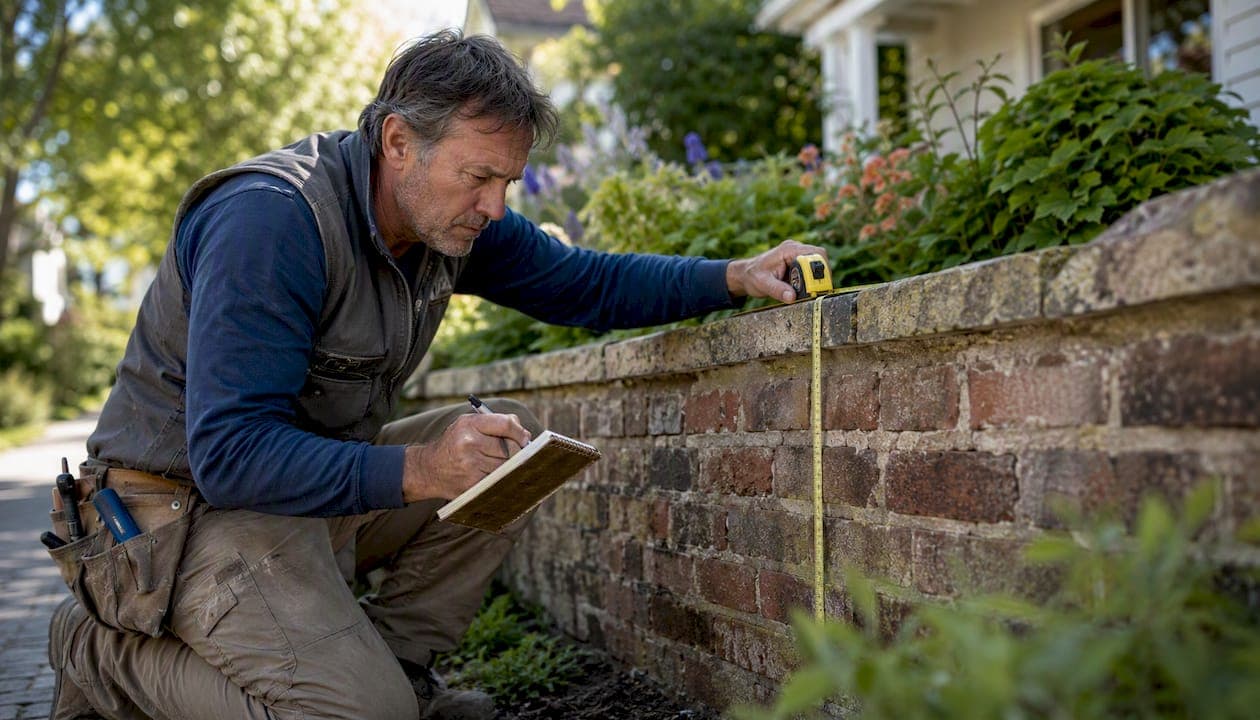
Most brick retaining walls with localized damage can be repaired, provided the root cause, typically poor drainage or a compromised footing, is addressed at the same time. Patching mortar over a leaning wall without fixing what caused the lean is money spent twice. The three conditions that most often determine whether repair is viable: how far the wall has moved, whether the footing has failed, and whether hydrostatic pressure is still building behind the wall.
Before you get close to a wall that is visibly leaning or bulging, cordon off the area and keep people away from the base. A wall under active soil pressure can shift without warning. If the lean is severe or the wall is near a structure, a driveway, or utility lines, call a masonry contractor before doing anything else.
Quick read:
- Localized mortar loss, minor cracking, and small patches of spalling are generally repairable.
- Active movement, footing failure, or separation between wall faces usually means a partial or full rebuild.
- Your immediate next step: document the damage with photos and measurements, then get a professional assessment.
Table of Contents
- How do you inspect a brick retaining wall for damage?
- What causes a brick retaining wall to fail?
- What repair options work for a damaged brick retaining wall?
- How much does brick retaining wall repair cost, and how long does it take?
- When can you DIY, and when should you call a masonry contractor?
- What happens during a professional brick retaining wall repair?
- When is repair no longer enough?
- Expert advice from Heritagemasonryandbrick on getting repairs right
- Key Takeaways
- The repair that actually lasts
- Heritagemasonryandbrick: free estimates and guaranteed repair work in Richmond, VA
- Sources and further reading
How do you inspect a brick retaining wall for damage?
A thorough visual inspection takes about 20 minutes and tells you most of what you need to know before calling anyone. Work from top to bottom, and check both the face and the top cap.
What to look for:
- Leaning or bowing: Stand back and sight along the wall face. Any visible curve or forward tilt is a structural concern.
- Horizontal cracks: These run parallel to the mortar courses and often signal soil pressure or footing movement.
- Stair-step cracks: Diagonal cracks following the mortar joints typically indicate differential settlement.
- Bulging sections: A localized belly in the wall face suggests soil pressure has overcome the wall's resistance at that point.
- Separated leaves: On older double-wythe walls, the outer face can pull away from the inner course. Tap the face; a hollow sound confirms separation.
- Mortar loss: Joints recessed more than 3/4 inch need repointing. Bricks can remain sound for centuries while mortar often fails in 20–30 years, so deteriorating joints are common even on structurally sound walls.
- Efflorescence: White mineral deposits on the face mean water is moving through the wall. Not structural on its own, but a reliable sign of drainage problems.
- Ponding and weep holes: Check whether weep holes are present and clear. Standing water at the base or saturated soil behind the wall is a red flag.
Measuring movement: Stretch a string line along the wall face and measure the gap at the worst point. Mark the wall with chalk at the base and top, then photograph it against a fixed reference point. Recheck in two to four weeks. A wall that is still moving needs professional attention immediately; a wall that has been stable for years is a better candidate for repair.
Pro Tip: Take dated photos from the same angle every few weeks. This documentation helps contractors give accurate estimates and can support an insurance claim if the damage is tied to a storm event or drainage failure.
What causes a brick retaining wall to fail?
Visible damage is almost always a symptom. The underlying cause is usually one of a short list of problems, and poor drainage and hydrostatic pressure top that list. Water trapped behind a wall dramatically increases lateral soil pressure, and that pressure is what pushes walls outward.
Primary causes:
- Hydrostatic pressure from poor drainage: Missing or clogged weep holes, inadequate gravel backfill, and downspouts discharging near the wall all contribute. This is the most common cause of retaining wall failure.
- Inadequate or failed footing: A footing that was too shallow, too narrow, or poured on unstable soil will eventually allow the wall to rotate or slide.
- Soil movement and settlement: Expansive clay soils, erosion at the base, or changes in grade can shift the load the wall carries.
- Freeze-thaw cycles: Water in mortar joints expands when it freezes, gradually widening cracks and loosening bricks. Repeated cycles over winters accelerate mortar failure.
- Tree roots: Roots growing beneath or behind a wall exert significant pressure and can displace footings.
- Poor original construction: Walls built without adequate batter (backward lean), without proper drainage, or with mismatched mortar are prone to early failure.
- Mortar mismatch: Applying modern Portland cement mortar to historic lime-mortar brickwork traps moisture and causes brick spalling. The wall cannot breathe, and the harder mortar transfers stress into the softer brick.
Pro Tip: Before any other repair, check drainage. Clear the weep holes, look for downspout discharge near the wall, and probe the soil behind it after rain. If the soil stays saturated, the drainage problem must be fixed first, or any masonry repair will fail again.
What repair options work for a damaged brick retaining wall?
Repair options range from simple mortar touch-ups to full reconstruction. Matching the repair to the actual problem is what determines whether the fix lasts.
Repointing and cosmetic patching
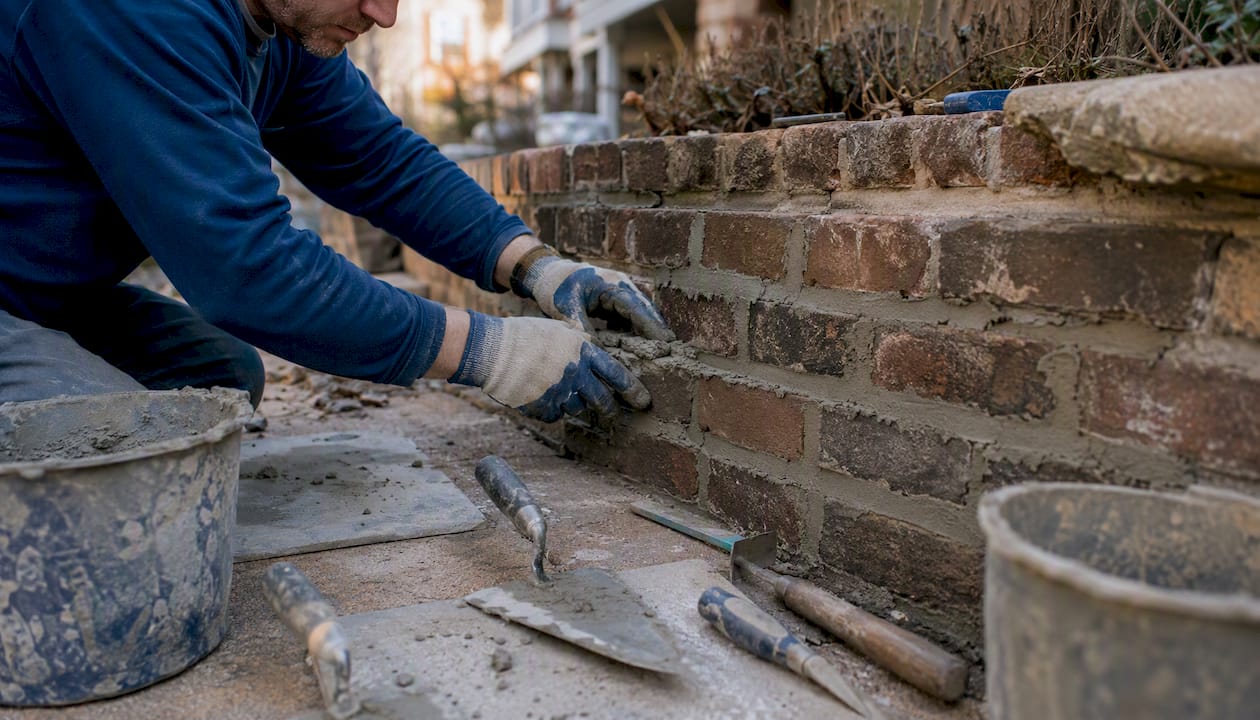
Appropriate when mortar joints are recessed or crumbling but the wall is plumb and stable. Type N mortar suits most general brickwork; older walls with lime mortar require a compatible lime-based mix to avoid trapping moisture. Repointing addresses the symptom of mortar loss but does not fix drainage or structural issues. Done correctly, it extends wall life by 20–30 years. Heritagemasonryandbrick's repointing and tuckpointing service includes mortar color and composition matching for a result that blends with the existing wall.
Drainage installation
When hydrostatic pressure is the root cause, excavating the backfill and installing a proper drainage column is the priority repair. A standard drainage column uses about 12 inches of 3/4-inch angular stone and a perforated drain pipe wrapped in geotextile fabric. This relieves the pressure that caused the damage and is the single most important step before any structural masonry work begins.
Partial reconstruction with footing repair
When a section of wall has moved but the damage is localized, a mason can demolish and rebuild that section, repair or extend the footing, and install drainage. This is more invasive than repointing but far less costly than a full rebuild.
Mechanical stabilization
For walls showing separation between faces or active outward movement, wall ties, anchors, or helical tiebacks can mechanically reconnect and stabilize the brickwork. The right system depends on wall thickness, mortar condition, and anticipated loads. A structural evaluation is often required.
Reinforcement coatings
Steel mesh reinforcement can increase compressive strength significantly, and composite-reinforced mortar (CRM) coatings with fiberglass mesh improve out-of-plane resistance. These approaches suit walls where preserving the face is a priority but structural capacity needs to increase.
Full replacement
When the footing has failed across the full length, movement is widespread, or repeated repairs have not held, full demolition and reconstruction is the prudent choice.
| Repair tier | Scope | Typical cost bracket | Invasiveness | Addresses drainage/footing? |
|---|---|---|---|---|
| Repointing/patching | Mortar joints, surface bricks | Low hundreds | Minimal | No |
| Drainage installation | Excavation, gravel column, pipe | a few hundred dollars up to low thousands | Moderate | Yes (drainage) |
| Partial rebuild | Section demo, footing repair, rebuild | Low to mid thousands | High | Yes (both) |
| Mechanical stabilization | Wall ties, anchors, tiebacks | Mid thousands | Moderate to high | Partial |
| Full replacement | Full demo, new footing, rebuild | $6,000 to $14,000 or more | Very high | Yes (both) |
Pro Tip: Always ask whether the proposed repair addresses the root cause. A contractor who quotes only repointing on a leaning wall is selling you a temporary fix.
How much does brick retaining wall repair cost, and how long does it take?
Repair costs range from a few hundred dollars for minor patching to a high cost range for a complete replacement, depending on wall size, site conditions, and what the repair actually involves.
| Scope | Estimated cost range | Typical timeline |
|---|---|---|
| Minor repointing/patching | several hundred dollars | 1–2 days |
| Drainage installation | a few hundred dollars up to low thousands | 1–3 days |
| Partial rebuild with drainage | low to mid thousands | 3–7 days |
| Mechanical stabilization | mid thousands | 2–5 days |
| Full replacement | $6,000 to $14,000 or more | 1–3 weeks |
Factors that move costs up:
- Wall height above 4 feet (often triggers permit and engineering requirements)
- Limited access for equipment
- Matching historic or custom brick and mortar
- Soil type (expansive clay or rocky ground increases excavation cost)
- Proximity to structures, utilities, or slopes
- Required engineering drawings or geotechnical reports
Curing time adds days to any schedule. Freshly pointed or rebuilt masonry needs at least 24–48 hours before backfilling, and full cure takes 28 days. Rushing that step is one of the most common causes of premature failure.
When can you DIY, and when should you call a masonry contractor?
The honest answer: most homeowners can handle minor maintenance, but anything involving movement, footing issues, or walls over 3–4 feet tall belongs with a professional.
What homeowners can reasonably do:
- Clear clogged weep holes with a wire or compressed air.
- Repoint small sections of recessed mortar on a stable, low wall (under 3 feet, no lean).
- Replace a loose or cracked cap brick using matching mortar.
- Redirect downspouts away from the wall.
- Document damage with photos and measurements before calling a contractor.
Minor repointing is DIY-feasible for low walls with no active movement, but the skill ceiling is lower than most guides admit. Mixing the wrong mortar or pointing too aggressively can damage bricks that were otherwise sound.
Call a professional immediately if you see:
- Any measurable forward lean or bowing
- Horizontal cracks running the length of the wall
- Open separation between the wall face and the backing
- Sections that sound hollow when tapped
- Soil actively pushing through cracks
- A wall near a structure, driveway, or utility line showing any movement
Questions to ask a masonry contractor:
- Are you licensed and insured in Virginia?
- Will you address the drainage and footing, not just the visible masonry?
- Do you have references for retaining wall work specifically?
- Is an engineer required for this repair, and will you coordinate that?
- What does your workmanship warranty cover, and for how long?
- Can you show me a mortar sample match before work begins?
What happens during a professional brick retaining wall repair?
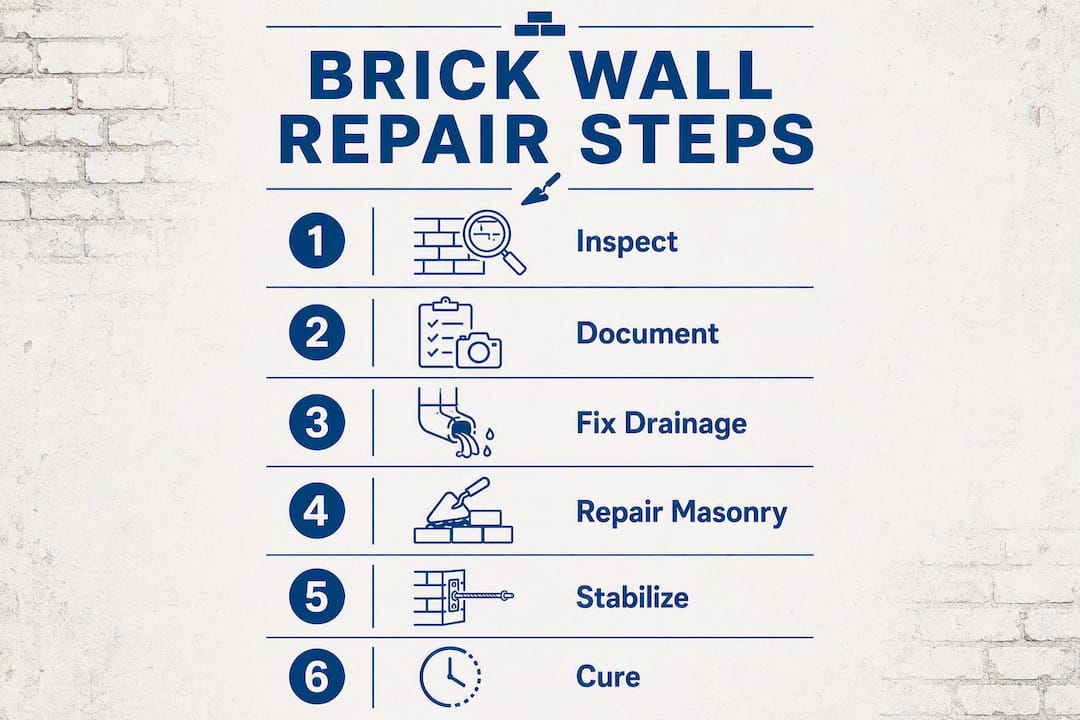
Knowing the sequence helps you evaluate quotes and prepare your property. A well-run repair follows these steps:
- Initial inspection and documentation: The contractor measures lean, photographs damage, probes soil conditions, and identifies the root cause.
- Drainage and soil evaluation: Water movement behind the wall is assessed. If hydrostatic pressure is present, drainage installation is planned before masonry work.
- Permitting and engineering: Walls over 4 feet typically require a building permit in most Virginia jurisdictions. Significant movement or proximity to structures may require stamped engineering drawings.
- Temporary shoring: If sections are unstable, shoring is installed to prevent collapse during demolition.
- Partial demolition: Damaged sections are carefully removed. Salvageable bricks are set aside for reuse.
- Drainage installation: The backfill is excavated, the drainage column is installed, and the perforated pipe is set and wrapped in geotextile.
- Footing repair or replacement: Cracked, settled, or undersized footings are repaired or rebuilt to the correct depth and width.
- Masonry reconstruction or repointing: Bricks are relaid or joints are repointed using matched mortar. For historic walls, mortar composition and color are matched to the original.
- Curing: Work is protected from rain and temperature extremes during the cure period.
- Backfill and landscape restoration: Soil is compacted in lifts, and disturbed landscaping is restored.
- Final inspection: The contractor walks through the completed work with the homeowner and confirms the warranty terms.
On permits: Many homeowners skip this step and regret it. An unpermitted retaining wall repair can complicate a home sale and may void insurance coverage. Check with your local building department before work begins.
On warranties: A reputable contractor's workmanship guarantee should cover the repair against defects in labor and materials. Heritagemasonryandbrick backs its work with a 5-year workmanship guarantee. Basic maintenance after repair, keeping weep holes clear, redirecting water, and inspecting annually, extends the life of any repair significantly.
When is repair no longer enough?
Some walls are past the point where repair is the right answer. Recognizing that threshold early saves money and prevents a more dangerous situation.
Definitive indicators that a rebuild is required:
- The wall is moving continuously or the lean is accelerating
- The footing has failed across most or all of the wall's length
- The two faces of a double-wythe wall have separated structurally
- Large-scale spalling has compromised the structural brick, not just the mortar
- Previous repairs have failed within a short time
- The wall has collapsed in sections
A wall near a driveway, steps, or a structure presents a collapse risk that makes delay genuinely dangerous. Falling masonry from a retaining wall can damage vehicles, injure people, and undermine adjacent structures. The cost of a full rebuild is significant, but it is almost always less than the combined cost of repeated failed repairs plus any damage a collapse causes.
Pro Tip: If a contractor quotes a repair on a wall that shows multiple definitive rebuild indicators, ask them directly: "What is the likelihood this repair holds for ten years?" If they cannot answer confidently, get a second opinion.
Expert advice from Heritagemasonryandbrick on getting repairs right
After more than 25 years of brick and masonry work in Richmond, VA, a few principles hold true on nearly every retaining wall job.
Match the mortar, every time. Using Portland cement mortar on a wall originally built with lime mortar does not just look wrong. It traps moisture, accelerates brick deterioration, and can cause irreversible spalling. For older Richmond-area walls, mortar composition and color matching is not optional. In some cases, a mortar sample is sent for laboratory analysis to replicate the original mix accurately.
Fix drainage before fixing masonry. Repairing visible brick or mortar without addressing root causes leads to recurring failures and higher lifetime costs. The drainage column comes first. Every time.
Document everything before the estimate. Photos taken from multiple angles, measurements of any lean, and a note of how long the damage has been visible all help a contractor give a more accurate quote and identify whether the problem is progressing.
For walls showing separation or active movement, mechanical stabilization with wall ties or helical anchors is often the right intermediate step before committing to a full rebuild. These systems require selection based on wall construction and anticipated loads, and a structural evaluation is part of that process. Heritagemasonryandbrick's brick repair services include assessment of stabilization options alongside traditional masonry repair.
Key Takeaways
Addressing drainage and footing failure alongside masonry repairs is the only approach that prevents a brick retaining wall repair from becoming a repeated expense.
| Point | Details |
|---|---|
| Inspect and document first | Photograph damage from fixed angles and measure any lean before calling a contractor. |
| Drainage is the priority | Hydrostatic pressure is the leading cause of retaining wall failure; fix drainage before masonry. |
| Match repair to root cause | Repointing alone does not fix a leaning wall; partial rebuilds and drainage installs address structural failure. |
| Budget realistically | Minor repairs run several hundred dollars; partial rebuilds and drainage installation run low to mid thousands; full replacements range from $6,000 to $14,000 or more depending on size and complexity. |
| Heritagemasonryandbrick | Offers free estimates, a 5-year workmanship guarantee, and 25+ years of experience in Richmond, VA. |
The repair that actually lasts
Most articles on brick retaining wall repair focus on the visible damage: the crack, the lean, the crumbling mortar. What they understate is how rarely the visible damage is the actual problem.
The walls that get repaired twice, sometimes three times, are almost always the ones where the first contractor addressed the face and left the drainage alone. It is an understandable shortcut. Excavating backfill, installing a drainage column, and repairing a footing is significantly more work than repointing joints. But the physics do not change. If water is still building pressure behind the wall, the repair is temporary by definition.
There is also a tendency among homeowners to underestimate how quickly a wall can go from "needs attention" to "needs a rebuild." A wall that has moved half an inch over five years is a repair candidate. A wall that has moved half an inch in six months is a different conversation entirely. The rate of movement matters as much as the total displacement.
The other thing worth saying plainly: not every wall is worth repairing. An older wall with a failed footing, separated faces, and a history of patched repairs is probably going to cost more to fix correctly than to rebuild from scratch. A good contractor will tell you that honestly, even when the rebuild is the more expensive recommendation.
Heritagemasonryandbrick: free estimates and guaranteed repair work in Richmond, VA
When a brick retaining wall shows real structural problems, the difference between a repair that holds and one that fails again usually comes down to who does the work and whether they fixed the right thing.

Heritagemasonryandbrick has been repairing and rebuilding brick retaining walls in Richmond, VA for over 25 years. The team handles the full scope: repointing and tuckpointing, drainage column installation, partial and full rebuilds, mechanical stabilization with wall anchors, and matching historic mortar and brick for older properties. Every job is backed by a 5-year workmanship guarantee.
Getting started is straightforward. Request a free estimate and bring your photos, measurements, and a description of any movement you have observed. That documentation helps the team give you an accurate assessment on the first visit, not a ballpark that changes once work begins.
Call 804-324-6304 or visit heritagemasonryandbrick.com to schedule your free estimate.
Sources and further reading
The following resources informed this guide and are worth reviewing if you want to go deeper on specific repair methods or cost data.
- How to Repair a Brick Wall Yourself: Repointing, Replacing Bricks, Aftercare, and More — Angi's practical homeowner guide covering repointing steps and brick replacement.
- Brick Mortar Repair in 6 Steps — This Old House's step-by-step repointing guide with mortar selection guidance.
- How to Repair a Retaining Wall — The Spruce's drainage-column installation walkthrough.
- How Much Does It Cost to Repair a Retaining Wall? — HomeGuide's cost breakdown by repair scope.
- Wall Ties for Brick Masonry (Technical PDF) — Brick Industry Association technical bulletin on mechanical stabilization.
- Sustainable Reinforcement Methods for Brick Masonry Walls — MDPI peer-reviewed study on steel and fiberglass mesh reinforcement.
- Brick Repairs by Heritagemasonryandbrick — Service page covering repair methods, mortar matching, and structural restoration in Richmond, VA.
- Repointing and Tuckpointing by Heritagemasonryandbrick — Technical detail on repointing services and material compatibility.
When you bring photos and measurements to your estimate appointment, these sources can help you ask sharper questions and understand the contractor's recommendations.