
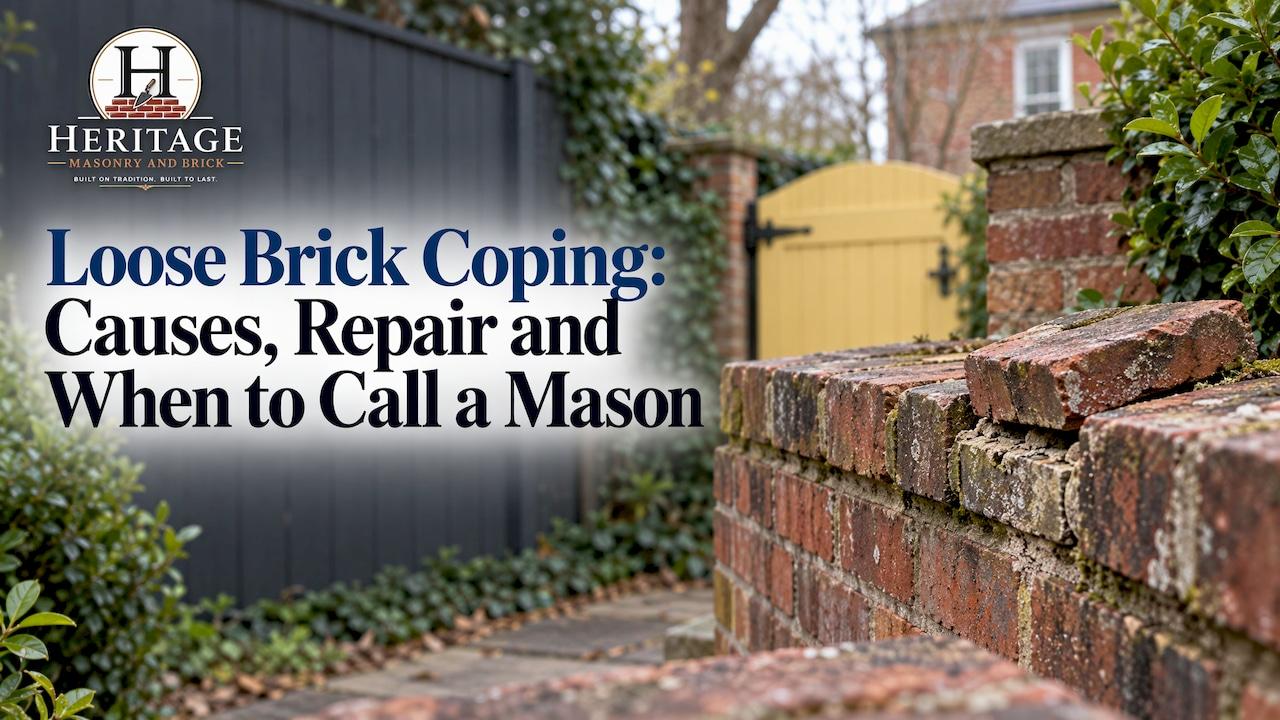
Loose brick coping needs attention soon, because coping is the layer that keeps rain out of the wall beneath it. Once the bricks or joints on top move, water gets in, and a small reset can become a rebuild. The lasting fix is to take the loose units off, find out why they moved, and reset them on mortar that matches the original brick and wall. For historic Richmond, VA brick, that usually means traditional lime mortar. We repair brick on homes and businesses across Richmond, and coping is one of the places where careful matching pays off for decades.
TL;DR
- Coping is the cap on top of a wall. Its job is to shed water away from the masonry below, so loose coping is a water problem first and a looks problem second.
- Wobbly bricks, open joints, gaps and cracked mortar on top of a wall, step cheek, column or parapet are the warning signs.
- Loose coping can fall, so treat it as a safety issue as well as a repair issue.
- Hard portland-cement mortar is a common mistake on old brick. Lime mortar that matches the original is gentler on historic brick and breathes.
- Heritage Masonry & Brick resets and repoints coping in Richmond with matched brick and mortar, free estimates, and a 5-year guarantee on materials and workmanship.
Table of Contents
- What brick coping is and why it matters
- How to tell your coping is loose or failing
- What makes coping come loose
- When loose coping points to something bigger
- How loose coping is repaired, step by step
- Why lime mortar for Richmond brick
- Repair or replace: how to decide
- Loose coping on chimneys, steps and columns
- Having us look at it in Richmond
- Our perspective on coping
- FAQ
- Sources
What brick coping is and why it matters
Coping is the covering at the top of a wall. According to the Brick Industry Association, its primary function is to channel water away from the building. It may slope in one or both directions, and the same technical note says it should slope at least 15 degrees from horizontal.
You will find brick coping in many places around Richmond properties:
- Garden walls and front yard walls
- Capped brick columns and gate piers
- Porch walls and the sides of brick steps
- Chimney tops and parapet walls on row houses and small commercial buildings
- Retaining walls and planter walls
Top surfaces take the most abuse. Rain, snow, sun and freeze-thaw cycles hit them directly, and nothing shelters them. The Brick Industry Association notes that sills, parapets, chimneys and copings exposed to more severe weathering may need repairs at shorter intervals than general brickwork. A loose cap is not a sign you did something wrong. It is a sign that the most exposed part of the wall has reached the point where it needs a mason.
How to tell your coping is loose or failing
Walk the wall and look at the top first, then at the face just below it. The signs are usually easy to see:
- Bricks that rock or shift when pressed lightly with a gloved hand
- Open or crumbling mortar joints between coping bricks, especially the cross joints (the vertical ones)
- Gaps between the cap and the wall face or between the cap and an adjoining building
- Staining, green growth or white powder on the wall below the cap, a sign that water is moving through the masonry
- Cracked or missing coping units
New York City's Department of Buildings lists open cross joints, inadequate joint dimension and excessive movement of coping stone as visual symptoms of coping failure. It gives the probable causes as poor original construction, water penetration, aging joint material, and deteriorating dowels or fasteners. A Delaware County, Pennsylvania guide for historic homeowners lists spalling, loose or dislodged masonry and softened or broken mortar as the signs of masonry deterioration. It also recommends documenting the element before repairs begin, so take photos before anyone touches it.
Why it is a safety issue
The same New York guidance notes that failed sealant at coping joints can let water into the masonry and lead to loosening or "fly-off" of coping, which makes it a public-safety hazard. On a garden wall that means a brick on a sidewalk. On a column beside your front steps, it means a brick near your family. Keep people and pets away from any coping you can move by hand until it is reset.
What makes coping come loose
Most loose coping traces back to water, and water usually gets in through one of a few routes.
Failed mortar joints. Mortar is the sacrificial part of a brick wall. It is meant to wear before the brick does. When joints open on top of a wall, rain enters directly, softens what is left and washes out the bedding beneath the brick.
No slope, overhang or drip. A well-built coping sheds water outward and extends past the wall face. A technical course text from the Illinois Institute of Technology says proper coping installation needs through-wall flashing underneath, a beveled slope and a drip groove at the edges. When any of those is missing, water runs down the wall face or sits on the cap.
Freeze-thaw. Water that gets into small gaps expands as it freezes. Richmond sees plenty of winter nights that swing above and below freezing, and each cycle can widen a hairline gap.
The wrong mortar. This one is common on older repairs. The National Park Service explains that hard portland-cement mortars are less permeable than the surrounding brick and can cause the masonry to deteriorate faster. A cap reset in hard cement can trap moisture in the old brick instead of letting it escape.
Movement in the wall below. If the wall or footing is shifting, the cap will shift with it. Resetting the bricks alone will not hold.

When loose coping points to something bigger
A few loose bricks on top are a repair. Certain signs mean the wall itself needs an assessment. The Brick Industry Association lists these structural warning signs that go beyond routine maintenance:
- Cracks wider than 0.075 inch (about 2 mm)
- Cracks running through multiple brick units
- Stepped or diagonal cracking
- Widespread spalled brick (faces popping off)
- Out-of-plane movement, meaning a wall that leans or bulges
The association says these warrant a professional engineer's investigation. If you see them, call an engineer, and call a mason for the repair that follows. We handle structural brick and masonry repairs in Richmond and can work from an engineer's findings.
On parapets and taller walls, the cap sits over flashing, membranes and hidden layers of brick. If water keeps coming back after the top is repaired, the cause is often concealed. This overview of parapet wall flashing explains how flashing continuity and wall construction affect leaks at the top of a wall, and why the coping and the flashing under it have to be treated together.

How loose coping is repaired, step by step
Here is how a proper reset goes, with the point at each step where it most often goes wrong.
1. Document and secure
Photograph the cap from several angles and mark the order of the bricks if they are being lifted. Remove only the units that are loose. Where the cap is part of a historic property, matching what was there matters, so the record is valuable.
Where it goes wrong: Pulling bricks out in a hurry and mixing them up. Old handmade brick varies in size, and the units often belong in a particular spot.
2. Cut out the old mortar
Remove the failed bedding and joint mortar carefully, to a depth that leaves sound material to bond to. Brush and clean the cavity.
Where it goes wrong: A grinder run too deep or too wide chips the brick edges. On soft historic brick, that damage is permanent. This is hand-skill work, and it is why we use traditional methods on old brick.
3. Check what is underneath
Look at the course below the cap. Is it solid? Is the bedding wet or hollow? Is there flashing? If the supporting masonry is crumbling or the wall is moving, fix that before anything goes back on top. The National Park Service guidance is clear that structural repairs must precede cosmetic ones.
Where it goes wrong: Resetting a cap onto a bad base. It looks fixed and loosens again within a season or two.
4. Choose the mortar and brick
The mortar should match the existing in color, hardness and permeability. Replacement brick, if needed, should match the original in size, texture and color. The Building Conservation guide on brick copings says they should be laid in a suitably specified lime-based mortar and jointed flush, with a good overhang and a throat to shed water clear of the brickwork below.
Where it goes wrong: Reaching for a bag of general-purpose cement mix. It sets harder than old brick and can lead to spalling next to the repair.
5. Reset the bricks fully bedded
Bed each brick on mortar on all sides so there are no voids for water to sit in. Set it at the original slope and overhang, and keep joints consistent with the surrounding work.
Where it goes wrong: Partial bedding, with mortar only under the corners. It looks solid on day one and fails at the first freeze.
6. Tool the joints and cure slowly
Finish the joints to match the existing profile. Then protect the work so the mortar cures gradually rather than drying out in sun or wind. Lime mortar in particular rewards slow curing.
Where it goes wrong: Skipping the curing step, particularly in summer heat, which leaves weak, powdery joints.
The Illinois Institute of Technology course text warns that non-professional repairs to coping joints only aggravate the problem and that joints need quality mortar within a properly flashed, sloped, drip-grooved detail. That is the gap between a patch and a repair. At Heritage Masonry & Brick, we match the existing brick and mortar on every repair so the work blends in, and our brick repair service covers coping on walls, columns, steps and chimneys.
Why lime mortar for Richmond brick
Richmond has some of the oldest brick in Virginia. Row houses in the Fan District, townhouses in the Museum District and the homes along Monument Avenue were built when lime mortar was the standard. That mortar is softer than portland cement and more permeable, so moisture moves out through the joints instead of through the brick faces.
The practical effect is that the joint takes the wear. When lime mortar finally erodes, you repoint the joint. The brick stays intact. With hard cement, the brick can take the damage instead. The National Park Service says matching the existing mortar's color, hardness and permeability is the rule for repointing historic brick, and the Building Conservation guide points to lime-based mortar for copings for the same reason.
A few points about lime mix mortar that homeowners ask about:
- It is a mix, not a single product. Lime mortar blends lime, sand and sometimes a small amount of other binder. The proportions and the sand's color and grain decide the strength, the look and the texture.
- Sand matters as much as lime. The sand gives mortar its color. A mortar that is the right strength but the wrong color shows as a patch.
- Matching is a craft. Our guides on matching mortar to brick and on historic mortar analysis explain how an old mortar is read before a new one is mixed.
- It heals and flexes. Lime mortar tolerates small amounts of movement better than hard cement, which suits walls that expand and contract with Richmond's seasons.
If your property is in one of Richmond's Old and Historic Districts, the city's review guidelines apply to changes to the exterior. The City of Richmond's Old and Historic Districts guidelines cover masonry and list the standards the Commission of Architectural Review uses. Check the current guidelines and the city's preservation staff before you change the look of historic masonry. Repair that matches the existing brick and mortar is the approach those standards favor, and it is the approach we take.
Repair or replace: how to decide
Most loose coping can be repaired. Replacement of the whole cap is for cases where the units are cracked through, badly spalled or missing, or where the slope and overhang were never right.
| Situation | Usual approach |
|---|---|
| A few loose bricks, sound base | Lift, clean, reset on matched mortar |
| Open or crumbling joints along the cap | Repoint with matched lime mortar |
| Cracked, spalled or missing units | Replace with matched brick, reset |
| Cap with no slope, overhang or drip | Rebuild the detail |
| Leaning or bulging wall, wide or stepped cracks | Engineer's assessment, then structural repair |
| Repeated leaks at a parapet or chimney | Inspect the cap and the flashing together |
Cost depends on the wall material, how much is damaged, the height and access, and local labor rates. A low wall you can reach from the ground is a different job from a parapet that needs scaffolding or a lift. We offer free estimates, so you can get a firm figure for your wall rather than a range from a general guide.
Loose coping on chimneys, steps and columns
The same principle applies wherever a cap sits on brick:
- Chimneys: The top is exposed to wind and rain, and loose brick at the crown can drop into the yard or onto a roof. Our chimney repair work covers brick and mortar at the top of the stack.
- Brick steps: Loose cap bricks on step cheek walls are a trip and fall risk as well as a water entry point. See our brick steps and step repair page.
- Columns and garden walls: A loose cap can fall with no warning. Resetting it early is a far smaller job than rebuilding a column.
- Brick edging and walkways: Loose edging has its own causes and fix, covered in our guide to loose driveway brick edging.
For a broader look at the top of a wall, our guide to parapet repairs that last walks through coping, flashing and mortar together.
Having us look at it in Richmond
Heritage Masonry & Brick is a family of traditional masons in Richmond, VA, with over 25 years in the trade. We repair brick on homes and businesses, and our work centers on lime mortar repointing, brick and structural repairs, chimneys, and brick steps, patios and walkways. On every repair we match the existing brick and mortar so the work blends in.
We offer free estimates and a 5-year guarantee on materials and workmanship. We ask for no deposit, and payment is due on completion. If you have loose coping on a house in the Fan, the Museum District, along Monument Avenue or anywhere in the Richmond area, start with our brick repointing and tuckpointing page or call 804-324-6304.

If you manage a commercial building, the same approach applies to parapets and capped walls. Get the cap and the joints looked at together, so the repair addresses the cause of the loosening and not only the loose brick.
Our perspective on coping
Most coping we get called to was not neglected. It was exposed. The top of a wall takes more weather than any other part, and in Richmond the older brick was laid in lime mortar that was meant to wear and be renewed.
What shortens the life of a repair is the material and the method. Hard mortar on soft old brick, a cap bedded in only a few spots, a joint that is too deep or too wide: each of them looks fine for a season. We match the brick and the mortar to what is already on the wall, and we use the traditional methods old brick was built with, because the repair has to behave like the wall around it.
That is why we stand behind our work with a 5-year guarantee on materials and workmanship, with no deposit and payment on completion. We want the first repair to be the last one for a long time.
Thomas
FAQ
How do I fix loose bricks on a wall cap?
The loose bricks are lifted, the old mortar is cleaned out, and the bricks are reset fully bedded in matching mortar, then the joints are tooled and cured slowly. The base underneath has to be sound first. On older Richmond brick, a lime-based mortar that matches the original is the right choice.
Is loose coping dangerous?
Yes, it can be. Loose coping can fall, and the water it lets in can weaken the wall below. Keep people away from anything you can move by hand, and have it reset promptly.
What is the right slope for coping?
The Brick Industry Association says coping should slope at least 15 degrees from horizontal, so that water runs off instead of sitting on top. A good coping also overhangs the wall face and has a drip or throat.
How much does it cost to repair brick coping?
The price depends on the wall material, how much is damaged, height and access, and local labor rates. A low garden wall and a tall parapet are very different jobs. We give free estimates for Richmond properties.
Do I need an engineer for loose coping?
Not for a few loose bricks on a sound wall. If you see cracks wider than about 2 mm, stepped or diagonal cracks, a bulging wall or widespread spalling, the Brick Industry Association recommends a professional engineer's investigation first.
Sources
- Brick Masonry Details: Caps and Copings, Corbels and Racking (Brick Industry Association)
- Maintenance of Brick Masonry (Brick Industry Association)
- Facade Conditions: An Illustrated Glossary (NYC Department of Buildings)
- Maintaining Your Historic Home (Delaware County Office of Planning)
- Parapet wall inspection process and distress conditions (Illinois Institute of Technology)
- Common Problems with Brick Masonry (U.S. National Park Service)
- Copings and cappings on brick walls (Building Conservation)
- Old and Historic Districts guidelines (City of Richmond)