
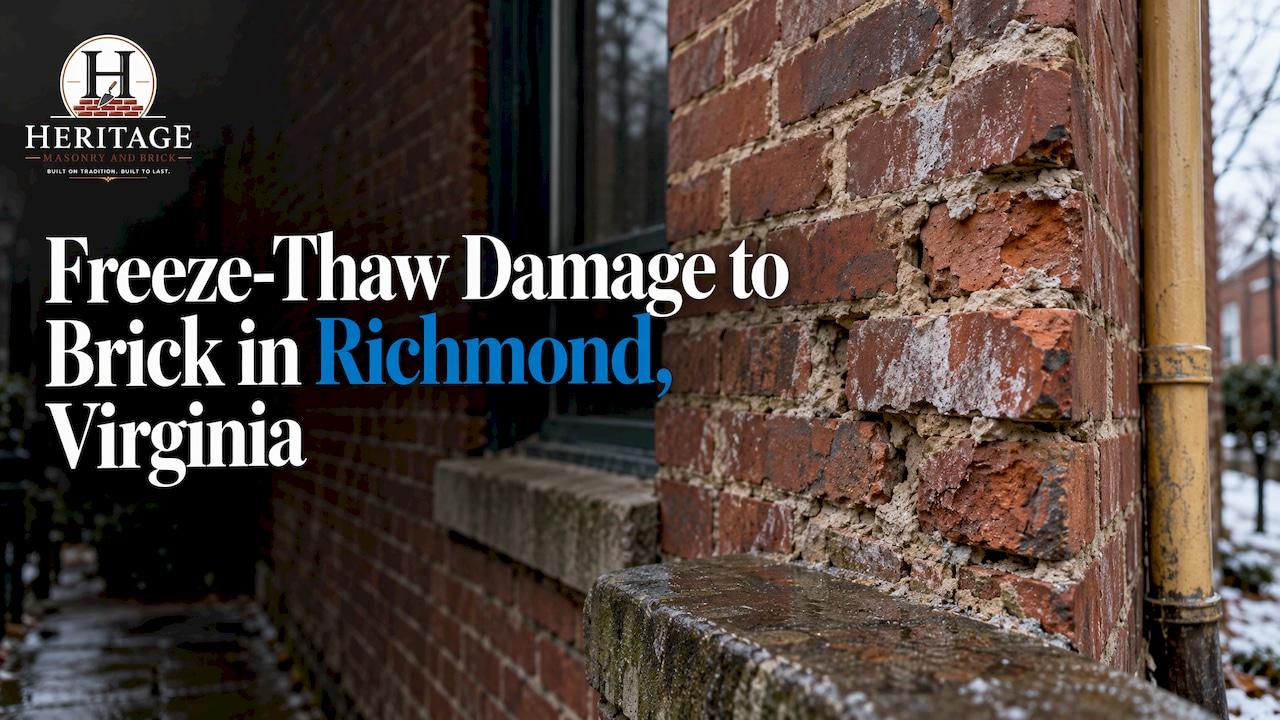
Freeze-thaw damage happens when water gets into brick or mortar, freezes, expands and pushes the material apart. Virginia winters swing above and below freezing, so brick walls, chimneys, steps and walkways in Richmond take that stress again and again. The fix is rarely a coating or a quick patch. It is finding where water is getting in, then repairing the brick and joints with mortar that matches the original. That is the work we do every day at Heritage Masonry & Brick, a family of traditional masons in Richmond with over 25 years in the trade.
TL;DR
- Water that enters brick or mortar expands about 9% when it freezes, and repeated cycles enlarge the cracks and let in more water.
- Look for flaking brick faces, eroded or open mortar joints, cracks, damp stains and crumbling steps or chimney tops.
- Not every crack is freeze-thaw. Settlement and seasonal movement look similar, so cracks need to be assessed before they are repaired.
- Old Richmond brick is often soft and was laid in lime mortar. Repointing with a harder, stronger mortar can make it spall, so the mortar must match.
- Gutters, downspouts and ground drainage are the first line of defense against recurring wetting.
Table of Contents
- What a freeze-thaw cycle does to brick
- Why older Richmond brick is exposed
- Signs of freeze-thaw damage on your property
- Is it freeze-thaw, or something else?
- How freeze-thaw damage to brick is repaired
- Why lime mortar is the right answer for old brick
- Chimneys, steps, patios and retaining walls
- Reducing the risk of the next winter's damage
- Brick repair in Richmond, with a guarantee
- Our perspective
- FAQ
- Sources
What a freeze-thaw cycle does to brick
Brick looks solid, but it is porous. Tiny voids run through each brick and through the mortar between them. When rain, melting snow or runoff fills those voids and the temperature drops below freezing, the water turns to ice. Frozen water has about 9% more volume than liquid water, according to the NIH Office of Research Facilities. Inside a rigid material with nowhere to go, that expansion creates pressure.
One cycle may do nothing visible. The trouble is repetition. Each freeze widens the voids a little, which lets in more water on the next wet spell, which expands again at the next freeze. The same NIH bulletin describes this cumulative effect: repeated cycles enlarge voids, allow additional water to collect and cause further cracking.
That is why a Virginia winter that hovers around freezing can be harder on masonry than a steadily cold one. Water gets in during the thaw, and it freezes again overnight.
Why older Richmond brick is exposed
Much of Richmond's best housing stock is historic brick: rowhouses and townhouses in the Fan District, the Museum District and along Monument Avenue, plus older commercial buildings downtown. These walls were built with materials and methods that behave differently from modern construction.
Guidance from the City of Petersburg, which faces the same Virginia weather and building types, notes that water entering masonry through deteriorated mortar joints or cracks can cause damage. It also warns that high-strength repointing mortar can cause soft-fired brick to spall when wet during freeze-thaw events, particularly in buildings from before 1900.
That second point matters for owners of historic property. In a traditional wall, the mortar was designed to be the softer, sacrificial part. Moisture and movement work through the joints first, and the joints can be repaired without losing the brick. Put a harder mortar in those joints and the brick takes the stress instead. The faces of the brick flake off, and that damage cannot be repointed away.

Signs of freeze-thaw damage on your property
Walk the outside of the building after a cold, wet stretch and look closely at the following.
- Spalling. The outer layer of a brick flakes, peels or pops off, leaving a rough, recessed face. The NIH bulletin lists surface spalling as one of the two main forms of damage, alongside internal cracking. Internal cracking may not show on inspection at first and can later reach the surface.
- Eroded or open mortar joints. Joints that are recessed, sandy, crumbling or separated from the brick are open doors for water.
- Cracks. Hairline cracks through joints and brick, especially around chimneys, parapets, sills and steps.
- Moisture clues. Virginia's Department of Historic Resources lists cracked masonry, eroded mortar joints, wet stains, mold, mildew, flaking paint and musty odors among the signs of uncontrolled moisture.
- Exposed horizontal surfaces. Brick steps, walkway edges, patios, chimney tops and retaining wall caps hold water longest, so they tend to show wear first.
If you manage a commercial building, add parapets, window heads and any spot where a downspout or roof edge drops water onto the wall.
Is it freeze-thaw, or something else?
A cracked wall does not automatically mean freezing is the cause. The National Park Service explains that brick cracking can come from freeze-thaw, foundation settlement, thermal and moisture movement, or corrosion, so the cause has to be found before the repair is chosen.
The NPS also notes that cracks caused by seasonal expansion and contraction may widen in cold weather and narrow in hot weather. Watching a crack over several months helps show whether it is active.
This is the reason repairs go in a set order. Determine the nature and source of the cracking first. Structural repairs come before cosmetic ones. A wall that is moving needs the movement dealt with before any new mortar goes in, or the new joints will crack the same way. When a crack runs through several courses, shows a step pattern, or sits near a settling foundation, it calls for a structural look, not a cosmetic patch. Our structural brick and masonry repairs cover exactly that, and a free estimate is the way to get a mason's eyes on it.
How freeze-thaw damage to brick is repaired
The right repair depends on what failed. Here is what the sequence looks like on a typical historic Richmond wall.
1. Find and stop the water source
A failing gutter, a cracked downspout, a roof leak or soil piled against the foundation can keep one section of wall wet all winter. Repairing brick without fixing the source invites the same damage again.
2. Repoint only where joints have failed
Virginia DHR's repointing guidance says to repoint joints that are open, deeply eroded, cracked or separated, and that firm, intact joints eroded less than one-third inch should generally be left alone. It also cautions that soft mortar in an old building is not by itself a reason to replace it, since original lime mortar is expected to be softer than many modern mortars.
Targeted repointing keeps as much original fabric as possible. Our brick repointing and tuckpointing work centers on this approach, and our guide on when to repoint brick explains the urgency levels.
3. Remove old mortar carefully
Petersburg's guidance recommends removing loose, deteriorated mortar with hand tools rather than power tools. Aggressive grinding chips the brick edges and widens the joints, which changes how the wall looks and sheds water. On a wall that is already stressed by frost, clean edges matter.
4. Match the new mortar to the old
The replacement should match the original in strength, texture, color, joint width and tooling profile, per the same Petersburg guidance. The NPS adds that joint width and tooling should match the historic appearance and that mortar should not be smeared beyond the joints onto the brick faces.
On every repair, we match the existing brick and mortar so the work blends in. Mortar color and tooling are the details people notice from the street, and they are the details that separate a repair that disappears from a patch that shows for years. Our guide on how to match mortar to brick walks through it, and historic mortar analysis shows what a sample can tell you before work begins.
5. Replace brick that has spalled through
When the face of a brick has gone, repointing alone will not restore the wall. Damaged units are cut out and replaced with brick that matches the originals in size, color and texture. See our brick repair service.
Why lime mortar is the right answer for old brick
The University of Mary Washington's historic preservation program notes that older brick mortar is typically lime- and sand-rich and that replacement mortar should not be stronger than the original. It also advises against synthetic caulking as a substitute for repointing mortar.
The NPS puts the same idea in terms of three properties: match the existing mortar's color, hardness and permeability, and avoid hard mortar that can accelerate deterioration of the masonry.
Three words in that guidance deserve plain explanations:
- Lime mortar is a mix of lime and sand, sometimes with a small amount of other binder, used in most masonry built before modern cement became common. It is softer than modern cement-heavy mortar.
- Permeability is how easily moisture passes through a material. Lime mortar lets moisture in a wall escape through the joints as vapor, so the brick dries out instead of holding water that can freeze.
- Hardness is how much force the mortar can bear before it cracks. If the mortar is harder than the brick, movement and frost stress go into the brick.
Lime mortar repointing is central to what we do. We use traditional lime mortar and the traditional methods old brick was built with, so that repairs last for decades. We stand behind that with a 5-year guarantee on materials and workmanship.
It also explains why coatings are not a shortcut. The NPS warns that non-permeable paint or waterproof coatings can trap moisture in deteriorated brick and speed up freeze-thaw decay, and says a deteriorated wall warrants assessment rather than simply coating it.
Chimneys, steps, patios and retaining walls
Horizontal and exposed masonry takes the hardest hits in a Richmond winter, because water sits on it and freezes there.
- Chimneys. The top of a chimney is exposed to rain, wind and snow on every side. Crumbling joints, loose bricks and cracked crowns let water into the stack. Our chimney repairs address those.
- Steps. Front stoops collect water in joints and at the tread edges. Worn or loose treads are also a trip hazard. See our brick steps and step repair work.
- Patios and walkways. Settling and open joints let water under the surface, where frost can lift and loosen brick. We build and restore brick patios and walkways.
- Retaining walls and foundations. Water pressure behind and through the wall, plus frost, can push sections out of line.
If you are planning new outdoor brickwork, such as a patio, walkway or garden wall, building it to shed water is the best protection against frost. Our new brickwork service covers that.
Reducing the risk of the next winter's damage
Keeping water out of the wall is the most effective protection. Virginia DHR's moisture guidance puts routine water-shedding and drainage maintenance first. Its recommendations include:
- Keep roofs and gutters weather-tight and operational. Inspect gutters at least twice a year, depending on nearby trees, and roofs yearly.
- Eliminate low spots around foundations.
- Clean downspout boots twice a year and add extensions that carry water away from the building.
- Keep foliage and vines off the building.
- Repair missing or damaged roofing and cracked downspouts.
The NIH bulletin adds sound parapets, copings, roof edges, overhangs and drip edges to control rain and snow entry, and ground that is well drained and sloped away from the structure.
For property managers, a simple annual walk-around in late fall, before the first hard freeze, catches open joints and failed flashings while repairs are still straightforward. For owners of historic homes, the same walk-around is the cheapest way to find a problem while it is still a small repointing job. Our freeze-thaw plan for homeowners goes deeper on prevention.

Brick repair in Richmond, with a guarantee
If you have spotted flaking brick, open joints or a crumbling chimney or step, the next move is to have a mason look at it before another winter works on it. Heritage Masonry & Brick repairs brick on homes and businesses across Richmond, from historic rowhouses in the Fan and Museum District to properties in Henrico County. Estimates are free, there are no deposits, and you pay on completion. The work carries a 5-year guarantee on materials and workmanship.

To book a free estimate, call 804-324-6304 or start from our masonry restoration and repair page.
Our perspective
Most of the freeze-thaw damage we see in Richmond is the result of a second mistake, not the first. Water got into an old wall, which is normal. Then someone repointed with the wrong mortar, or sealed the face, and the brick paid for it.
Old brick was built to breathe. Lime mortar is the part of the wall that is meant to give way first, and it is the part we can renew. That is why we use traditional lime mortar and the methods old brick was built with, and why we match the existing brick and mortar on every repair. When the repair matches, it lasts, and it looks like it was always there.
We are a family business, and we put our name behind the work: a 5-year guarantee on materials and workmanship, free estimates, no deposits and payment on completion. If you own historic brick in the Fan, the Museum District or along Monument Avenue, that is the standard we hold ourselves to.
Thomas
FAQ
What is considered a freeze-thaw cycle?
A cycle is one round of water entering a porous material, freezing and expanding, then thawing. In brick, the water fills pores and joints, and freezing expands it by about 9%. Many cycles over many winters cause the cumulative damage.
Can freeze-thaw damage brick in Virginia, or only in colder states?
Yes. Virginia winters regularly move above and below freezing, and that is what produces repeated cycles. Virginia's own preservation and municipal guidance warns about moisture and freeze-thaw damage to historic masonry, especially in older, soft-fired brick.
Is a crack in my brick wall always freeze-thaw damage?
No. The National Park Service lists freeze-thaw, settlement, thermal and moisture movement and corrosion as possible causes. A mason should assess the crack, and structural repairs come before cosmetic ones.
Why does the mortar type matter when repointing?
Mortar that is harder than the brick pushes stress into the brick, which can then flake. Match the original's color, hardness and permeability. In older Richmond buildings that usually means lime mortar.
Should I seal or paint damaged brick to protect it?
Not without an assessment. Non-permeable paint and waterproof coatings can trap moisture in deteriorated brick and speed up freeze-thaw decay. Repairing the joints and the water source protects the wall properly.
Sources
- The Freeze-Thaw Cycle in Concrete and Brick Assemblies, NIH Office of Research Facilities
- Common Problems with Brick Masonry, National Park Service
- The Basics of Moisture Problems, Virginia Department of Historic Resources
- Repointing Mortar, Virginia Department of Historic Resources
- Appropriate Materials, City of Petersburg
- Materials, University of Mary Washington Historic Preservation