
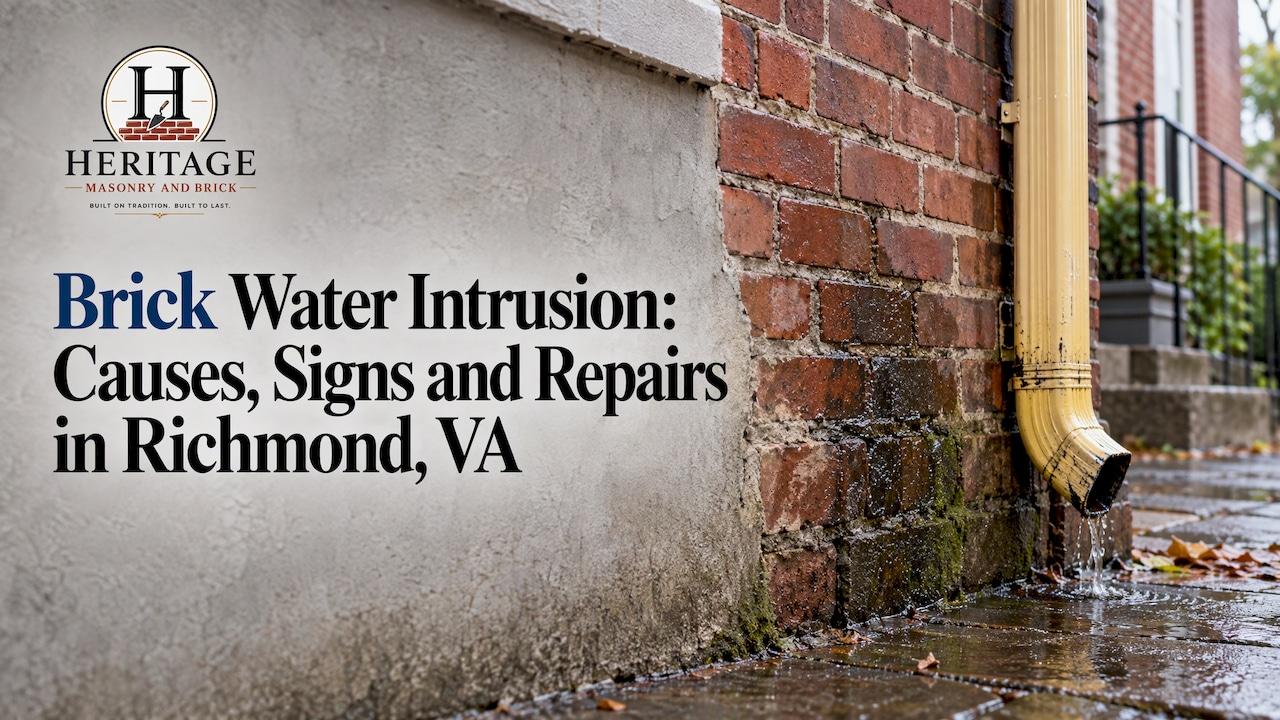
Water gets into brick walls mainly through the thin gaps where mortar and brick meet, not through the brick itself. In Richmond, Virginia, where many homes carry 100-year-old brick, failing mortar joints are the usual entry point. The lasting fix is to find the path the water takes, repair it with mortar that suits the brick, and keep the wall able to dry out. Below, we explain how moisture moves through brick, the signs to look for, what to do first and how a proper repair is done.
TL;DR
- Brick walls take on water through tiny separations between brick and mortar, so cracked, receding or crumbling joints are the first place to look.
- Damp spots on interior walls, white powder (efflorescence) and loose bricks all point to moisture moving through the wall.
- Do not paint or seal a wet wall. Coatings can trap moisture behind them and speed up decay.
- Repointing with lime mortar that matches the original is the repair we recommend for older Richmond brick.
- Call Heritage Masonry & Brick at 804-324-6304 for a free estimate. Our work carries a 5-year guarantee on materials and workmanship.
Table of Contents
- How water gets into a brick wall
- Signs of moisture in a brick wall
- What to do first when water is coming through
- Finding where the water enters
- How we repair water intrusion in brick
- Brick repair for Richmond homes and businesses
- Our perspective
- Preventing moisture damage in Richmond brick
- What water damage repair can cost
- FAQ
- Sources
How water gets into a brick wall
Brick looks solid, but a brick wall is a system of brick units, mortar joints, flashing and drainage details. The Brick Industry Association (BIA) explains that when water passes through brick masonry, it typically does so through minute separations between the brick units and the mortar joints. Under normal exposure, very little passes straight through sound brick or sound mortar.
Research from Canada's National Research Council points the same way: in most cases of rain penetration, leakage takes place between the brick and the mortar. During a storm, air pressure on the wet outside face is usually higher than on the inside, which pushes rain through any pathway it finds.
Three forces move water through those gaps:
- Wind-driven rain. Pressure forces water into joints and hairline separations.
- Capillary action. The University of Waterloo's Building Engineering Group notes that capillarity can pull water into very small openings without any external driving force. Narrower cracks pull harder.
- Gravity. The same group identifies water running down through cracks and openings under gravity as the most common cause of serious problems. Missing flashing around windows, doors and other openings makes this worse.
Old solid brick versus newer veneer
Historic masonry walls were built differently from modern ones. The BIA notes that older walls served as both structure and exterior skin, from 12 inches to 6 feet of solid brick, and that their sheer mass kept water out. The wall absorbed moisture and later released it as vapor.
That is the key to many Richmond rowhouses and Fan District homes. Their walls were designed to absorb and then dry. Modern drainage walls work another way: they assume rain will get past the outer layer, then collect it on flashing and send it out through weep holes. If you want detail on that system, see our guide to through-wall flashing for brick and our article on weep holes in brick.
Not every leak starts outside
The Virginia Department of Historic Resources lists five common sources of unwanted moisture in older buildings: exterior moisture through deteriorating materials, ground moisture from runoff, leaking pipes or equipment, interior household moisture, and water from maintenance or construction materials. A damp wall can come from a failing joint, but it can also come from a gutter, a downspout or a plumbing leak. Sorting these out is part of any good repair.
Signs of moisture in a brick wall
Most homeowners notice the symptom inside before they see the cause outside. This Old House lists the signs that moisture is moving through failing mortar: damp spots or water stains on interior walls next to brick exteriors, white powdery efflorescence, and cracking or crumbling mortar. The same article adds two more warning signs: joints receding more than 1/4 inch from the face of the brick, and loose or missing bricks.
In practice, we see these most often in Richmond:
- Stained or bubbling plaster and paint on the inside of an exterior brick wall
- Mortar that rubs off as sand when you touch it
- Joints recessed well behind the brick face
- Bricks with flaking or peeling faces
- White deposits on the surface, especially after rain and drying
- A musty smell near the base of a wall or in a basement
What efflorescence tells you
Efflorescence is not the damage itself. It is a clue. The BIA defines it as white deposits left when moisture carrying dissolved salts evaporates at the brick surface. The BIA also says water ingress in the area should be investigated and resolved before cleaning, or the deposits will come back. Our guide on efflorescence on brick goes through what the patterns mean.

What to do first when water is coming through
The first hours are about safety and limiting damage, not repair.
- Make the area safe. Cornell's environmental health office advises that affected electrical equipment be turned off, unplugged, moved to higher surfaces and covered where applicable. If water is near outlets, call a licensed electrician.
- Photograph everything. Date-stamped photos of the wall, the stains and the exterior help with any insurance claim and help us diagnose the cause.
- Dry the inside. The same Cornell guidance says water-damaged building materials should ideally be addressed within 48 hours to prevent excessive mold growth. The University of Vermont's program gives the same 48-hour window for cleaning and drying wet or damp spots.
- Do not seal the wall yet. Painting over a wet wall or smearing on a cement patch hides the entry point and can hold moisture inside.
- Call a mason. Once the wall has dried and the weather allows, a specialist can trace the source.
Finding where the water enters
A leak you see inside is rarely directly behind the opening outside. Water can travel along a ledge, down a cavity or along a lintel before it shows up. A careful inspection covers:
- Mortar joints. Cracked, hollow, sandy or recessed joints, especially on the side that takes the most wind-driven rain.
- Brick faces. Spalling or flaking, which lets water into the softer core.
- Openings. Window heads and sills, door heads, balcony and porch connections, and any missing or failed flashing.
- Roof and gutters. Overflowing gutters and leaking downspouts can soak one wall repeatedly.
- Ground level. Soil piled against the wall, low spots and splash-back from hard surfaces.
- Chimneys. Exposed on all sides, they take more weather than any other brick on the house. See our guide to chimney waterproofing for brick.
The Virginia DHR also recommends a hose test to check surface drains, plus checking irrigation, hose bibs and air conditioning drain outlets for leaks. Some of the most troublesome damage in older buildings comes from inside, from equipment and daily use of the building.
How we repair water intrusion in brick
The repair depends on the cause. In most cases we see in Richmond, it starts with the mortar joints.
Repointing: the standard fix for failed joints
The BIA describes two ways to repair mortar joints, face grouting and repointing, and says repointing is generally recommended because it suits more types and severities of deterioration. Repointing means cutting out the damaged mortar to a sound depth and packing in fresh mortar, so the joint is repaired rather than coated.
We do this work by hand with traditional methods. You can read more about our repointing and tuckpointing service, and our guide on when to repoint brick explains urgency levels and the questions to ask any contractor.
Why lime mortar matters for older Richmond brick
Most brick built in Richmond before the early 20th century was laid in lime mortar. Lime mortar is made from lime and sand, and it is softer and more porous than modern Portland cement mortar. That softness is the point. Moisture inside a wall leaves as vapor, and it needs a path. In an old wall, the path should be the mortar joint, not the face of the brick.
The SPAB, a respected conservation body, advises that for buildings dating from before about 1919, lime mortar, not cement, should be used to minimize evaporation through the bricks and the resulting damage to their faces. Its guidance is from the UK, but the physics of soft historic brick and hard cement is the same on a Richmond street.
Why this matters in practice:
- Lime mortar is softer than old brick. The joint takes the stress of movement and weather, so the brick does not.
- Lime mortar breathes. Moisture can evaporate through the joints and leave the wall dry.
- Hard cement mortar can force water out through the brick. Over time that can peel the face off the brick, which then absorbs even more water.
- Lime mortar can be matched. The sand, the lime and the tooling can all be matched to the original joints so the repair blends in.
On every repair we match the existing brick and mortar, in color, texture and joint profile, so the work blends in and lasts for decades.
Replacing damaged brick
Not every brick needs to come out. SPAB says only severely damaged bricks should be cut out and replaced, and that replacements should match the originals in size, color, texture and durability and be laid in the same bond. That is how we approach it. For cracked walls, bulging sections or failing lintels, our structural brick and masonry repairs address the underlying movement as well as the surface. For individual bricks and damaged faces, see our brick repair service.
Why sealing the whole wall is the wrong move
It is tempting to roll a waterproof sealer over leaking brick. The National Park Service warns that waterproofing brick with chemicals or painting with non-permeable coatings accelerates decay by trapping moisture behind the coating. Utah's State Historic Preservation Office makes the same point: water will always get in somewhere, so the goal is letting moisture escape efficiently, since trapped water that freezes expands and cracks the brick.
The NPS also notes that abrasive cleaning such as sandblasting removes the hard wearing surface of the brick and exposes the softer core to water and freeze-thaw action. If your brick has been cleaned that way, repair needs extra care.
Fine Homebuilding makes a point worth remembering: most water infiltration can be prevented but not all of it, and the real key is how water flow is managed once it gets behind the brick. Good repair means sound joints, working flashing and clear weep holes together.

Brick repair for Richmond homes and businesses
Heritage Masonry & Brick is a family of traditional masons with over 25 years in the trade, working on homes and businesses across Richmond, Virginia. We repair brick where water is getting in, joints are loose or crumbling, walls are cracked or steps are worn. Our work includes lime mortar repointing, structural repairs, chimneys, and new brick steps, patios and walkways.
We offer free estimates, require no deposit and ask for payment on completion. Our work carries a 5-year guarantee on materials and workmanship. Call 804-324-6304 today, or see our Masonry Advice page and our historic brick repair in the Fan and Museum District.

For chimneys, retaining walls and wider restoration projects, start at Heritage Masonry & Brick and tell us what you are seeing.
Our perspective
Most of the brick walls we are called to in Richmond have a simple story. The mortar wore out first, water found the joints, and the brick began to suffer behind them. Fixing that early costs far less than fixing it after the brick faces have given way.
We do not believe in coating a wall to hide a problem. Old brick was built to breathe, and our repairs respect that. We use traditional lime mortar, match the existing brick and joint style, and cut out only what has failed. The goal is a repair that blends in and keeps working for decades, not a patch that needs redoing in a few years.
That is also why we offer a 5-year guarantee on materials and workmanship, take no deposit and ask for payment only when the job is done. If you can see damp, crumbling joints or white staining on your brick, have us look at it before the next hard rain.
Thomas
Preventing moisture damage in Richmond brick
Prevention comes down to moving water away from the wall and keeping the masonry in good repair. The BIA says water resistance depends on four factors: design and detailing, materials, construction and maintenance, and a weakness in any one can cause leaks.
A simple yearly routine, based on Virginia DHR guidance:
- Keep the roof and gutters weather-tight, and inspect gutters at least twice a year and the roof yearly.
- Clean downspout boots twice a year and add extensions that carry water away from the building.
- Fill low spots around the foundation so water slopes away from the wall.
- Walk the exterior each spring and fall, looking at joints, window heads and the base of walls.
- Keep plants and soil from piling against brick.
Grading matters outside the home too. These drainage-first steps for driveways show the same principle of sending water away from where it can do harm.
Richmond's mix of humid summers, heavy storms and winter freeze-thaw cycles is hard on soft historic brick, so joints that look minor in fall can let in a lot of water by spring. If you are seeing the early signs, our guides on water leaking through brick and a crumbling brick wall cover what to check next.
What water damage repair can cost
Brick repair prices depend on the wall, access, the extent of the failed mortar and how much brick must be replaced, so we provide free estimates after seeing the work. For general context, one 2026 cost guide puts water damage restoration at $3 to $7.50 per square foot, with total projects from $1,300 to $6,500. That covers restoration in general, not masonry specifically, and it varies with the source and severity of the damage. The same logic applies to brick: repairing joints early is the way to avoid larger interior damage.
FAQ
What happens if water gets behind brick?
Water that stays behind brick can stain and damage interior walls, feed mold and wear away mortar and brick faces. In winter, trapped water can freeze and crack the brick. Modern drainage walls are designed to send that water out through flashing and weep holes, so a blocked path is a common cause of trouble.
Can a brick wall be fully waterproofed?
Not realistically. Preservation guidance says water will always get in somewhere, and that the goal is letting it escape. Sound mortar joints, working flashing, clear weep holes and good drainage do more than a surface coating, which can trap moisture behind it.
How do I know if I need repointing?
Look for cracked or crumbling mortar, joints recessed more than 1/4 inch, loose bricks, white powder on the surface and damp spots on interior walls. If you see any of these on a Richmond home, call us at 804-324-6304 for a free estimate and we will check the joints.
Why use lime mortar on old brick?
Lime mortar is softer and more breathable than cement mortar. On historic brick it lets moisture leave through the joints instead of through the brick faces, which protects the brick. We use it on older Richmond homes and match it to the original mortar.
Sources
- Brick Mortar Repair in 6 Steps, This Old House
- Water Penetration Resistance: Design, Brick Industry Association
- Maintenance of Brick Masonry, Brick Industry Association
- Rain Penetration of Walls of Unit Masonry, National Research Council Canada
- Rain penetration, University of Waterloo Building Engineering Group
- The Basics of Moisture Problems, Virginia Department of Historic Resources
- Responding to Water Damage and Preventing Mold Growth, Cornell EHS
- Water Intrusion Written Program, University of Vermont
- A guide to the repair of old brick walls, SPAB
- Common Problems with Brick Masonry, U.S. National Park Service
- Let That Brick Breathe, Utah State Historic Preservation Office
- Flashing Brick-Veneer Walls, Fine Homebuilding
- Water Damage Restoration Costs, Modernize
- Gravel driveway drainage-first steps