
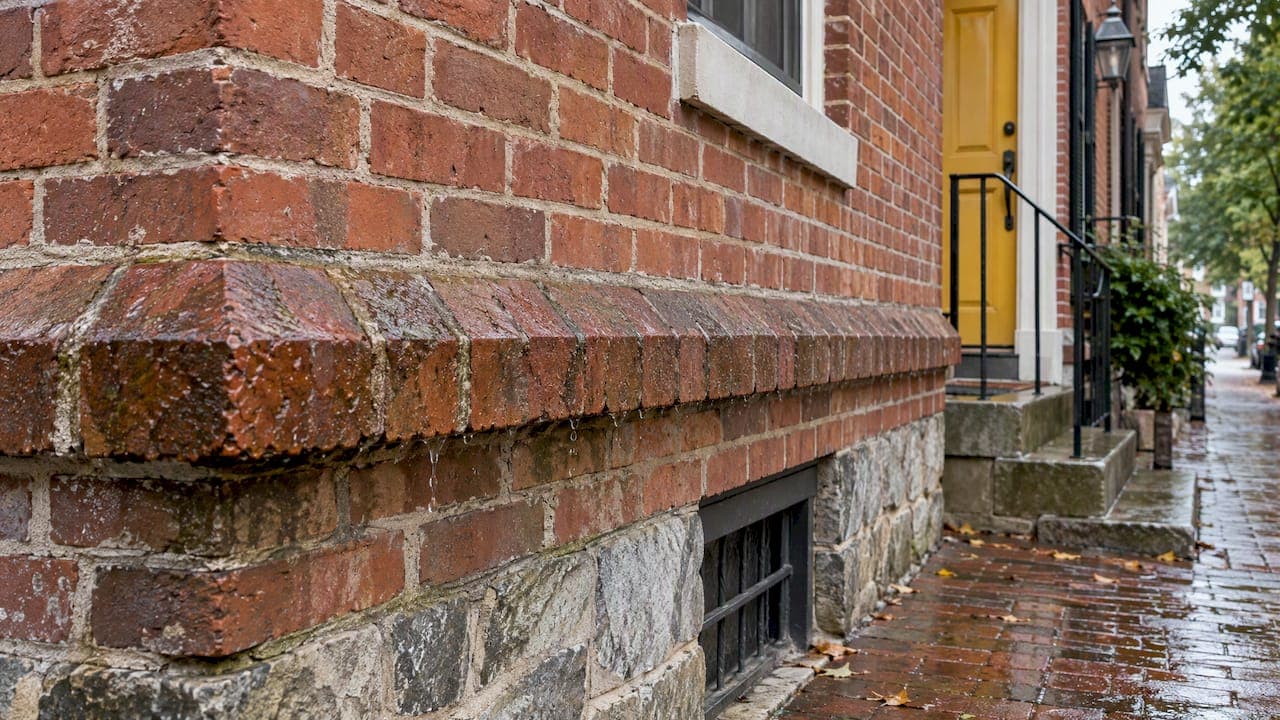
A brick water table is the ledge of masonry that projects from the lower part of a wall, just above the ground. It marks the line where the foundation ends and the main wall begins, and its job is to shed rain away from the base of the house. When it is built and maintained correctly, it protects the wall below. When the mortar fails, the slope reverses or the flashing behind it is missing, it does the opposite: it collects water and passes it into the wall.
This guide explains what a water table is, the common brick profiles, how the drainage details behind it work, the signs of failure, and what repair involves. We are a masonry contractor in Richmond, so we also cover what we see on older Richmond brick houses.
TL;DR
- A water table is a projecting course of brick near the base of a wall. It sheds water outward and visually separates the foundation from the wall above.
- Brick is porous, so the water table cannot work alone. It depends on sloped surfaces, sound mortar joints, flashing and weep holes.
- Crumbling mortar, standing water on the ledge, efflorescence and damp interior walls near the floor are the usual warning signs.
- Most repairs are repointing and replacing damaged units with matched brick. Rebuilding is only needed when the course is loose or the structure behind it is wet.
- We offer free estimates and a 5-year workmanship guarantee on Richmond brick repairs. Call 804-324-6304.
Table of Contents
- What a brick water table is
- Common brick water table profiles
- Why the water table cannot work alone
- Signs your water table is failing
- What causes water table damage
- Repair or rebuild: how we decide
- Our perspective on water tables
- When a water problem becomes a foundation problem
- Care and prevention
- Having your water table repaired in Richmond
- FAQ
- Sources
What a brick water table is
The term describes a projection of masonry on the lower outside of a wall, slightly above the ground, or at the top of a wainscot section. The name has nothing to do with groundwater. It is the same word "water" as in water-shedding: the ledge throws rain off the wall face so it does not run straight down into the foundation joint.
On a typical brick house you see it as a band one or two courses tall, stepped out a few inches from the wall above. Below it sits the foundation, often parged or built of brick as well. Above it sits the main wall. Some houses use the water table as the transition between brick and a different siding material, but on an all-brick house it is a design feature and a drainage feature at once.
It is not new. Virginia's historic register notes, for example, an early-19th-century house in Pittsylvania County where rounded bricks cap the top of the water table. Many Richmond rowhouses and townhouses in the Fan, the Museum District and along Monument Avenue have the same feature, and their water tables have had a century or more of rain, frost and splash-back to deal with.
Common brick water table profiles
Brick manufacturers sell special shapes made for this course. You will see three broad approaches on houses.
| Profile | How it is built | What to know |
|---|---|---|
| Rowlock | Standard-size brick turned on its long edge and set in a course, often with a sloped top or a bullnose edge | The most common on older houses. Manufacturers list rowlock water table shapes including stock-molded units and corner pieces. |
| Ogee or molded | A shaped brick with a curved profile that steps out from the wall | Decorative and traditional. General Shale lists its ogee rowlock water table in modular and larger sizes. |
| Header or on-the-flat | Brick laid flat and projected out from the wall face, sometimes with a sloped or beveled unit | Gives a subtler step. Glen-Gery's shapes catalog groups water tables into on-the-flat and rowlock types. |
In practice, the profile matters less than the slope. A practitioner note in a General Shale technical bulletin makes the point that a detail only succeeds if its ability to shed and drain water is not given up for looks. A water table that looks traditional but has a flat or backward-sloping top can hold water against the wall.
Why the water table cannot work alone
Brick is not waterproof. It is a porous clay product that absorbs moisture and releases it again as it dries. Spec guidance on fired brick shows how much water it is expected to take on: under ASTM C62, Grade SW brick limits average boiling absorption to 17%, and Grade MW to 22%. Those numbers describe a material that handles moisture, not one that blocks it.
Because of that, a modern or well-built brick wall relies on a drainage system behind the face. The Building America Solution Center advises installing flashing at the bottom of exterior walls and integrating it with the other water management details so water is directed down and out of the wall. In a brick veneer wall that means:
- Flashing under the first course of masonry above grade, and at other support points.
- Weep holes immediately above the flashing, spaced at a maximum of 33 inches on center and at least 3/16 inch in diameter, so water trapped in the air space can exit.
- An air space between the brick and the sheathing, kept clear of mortar droppings.
- A sloped, sound water table course that sends the water that lands on it outward.
The City of Fairfax publishes a brick veneer detail showing flashing with weep holes at 33 inches on center maximum at the base of a veneer wall. It is a useful picture of the layering, even though your own house may be older and built differently.
Older Richmond houses are often solid, multi-wythe brick with no cavity and no flashing at all. They manage water by absorbing and releasing it, which is why the mortar matters so much. We cover that below.
Signs your water table is failing
Walk around the house after a rain, or on a dry day with a flashlight, and look at the lowest brick courses. These are the signs we look for:
- Mortar that is sandy, recessed or missing. Open joints let water into the wall and the core of the course.
- Cracked, spalled or loose bricks on the projecting course. The exposed top and front take the most weathering.
- Standing water or staining on the ledge. If it stays wet long after rain stops, the slope is wrong or the joints are open.
- White, powdery efflorescence on the water table or the wall just above it. It means water is moving through the masonry and carrying salts out.
- Gaps where the water table meets the foundation or siding. Failed sealant or mortar here sends water behind the wall.
- Damp plaster, peeling paint or musty smells inside, low on the wall near the baseboard.
- Soil or mulch piled against the course. Grade that is too high buries the water table and hides weep holes, so it cannot do its job.
If you see standing water or dampness that keeps returning, our guide to water leaking through brick walks through the causes. For the weep holes themselves, see how to inspect, fix and maintain weep holes in brick.
What causes water table damage
Mortar failure
Mortar is the sacrificial part of a brick wall. It is meant to wear before the brick does. On a water table, the upward-facing joints take the most water, so they fail first. Once a joint opens, water enters, freezes in winter and pushes the joint and the brick face apart. Richmond sees regular freeze-thaw cycles, which speed this up.
Hard mortar on soft brick
Many older Richmond houses were built with soft, historic brick and lime mortar. A past repair with hard Portland cement mortar can trap moisture in the brick, because the brick becomes the weaker path for water to leave. The result is spalling faces, not damaged mortar. Matching the mortar to the brick is the single most important decision in a historic repair.
Wrong slope or an ornamental detail
As the General Shale bulletin notes, shaped courses such as ogee or header rowlocks can look right and still trap water when the slope is incorrect. This tends to show up where a past owner replaced a course with plain brick laid flat, or where a new addition copied the look but not the function.
Missing flashing or blocked weep holes
On a cavity or veneer wall, a missing flashing or weep holes sealed by paint, caulk or mortar will force water to stay inside the wall. It often shows up as damp low on an interior wall, not as visible damage at the water table itself.
Grade, gutters and splash-back
Downspouts that discharge at the foot of the wall, a patio that slopes toward the house, or soil raised above the water table all deliver water to exactly the spot the course is trying to protect. If you have a brick patio next to the wall, our brick patio drainage guide shows how to check where the water goes.
Repair or rebuild: how we decide
The first question is how deep the problem goes. We look at the mortar, the brick faces, the slope of the course, the flashing and weep holes where they exist, and the moisture condition of the wall behind. If you want to understand what a moisture reading means, we explain it in brick moisture testing for homeowners.
| Condition | Typical repair |
|---|---|
| Worn joints, bricks sound | Repointing: grind out failed mortar and repack with matching mortar |
| A few cracked or spalled units | Replace with matched brick, then repoint around them |
| Loose or displaced course, wrong slope | Take down and rebuild the course with correct slope and bedding |
| Water entering behind the face | Investigate flashing, weep holes and drainage; correct before closing the wall |
| Foundation cracking or movement below | Structural assessment first; see structural brick and masonry repairs |
A few notes on each.
Repointing. Mortar is removed to a consistent depth, the joints are cleaned, and new mortar is packed in and tooled. The new mortar must be no harder than the brick. On historic brick, that means lime-based mortar. Cement-heavy mortar is the wrong fix on soft old brick, however long it lasts.

Brick replacement. Water table bricks are often shaped units, and old ones are not always in production. Matching size, color, texture and profile is slow work. Good matching is what makes a repair look like it was always there.
Rebuilding. Where the course is loose, we take it down, check what is behind it, and rebuild with the correct slope. This is the moment to fix flashing or drainage, because the wall is open.
Parging below. The foundation just below the water table is often parged. A cracked or detached parge coat lets water into the foundation wall. Our guide to parging a brick foundation explains the mortar type and when a pro should do it.
Our perspective on water tables
We are a family-run masonry company, and historic brick restoration is what we do. Water tables are one of the places where we see the most avoidable damage, and nearly all of it comes back to the same few things.
First, the repair has to match the wall. We carefully match existing brick and mortar and use traditional lime mortar for lasting repairs on older brick. A water table patched with the wrong mortar looks fine for a year or two and then starts taking the bricks with it.
Second, we do not treat the water table as a trim detail. It is a piece of drainage. When we are on site we check the slope of the top, whether water is running off or sitting, how the grade meets the course, and whether downspouts are dumping at the base. Fixing mortar and ignoring a downspout is how a repair fails in three winters.

Third, a repair should be priced and guaranteed plainly. We give free estimates, ask for no deposit, and are paid when the work is complete. We back materials and workmanship with a 5-year guarantee, because we expect the work to last well beyond that.
Fourth, we tell you when the problem is bigger than the brick. If water has been getting in for years, the damage may reach the framing, the floor system or the foundation. That is a different conversation, and it is better to have it early.
— Thomas
When a water problem becomes a foundation problem
A failing water table is cheap to fix compared with what follows when water keeps entering at the base. Wet masonry, settling soil and movement in the foundation wall can start to show as stair-step cracks, doors that stick and floors that slope. If that is where you are and you are weighing a sale rather than a repair, this overview of selling a house with foundation problems explains the options a seller faces. If you plan to stay, our brick foundation repair guide covers what repair involves and what to ask a contractor.
Care and prevention
You can extend the life of a water table with a few habits. None of them require climbing a ladder.
- Keep the grade down. Soil, mulch and gravel should sit below the water table and well below the weep holes.
- Move the water away. Extend downspouts so they discharge several feet from the wall, and check that gutters are not overflowing at the corners.
- Look at the joints each spring. Probe with a key. If mortar crumbles or the tip sinks in easily, it is time to have it checked.
- Do not seal the wall. Paint, caulk and film-forming sealers can trap moisture. Never fill weep holes.
- Cut back plants. Ivy and shrubs hold moisture against the brick and push into joints.
- Fix small problems promptly. A few open joints are a small job. A winter of freeze-thaw on open joints is not.
For general masonry questions, our masonry advice page collects short answers on common problems.
Having your water table repaired in Richmond
Heritage Masonry & Brick repairs and restores brick across Richmond, including historic houses in the Fan, the Museum District and along Monument Avenue. For a water table, that usually means brick repair and repointing and tuckpointing, with brick matched to the original and lime mortar where the wall calls for it.
What you get when you call:
- A free estimate
- Careful matching of existing brick and mortar
- No deposit; payment on completion
- A 5-year guarantee on materials and workmanship
Request your free estimate or call 804-324-6304 today.
FAQ
Is brick water resistant?
Brick sheds a lot of rain, but it is not waterproof. It is porous and absorbs moisture, which is why walls are designed with flashing, weep holes and sloped details so water can drain out. ASTM C62 even sets limits on how much water a given grade of brick may absorb, which shows absorption is expected.
What is water table construction?
It is a projecting course of brick, stone or similar material at the lower part of a wall, set above the ground. It is built with a sloped top so rain runs outward, and it sits above the foundation joint. On veneer walls it is paired with flashing and weep holes behind it.
Can I repair a water table myself?
Small jobs such as clearing soil from the course are fine. Repointing and replacing shaped brick are another matter. Mortar that is too hard, or a slope set wrong, will cause new damage. On a historic house we recommend hiring a masonry contractor.
How do I know whether I need repointing or a rebuild?
If the bricks are sound and the mortar is worn, repointing is usually enough. If the course is loose, cracked through, or sloping the wrong way, it probably needs rebuilding. An on-site look is the only reliable way to tell, and we offer free estimates.
Sources
- Flashing at Bottom of Exterior Walls, Building America Solution Center
- Brick Masonry Details technical bulletin, General Shale (Nov 2020)
- Water table (architecture), Wikipedia
- Fired Clay Brick Guide, SpecForge
- Brick veneer flashing and weep holes detail, City of Fairfax, VA
- Philip Craft House, Virginia Department of Historic Resources
- Rowlock water table shapes, Belden Brick
- Ogee Rowlock Watertable, General Shale
- Shapes catalog, Glen-Gery