
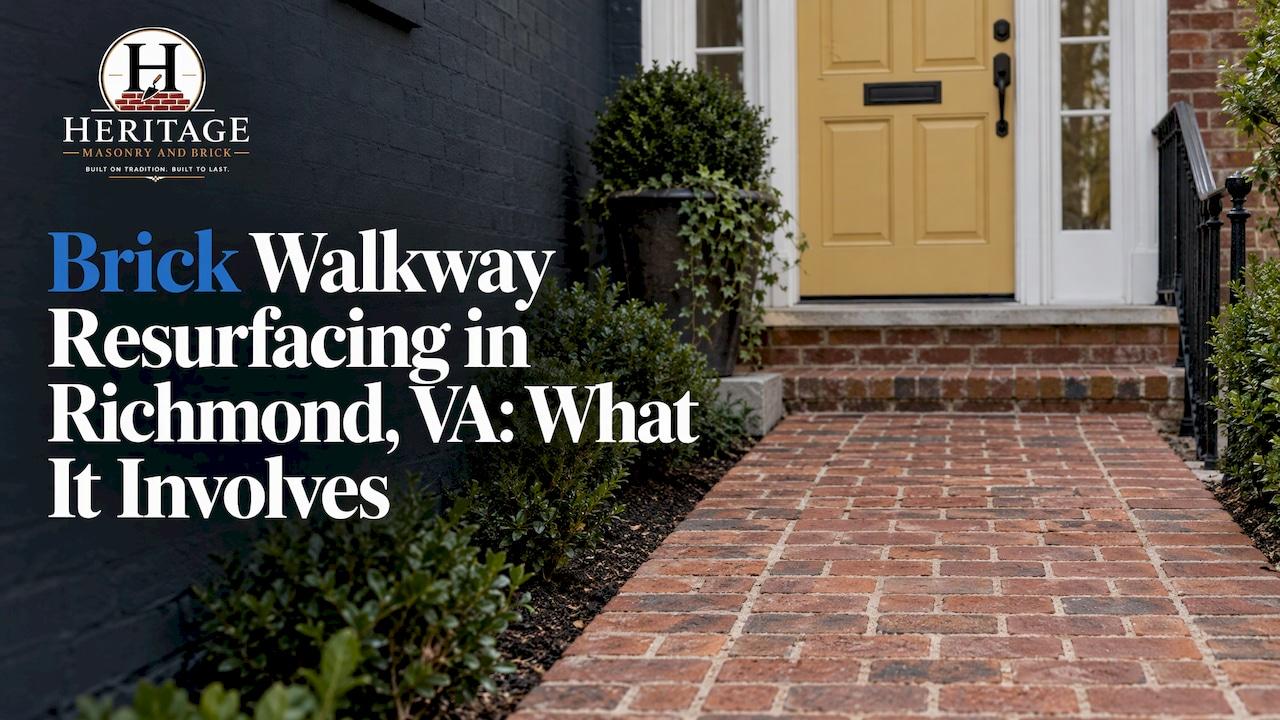
Resurfacing a brick walkway means restoring the walking surface you already have: cleaning the brick, resetting sunken or loose units, replacing damaged ones, renewing the joints and, where it suits the brick, sealing. Done properly, it saves the original brick and the look of the property. In Richmond, Virginia, where so many walks are decades or even a century old, that matters.
We are Heritage Masonry & Brick, a family of traditional masons with over 25 years in the trade. This guide explains how resurfacing works, why the mortar and the base matter more than the brick face, and how to judge what your walkway needs.
TL;DR
- Resurfacing is cleaning, resetting, replacing and rejointing the existing brick, not covering it with a new layer.
- Most failures start below the surface: a washed-out base, poor drainage or the wrong mortar. Fix the cause first.
- On older Richmond brick, joints should be filled with a softer, traditional lime mortar, not hard Portland cement mix.
- Clean with the gentlest method that works. Never use unbuffered muriatic acid.
- We offer free estimates, a 5-year guarantee on materials and workmanship, no deposits and payment on completion. Call 804-324-6304.
Table of Contents
- What brick walkway resurfacing actually means
- Repair, resurface or rebuild: how to decide
- Find the cause before you fix the surface
- How a mason prepares a brick walkway
- Sand joints or mortar joints?
- Understanding brick itself
- Sealing a resurfaced brick walkway
- Resurfacing in Richmond, Virginia
- Our perspective
- Have your brick walkway resurfaced by Heritage Masonry & Brick
- FAQ
- Sources
What brick walkway resurfacing actually means
People use "resurfacing" for a few different jobs. With a brick walk it rarely means pouring something over the top. It usually means one or more of these:
- Cleaning away moss, algae, stains, old sealer and failed joint material.
- Resetting bricks that have sunk, tilted or lifted, after repairing the base under them.
- Replacing cracked, spalled or missing bricks with a close match in size, color and texture.
- Rejointing the gaps between bricks, with sand or mortar depending on how the walk was built.
- Sealing the finished surface, when the brick and conditions call for it.
A walk that has a few low spots and tired joints is a good candidate. A walk where the base has failed over most of its length, or where water keeps undermining it, needs a deeper rebuild. Even then, the original bricks can often be cleaned and relaid, which keeps the patina that new brick lacks.
If you want the shorter, repair-focused version, see our practical guide to brick walkway repair.
Repair, resurface or rebuild: how to decide
The right answer depends on what you see and what is underneath. Here is how we sort walkways in Richmond.
| What you see | Likely cause | Usual approach |
|---|---|---|
| Green or black film, moss in joints | Shade, moisture, organic growth | Gentle cleaning, rejointing where needed |
| A few sunken or rocking bricks | Local base loss | Lift, rebuild base, reset |
| Crumbling or sandy mortar joints | Aged or failed mortar | Rake out and repoint |
| Cracked or flaking brick faces | Freeze-thaw, salts, hard mortar | Replace affected bricks, correct the cause |
| Long dips, pooling water, heaving | Drainage or base failure | Lift section, regrade, rebuild base, relay |
For historic properties, there is also the question of what to keep. Virginia's own historic downtown design guidance calls for retaining original and early materials and character, and for replacement features to match the old in design, color, texture and, where possible, materials. That is the principle we work to on every repair. If your house sits in the Fan District, the Museum District or along Monument Avenue, matching matters as much as sound construction.
Find the cause before you fix the surface
A walkway that sank once will sink again if the reason is still there. Guidance from a paving manufacturer says to determine the cause of the damage and remove it before repairing, and gives the example of a gutter downspout eroding the base, where the first step is to remove or redirect the flow of water.
The National Park Service makes the same point about brick joints. It describes the assumption that repointing will fix structural trouble as a frequent error, and says rising damp, settlement and poor drainage need to be resolved first.
On a walkway, the usual culprits are:
- A downspout or sump discharge that empties onto or beside the walk.
- A slope that sends water toward the house instead of away.
- Tree roots lifting sections.
- A base that was too thin, uncompacted, or made of sand alone.
- Missing or failed edge restraints at the sides of the walk.
Our article on how to diagnose brick patio drainage in 20 minutes covers the same checks, and they apply to walks as well.
How a mason prepares a brick walkway
Preparation decides how long the finished work lasts. On our jobs it runs in this order.
1. Inspect and mark the scope
We walk the whole length of the walk, note every sunken, loose or cracked brick, look at where water goes and check the edges. A This Old House walkway repair guide starts the same way, assessing damage and project scope, and notes that the excavation extends about 6 inches beyond the edges of the walkway. Marking the scope first keeps the work, and the estimate, honest.
2. Clean gently
Brick is fired clay with a hard outer skin. Harsh cleaning can strip it and shorten its life. The Brick Industry Association's cleaning guidance says to start with the gentlest effective method, such as bucket-and-brush cleaning or pressurized water, and warns against unbuffered muriatic or hydrofluoric acid.
That is our approach too. If moss is the issue, read our guide on moss on brick patios and cleaning without losing joint sand. For the broader method, see masonry cleaning that puts preservation first and our seven steps to clean brick safely.
3. Lift the failed areas
Sunken bricks come up, along with any neighbors that are not sitting squarely. Each brick is cleaned and set aside in order. Soft, saturated material underneath comes out.
4. Rebuild the base
This is the step that most often separates a repair that lasts from one that sinks again. According to This Old House, sand alone is a poor base for brick because it never fully compacts, and ground limestone, which compacts into a firm layer, should fill depressions before the sand bed is reset. The same guide has the base compacted with a hand tamper, then a thin sand layer added and checked with a level so the bricks sit at the right height.

For walks that carry heavy use, or where the ground has a history of movement, a more permanent build is possible. The paving manufacturer's guidance says a gravel or concrete base with pavers set in wet mortar increases the permanence of repairs. A mortar-set walk is a masonry job, and it is where traditional skills pay off.
5. Reset and replace
Bricks go back in their original pattern, each tapped to level with its neighbors. Where a brick has cracked or spalled, we replace it with one matched to the existing color, texture and size. A patch that stands out as a different color undoes the point of resurfacing.
Sand joints or mortar joints?
Brick walks are built two ways, and the repair must respect the original method.
- Sand-set walks have bricks laid on a sand bed, with fine sand swept into the joints. Maintenance means topping up joint sand, and the This Old House repair guide suggests sweeping more sand across after the first heavy rain to fill voids.
- Mortar-set walks have bricks bedded and jointed in mortar over a solid base. Here the mortar choice is critical.
Why lime mortar matters on old brick
Mortar is not just glue. It is the sacrificial part of a brick structure. The National Park Service explains that historic mortar was made intentionally softer than the surrounding brick, so water and salts move out through the joints instead of the brick. Hard, modern Portland cement mortar against soft historic brick can make the brick itself crack or spall, and the NPS calls that pairing a catastrophic mix.
That is the reason we use traditional lime mortar. Lime mortar is a mix of lime, sand and, depending on the job, other ingredients, blended to suit the brick it sits beside. A good lime mix is softer than the brick, breathes and lets moisture escape through the joint. Matching it also means matching sand, so the joint color and texture blend with the original work.
Our approach on historic Richmond brick:
- Look at the existing brick and mortar: hardness, color, joint profile and sand.
- Choose a lime mix that is softer than the brick.
- Rake out failed joints carefully, without cutting into the brick edges.
- Pack the new mortar in and tool it to match the old joint profile.
For the lab side of this, see what historic mortar analysis tells you before repointing. If your walk is mortar-set and the joints are crumbling, our repointing and tuckpointing service is built for exactly this.
Understanding brick itself
A little knowledge of brick helps you read your walkway.
- Old soft-fired brick, common in older Richmond houses, is more porous and often softer. It needs a soft mortar and gentle cleaning.
- Harder, modern brick tolerates more, but still suffers when water cannot escape.
- Pavers may be clay brick or concrete. They look similar but behave differently, particularly with sealers and salts.
- Spalling, where the face flakes off, usually points to trapped moisture, salts, freeze-thaw cycles or a mortar that is too hard.
A brick with a worn face is not always a failed brick. Many can be turned over or reused in a less exposed spot. A mason makes that call brick by brick, which is one reason resurfacing by hand beats wholesale replacement.
Sealing a resurfaced brick walkway
Sealer is optional, and it is a choice, not an automatic last step. If you decide to seal, a few points keep it from going wrong.
- Timing after work. 4Pavers notes that new pavers are usually sealed only after the installation has settled, dried and released excess moisture, and that sealing too early can trap moisture or leave visible residue.
- Weather. One masonry supplier's sealing guide advises avoiding application when rain is expected within 24 hours, and says most sealers have a minimum temperature, typically around 40 to 50°F, below which curing can go wrong and leave a hazy finish.
- Choosing the product. This Old House lists breathability, finish, compatibility with the paver material, UV resistance and water-based versus solvent-based formulas as the key factors, and advises testing on a small hidden area first.
- Renewal. The same source suggests resealing high-traffic pavers every one to two years and moderate-use areas every two to three years, after a thorough cleaning.
For brick, breathability is the point to hold on to. A coating that traps moisture works against old masonry. Our article on when to seal paver patios, and how to avoid peeling and haze goes into more detail.
Resurfacing in Richmond, Virginia
Richmond walkways deal with humid summers, shade from mature trees, leaf litter, and winter freeze and thaw. Shaded front walks in the Fan and Museum District stay damp, which feeds moss and loosens joints. Walks near older foundations and rowhouse stoops tend to have been laid and repaired many times, often with mixed materials, so a careful read of what is already there comes first.
If your property is in one of those neighborhoods, our page on historic brick repair in the Fan and Museum District explains how we approach it. For broader context, read about masonry restoration methods for historic brick in Richmond, VA.

If the walk ends at steps, a stoop or a driveway edge, those usually need attention at the same time. See our guides on brick steps and step repair and fixing loose driveway brick edging.
Our perspective
We have worked on brick in Richmond for over 25 years, and the lesson repeats on almost every walkway: the surface is the last thing to fail and the first thing people notice.
When a walk comes to us, we start underneath. We look at where the water goes, how the base was built and what mortar was used. Then we clean the brick gently, reset it on a base that will stay put, and joint it with a mortar that suits the brick. On older brick, that means traditional lime mortar. It is softer than the brick, so the joint takes the wear and the brick stays sound.
We also match what is there. Same brick character, same joint color, same tooling. When we finish, the walk should look like it was always that way, only better. That is how we aim for work that lasts for decades, and it is why we back it with a 5-year guarantee on materials and workmanship.
Thomas
Have your brick walkway resurfaced by Heritage Masonry & Brick
We repair and restore brick walks, patios, steps and walls for homes and businesses across Richmond, VA. Our brick patios and walkways service covers cleaning, resetting, replacement brick, repointing in lime mortar and new walkway construction. Estimates are free, we require no deposit, and payment is due on completion.

If the problem is mainly worn brick or damaged joints, see our brick repair page. Ready to talk? Call 804-324-6304 today, or start at our home page.
FAQ
Can you resurface a brick walkway without taking it up?
Often, yes. If the base is sound, cleaning, repointing the joints and replacing a few damaged bricks can restore the walk without lifting it. Sunken or rocking sections need to be lifted so the base underneath can be rebuilt first.
Should I use sand or mortar between the bricks?
It depends on how the walk was built. A sand-set walk should be rejointed with sand, and a mortar-set walk with mortar. On older Richmond brick we use lime mortar, because the National Park Service warns that hard modern mortar can damage soft historic brick.
Is it safe to pressure wash brick?
It can be, with care. Industry guidance says to start with the gentlest effective method, including low-impact water cleaning, and to avoid unbuffered muriatic acid. Old, soft brick is easier to damage, so on historic walks we choose the method by the brick.
How often do I need to reseal a brick walkway?
If you choose to seal, This Old House suggests every one to two years for high traffic and every two to three years for moderate use. Always clean first and follow the sealer maker's instructions.
When should I call a mason instead of patching it myself?
Call when the same spot keeps sinking, water pools on the walk, joints are crumbling across a wide area or the brick is flaking. Those point to a cause below the surface. We offer free estimates in Richmond and the surrounding area.
Sources
- Design Guide 2025, Virginia Department of Housing and Community Development
- Mortarless Paving, repairing sunken brick or stone walks and patios
- Preservation Brief 2: Repointing Mortar Joints in Historic Masonry Buildings, National Park Service
- How To Repair a Brick Walkway, This Old House
- Cleaning Brickwork, Brick Industry Association
- How to Repair a Brick Patio, This Old House
- Mortar, Unsung Hero of History, National Park Service
- Paver Sealing Guide, 4Pavers
- Brick Sealing Guide, Chief Bricks
- How To Restore Faded Pavers, This Old House