
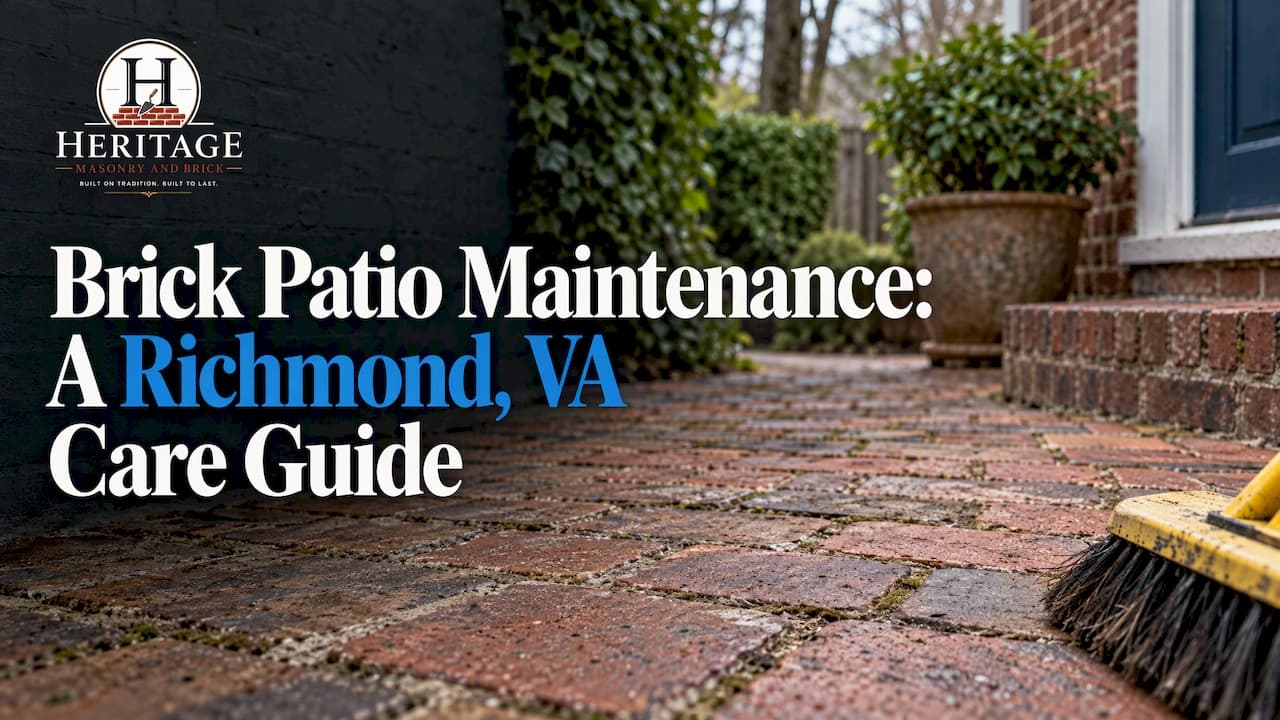
A brick patio needs three things to last: clean surfaces, full joints, and water that drains away from the house. Sweep regularly, wash gently, keep the joints filled, and fix any low spot before it grows. Do that and a patio in Richmond, Virginia can serve your family for decades. Skip it and weeds, moss and settlement take over in a few seasons.
We are Heritage Masonry & Brick, a family of traditional masons with over 25 years in the trade. We repair brick patios, walkways, steps and walls across Richmond, from Fan District rowhouse courtyards to backyard patios in the West End. This guide covers what you can do yourself, what to avoid, and when a patio needs a mason.
TL;DR
- Sweep often, wash with a mild detergent and a stiff brush, and keep pressure washing under 400 psi. Test any cleaner on a hidden spot first.
- Keep joints full. Sand-set patios need fresh joint sand now and then. Mortared patios and nearby brick walls need lime mortar repointing when joints crumble.
- Slope and drainage decide how long a patio lasts. Fix pooling and sunken spots early.
- Richmond's freeze-thaw winters and humid summers are hard on brick, so use a seasonal checklist and be careful with deicers.
- Call us at 804-324-6304 for a free estimate. Repairs carry a 5-year guarantee on materials and workmanship.
Table of Contents
- Know what kind of patio you have
- A year-round routine for Richmond
- Cleaning a brick patio without damaging it
- Weeds, moss and algae
- Keeping the joints in shape
- Drainage: the quiet cause of most patio damage
- Repairing loose, sunken or cracked bricks
- How long does a brick patio last?
- Our perspective: maintain the joints, not just the surface
- When to have us look at your patio
- FAQ
- Sources
Know what kind of patio you have
Maintenance depends on how the patio was built. Two types are common around Richmond.
Sand-set pavers. Bricks sit on a compacted base and a bed of bedding sand, and the joints are filled with sand. These are flexible and easy to repair, but the joint sand washes out over time. The Brick Industry Association (BIA) says eroded joint sand should be periodically replaced.
Mortared brick. Bricks are set on a rigid slab with mortar joints, common on older patios, stoops and courtyards. These are stiffer and more sensitive to water getting into cracked joints. Their maintenance looks like wall maintenance: keep joints sound and water out.

If you are not sure which you have, press a screwdriver into a joint. Loose sand gives way. Mortar does not.
A year-round routine for Richmond
Richmond has humid summers, wet falls and winters that cycle above and below freezing. Moisture is what damages brick, so the routine below follows the calendar.
| Season | What to do |
|---|---|
| Early spring | Look for heaved or loose bricks after winter. Check joints for gaps. Sweep out debris and rake out any weeds. |
| Late spring | Wash the patio. Re-fill joints with sand if needed. Trim back plants that shade or drip on the brick. |
| Summer | Sweep weekly. Treat stains quickly. Watch for ants or weeds starting in open joints. |
| Fall | Clear leaves promptly, since wet leaves stain and hold moisture. Check that the surface still drains away from the house. |
| Winter | Use a plastic shovel. Avoid harsh deicers. Note any chipped or flaking bricks. |
Cleaning a brick patio without damaging it
Most cleaning damage comes from being too aggressive. Brick has a hard fired face, but it can still be etched, pitted or stripped of its surface. Mortar is softer still.
Start with the gentlest method
- Sweep off leaves, grit and loose dirt.
- Wet the surface with a garden hose.
- Scrub with a mild detergent and water using a stiff-bristle brush, not wire.
- Rinse thoroughly, working from the house outward so dirty water runs off the patio.
The BIA's cleaning guidance recommends mild detergents with a bucket and stiff-bristle brush, or low-pressure water under 400 psi with a fan tip. It also says to avoid unbuffered muriatic acid, which can damage brick and mortar. For deeper background on safe methods, see our guide to cleaning brick safely in seven steps and our preservation-first approach to masonry cleaning.
Keep pressure washing low
Pressure washers are the most common way homeowners harm a patio. A hard jet blasts sand out of the joints, erodes mortar and can strip the face off softer, older brick. The BIA says not to exceed 400 psi unless the brick manufacturer permits it, and that 400 to 800 psi may suit only some brick types. Many consumer machines go well beyond that. If you use one, use a wide fan tip, keep the wand moving and hold it back from the surface. Our article on the risks of pressure washing brick above 500 psi explains what the damage looks like.
Always test first. The BIA advises trying any cleaner or method on a small hidden area under conditions close to those of the full cleaning. Wait for it to dry before judging the result, because wet brick looks darker.
Stains
- Leaf tannins, sap, and food: warm soapy water and a stiff brush, applied soon after the spill.
- Stubborn dark spots: an oxygen-bleach paste. One consumer guide suggests a paste the consistency of peanut butter left to sit for about an hour. Test it on a hidden brick first and rinse well.
- White powdery deposits: this is usually efflorescence, salts carried out by moisture. It is a sign of water getting in, not just a cosmetic issue. Read how to diagnose and fix efflorescence on brick.
- Old paint: do not scrape or sandblast it. See our notes on paint removal from brick in Richmond.
Making old brick look new again
What most people mean here is a good wash and fresh joints. The BIA says existing brickwork should be evaluated and repaired before any appearance treatment, that moisture problems should be corrected first, and that new or repaired masonry should cure and dry for at least 30 days before treatment. It also advises against using coatings to hide defects. A sealer or stain over a wet, cracking patio only traps the problem.
Weeds, moss and algae
Weeds need soil and a gap. Joints full of sand give them very little of either.
Cornell's turf and landscape weed program says prevention, meaning proper joint filling and regular sweeping, is cheaper and quicker than fighting an established infestation. Pull weeds with a joint knife or a paving brush, then refill the joint. Polymeric sand is one option for this. It becomes solid when activated with water, which resists weeds better than loose sand. Follow the manufacturer's instructions closely, and remember that a hardened joint is harder to refresh than loose sand.
Avoid home remedies. Extension specialists advise against salt or strong vinegar on patio weeds because they can harm nearby plants and often fail to kill established roots. Boiling water works on small weeds, but one British expert warns its heat can weaken pointing mortar over time.
Moss in shady, damp spots
Moss is common in Richmond's shaded backyards and north-facing courtyards. It holds moisture against the brick and makes the surface slippery. The Royal Horticultural Society says that in shady, damp areas, pruning overhanging plants and reducing compaction improves air flow and sun exposure and discourages moss and algae. Plant placement matters here too; this guide to outdoor patio plant setup shows how to arrange plantings so they don't crowd the paving. We cover the cleaning side, including how not to wash out the joint sand, in our guide to moss on brick patios.
Keeping the joints in shape
Joints are the weak point of any brick surface. In a sand-set patio, they hold the bricks in place by friction. In a mortared one, they keep water out of the slab and the wall behind.
Sand-set joints
When you can see gaps or the sand has dropped below the brick edges, sweep dry, fine joint sand across the surface until the joints are full, then compact and sweep again. Do this after washing, since a good wash removes sand.
Mortared joints and lime mortar
Mortared joints that crumble, crack, or sit recessed let water in. Water then freezes, expands and pushes bricks apart. The fix is repointing: removing the failed mortar to a proper depth and filling with new mortar.
The mortar choice matters a great deal. Modern cement-heavy mortar is hard and dense. On older brick, that means it can be stronger than the brick itself, so movement and moisture stress the bricks instead of the joints. The National Park Service notes that hardness is not a measure of appropriateness for lime-based historic mortars and that stresses should be relieved by the mortar rather than by the masonry units. It describes lime mortar as soft, porous and changing little in volume with temperature swings, which makes it a good choice for historic buildings.
That is why lime mortar is central to our work. Richmond is full of brick laid in the 1800s and early 1900s with lime-based mortars, in the Fan, the Museum District, along Monument Avenue and in Church Hill. A lime mix lets moisture move out through the joint rather than through the brick face. It also weathers and can be matched in color and texture. We match the existing brick and mortar on every repair so the work blends in. If you want to understand how that matching works, read how to match mortar to brick.
Not every patio needs lime. A new patio of modern brick is a different case, and the right mix depends on the brick and the setting. We check before we recommend anything. For mortared joints that need work, see our repointing and tuckpointing service.

Drainage: the quiet cause of most patio damage
A patio that holds water fails faster. Water softens the base, drives settlement, feeds moss and freezes in winter. The Oregon State University Extension paver guide says the surface should slope downward away from the house.
After a hard rain, walk the patio and look for:
- puddles that last more than a few hours
- water running toward a foundation wall, basement stairwell or window well
- downspouts discharging onto the patio
- sunken bricks or a dip where a path meets the patio
We walk through this in diagnosing brick patio drainage in 20 minutes. Delay has a cost. This Old House describes a Chicago patio that kept settling over five years and eventually sent rainwater toward a basement stairwell. Grading is also a key part of commercial patios, where slope and drainage practices that carry water away from the building protect both the paving and the structure.
A good base prevents most of these problems. We explain what a sound base should look like in our guide to patio base preparation.
Repairing loose, sunken or cracked bricks
Small repairs on sand-set patios are realistic for a careful homeowner. The BIA describes the method for lifting and resetting clay pavers:
- Pry out one paver, then loosen the neighbors with a hammer, chisel or pry bar.
- Remove bedding sand as needed and rebuild and compact the base.
- Reinstall the units in their pattern.
- Refill the joints with fresh sand.
This Old House adds practical details: number any cut edge bricks, dig out soft or waterlogged soil, add about an inch of sand and tap bricks down with a rubber mallet. After resetting, the BIA says small areas can be leveled with a hammer on a wooden block, while larger areas may need a plate vibrator.
When to call a mason
- The sunken area is large, or keeps sinking after you reset it.
- Water is pooling toward the house.
- Bricks are flaking, spalling or crumbling rather than simply loose.
- Mortar joints are cracked across the patio, or the patio meets a retaining wall, steps or foundation that is also failing.
- You have historic brick and are unsure what mortar or replacement brick matches.
Note that flaking brick is not cosmetic. The BIA says snow-removal equipment can chip or shift clay pavers, and that deicing chemicals can cause thermal shock, spalling, staining or efflorescence, so damaged units may need replacing rather than treating. For winter in Richmond, that means a plastic shovel and sand for traction rather than rock salt.
How long does a brick patio last?
A well-built brick patio can outlast the house it sits beside. This Old House reports a conservative brick-industry estimate of 40 years for brick pavers, and notes that brick-paver sidewalks in colonial-era cities have been in service for nearly 150 years. Durability depends on the brick's weather rating and its resistance to freeze-thaw damage, so ask about both when buying brick for outdoor use.
In practice, lifespan comes down to the base, the slope, the joints and how quickly small problems get fixed.
Our perspective: maintain the joints, not just the surface
Most patios we see in Richmond are not ruined by age. They are worn down by small neglects: a downspout aimed at the paving, sand that was never replaced, a pressure washer set too high, or hard cement patched over soft old mortar.
We work with a simple rule. Treat brick the way it was built. Old brick was laid with lime mortar by hand, and it does best with repairs that behave the same way: soft, breathable, matched in color. Repairs that look new next to the old work, or that are harder than the brick, usually fail again.
We also tell homeowners when they do not need us. Sweeping, a gentle wash and a bag of joint sand will carry a sound patio a long way. When the problem is structural or the mortar is failing, doing it right the first time is cheaper than doing it twice.
— Thomas
When to have us look at your patio
Heritage Masonry & Brick repairs brick patios, walkways, steps and retaining walls for homeowners, property managers and builders throughout Richmond, VA. We match the existing brick and mortar and use traditional methods, including lime mortar repointing where it is the right fit.

Estimates are free. We offer a 5-year guarantee on materials and workmanship, require no deposit and ask for payment on completion. See our brick patios and walkways page, our brick repair service, or the steps and step repair page. Call 804-324-6304 today.
FAQ
How often should I clean a brick patio?
Sweep it weekly or as needed, and do a full wash once or twice a year, usually in spring and after a heavy leaf season in fall. Treat spills and stains quickly. Washing too often with strong tools does more harm than letting a little patina build.
Can I pressure wash my brick patio?
Yes, but gently. The BIA says to stay under 400 psi unless the brick manufacturer allows more, use a fan tip and test a hidden spot first. A hard jet can blow out the joint sand and erode mortar, so refill joints after washing.
Should I seal a brick patio?
Only after the patio is sound, dry and drained. The BIA advises fixing moisture and masonry defects first and warns against using treatments to cover them. Ask a mason which product suits your brick, since a sealer that traps moisture can cause more damage.
How do I stop weeds between the bricks?
Keep the joints full and sweep regularly. Remove existing weeds with a joint knife, then refill the gap. Avoid salt and strong vinegar, and be careful with boiling water on mortared joints.
When does a brick patio need repointing instead of new sand?
If the joints are mortar, they need repointing when they crumble, crack or sit recessed. If the patio is sand-set, add fresh joint sand. A screwdriver test tells you which you have, and we are glad to look at it for you.
Sources
- Cleaning Brickwork, Brick Industry Association
- Cleaning Brickwork, BIA (sample area testing)
- Paving Systems Using Clay Pavers on a Sand Setting Bed, BIA
- Changing the Appearance of Brick, BIA
- Hard Surfaces, Cornell Turfgrass and Landscape Weed ID
- Safe removal of weeds from brick patio, Ask Extension
- Algae and Moss on Hard Surfaces, Royal Horticultural Society
- How to Stop Patio Weeds for Good, Country Living
- Preservation Brief 2: Repointing Mortar Joints, National Park Service
- 10-Step Guide to Installing Pavers, Oregon State University Extension
- How to Repair a Brick Patio, This Old House
- All About Brick Pavers, This Old House
- How to Make Your Patio Look New Again, ScottsMiracle-Gro
- Outdoor patio plant setup
- Patio plantscapes and drainage practices