
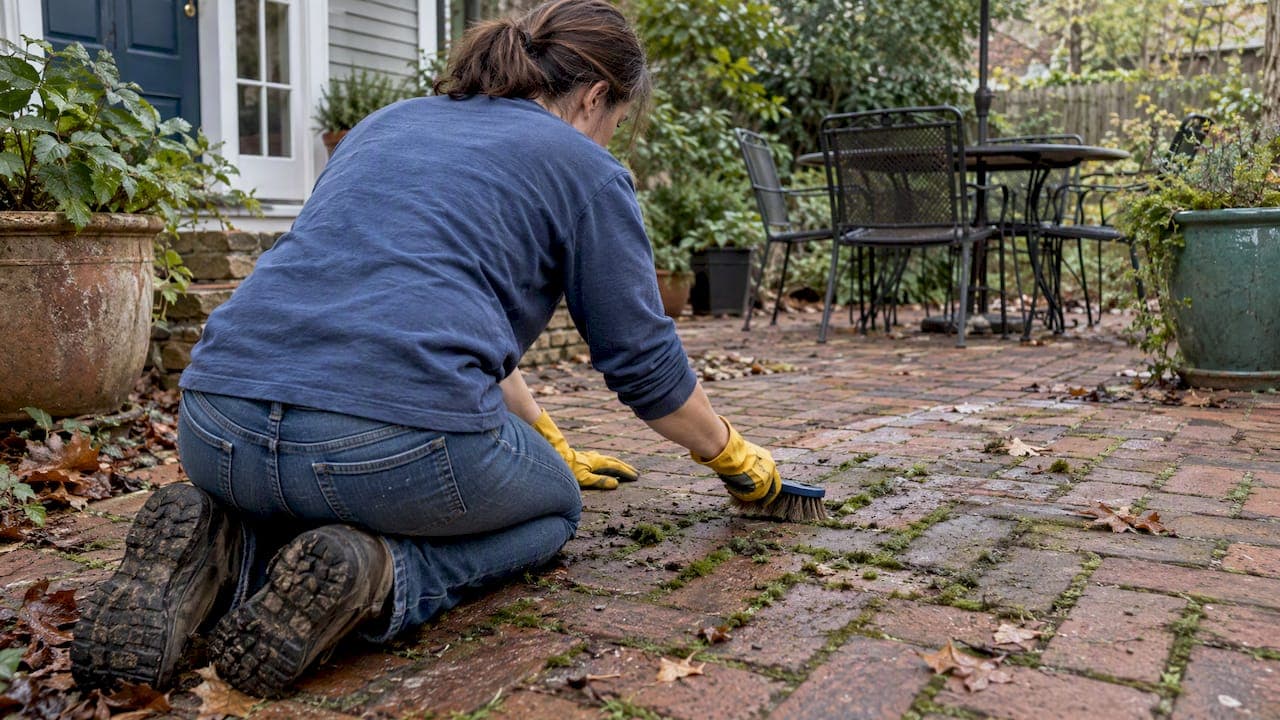
The fastest masonry-safe way to clear moss from a brick patio is to kill it with an appropriate treatment, loosen it gently with a soft brush, then rinse and let the surface dry. Skip the pressure washer on brick: high pressure strips mortar and joint sand and can leave patios weaker than before. Oxygen bleach and EPA-labeled fatty-acid products both work quickly with proper care. The steps below cover method choice, a safe cleaning sequence, and how to keep moss from coming back.
TL;DR:
- Spot test cleaners for 24 hours; oxygen bleach sits for 15 to 20 minutes, while fatty acid products need their labeled dilution and contact time.
- Use a garden hose and stiff nonmetal brush along joint lines; stop if sand or grit appears, because joint material is washing out.
- Moss returns when shade, standing water, or debris remain; check drainage after rain, clear joints monthly in growing season, and replace sand annually.
- Crumbling mortar, loose bricks, persistent pooling, or moss returning despite upkeep can signal failed joints, a shifting base, or drainage problems requiring professional inspection.
- Fatty acid treatments can harm plants, leave slippery residue, and require keeping people and pets away until the surface dries.
Table of Contents
- Comparing natural, commercial, and mechanical removal methods
- A step-by-step safe removal procedure for brick patios
- Keeping moss from coming back
- When moss signals a bigger masonry problem
- Is it moss, algae, or lichen on your brick?
- Can moss actually damage a brick patio?
- A masonry pro's take on preservation-first cleaning
- Need help beyond moss removal? We handle the masonry side
- FAQ
- Sources
Comparing natural, commercial, and mechanical removal methods
Picking the right method depends on how established the moss is and how much risk you're willing to take with your brick and joints.
- Vinegar kills surface moss fast, but its acidity can etch some mortar and discolor certain brick over repeated use.
- Baking soda works slowly and gently, making it a low-risk choice for softer or older brick.
- Oxygen bleach (sodium percarbonate) foams to lift moss and breaks down into oxygen and water, which makes it one of the more masonry-friendly options, though a spot test is still worth doing.
- EPA-labeled fatty-acid products, including Safer Brand Moss and Algae Killer and citrus-oil formulas like Moss Avenger, kill moss on contact and are built for outdoor surfaces, but their labels warn about plant damage, residue, and temporary slipperiness.
- Manual brushing with a stiff natural or synthetic bristle brush removes dead moss without touching the mortar.
- High-pressure washing is the riskiest option on brick: it can blast out joint sand and pit softer masonry in seconds.
Always test any cleaner on a small, inconspicuous patch of brick 24 hours before treating the whole patio, a precaution built directly into EPA pesticide product labels for exactly this reason. Pets and plants generally tolerate oxygen bleach better than fatty-acid concentrates, which are effective but carry stronger label cautions about runoff near garden beds.
A step-by-step safe removal procedure for brick patios
Before you treat anything, look at your brick. Older, softer, or historic brick needs gentler handling than modern pavers, and preservation guidance from the National Park Service recommends starting with the gentlest method that will work and testing before scaling up.
- Spot-test first. Apply your chosen cleaner to a small, hidden section and wait 24 hours to check for discoloration or etching.
- Mix and apply the killer. For oxygen bleach, follow the package dilution and let it sit until it stops foaming, usually 15 to 20 minutes. For an EPA-labeled fatty-acid product, follow the label's exact dilution and contact time, and keep people and pets off treated areas until the surface is dry.
- Protect nearby plants. Cover garden beds or hose them down afterward to dilute any runoff, since several labeled products note the potential for plant damage.
- Loosen with a brush. Once the moss has browned and loosened, scrub with a stiff natural or synthetic bristle brush, working with the joint lines rather than against them.
- Never use a wire or metal brush. Metal bristles abrade brick and can leave particles that rust-stain the surface over time.
- Rinse with a garden hose. A regular hose nozzle removes dead moss and residue without disturbing joint sand.
- If you use a pressure washer, start very low. Begin at garden-hose pressure or the lowest setting available, generally in the 100 to 300 psi range, and hold the nozzle at a wide angle and distance from the surface.
- Watch the rinse water. If you see grit or sand washing out, stop immediately. That is joint material leaving the patio, not dirt.
- Rake out debris from the joints once the surface has dried somewhat.
- Re-sand the joints where sand has thinned or washed away.
- Let the patio dry fully before walking on it regularly, especially if you used a fatty-acid product that can leave a temporary film.
Pro Tip: Treat moss on a cloudy, dry day so the killer has time to work before rain or hose rinsing washes it away too early.
Keeping moss from coming back
Moss returns because the conditions that grew it in the first place are still there: shade, moisture, and organic debris sitting in the joints.
- Check drainage first. Standing water after rain is the clearest sign your patio needs a grading fix or a small trench drain.
- Trim back shade-producing branches and shrubs so sunlight and airflow reach the brick surface.
- Sweep leaves, pollen, and dirt out of the joints regularly, since organic buildup is what moss spores need to take hold.
- Brush and re-sand joints each season, particularly after winter when freeze-thaw cycles loosen sand.
- Consider a breathable sealer on cleaned, dry brick. A sealer that lets moisture escape helps prevent trapped water without causing the spalling that non-breathable coatings can cause.
| Maintenance task | Frequency | Why it matters |
|---|---|---|
| Sweep joints clear of debris | Monthly in growing season | Removes organic matter moss needs to establish |
| Check for standing water | After heavy rain | Flags drainage problems before moss returns |
| Trim overhanging vegetation | Twice yearly | Increases sunlight and airflow across the surface |
| Re-sand joints | Annually or as needed | Replaces sand lost to washing or weather |
A patio drainage checklist can help you spot pooling issue before they turn into a recurring moss problem. If moss comes back within a few weeks of cleaning despite these steps, the underlying moisture or shade issue likely needs more than routine maintenance.
When moss signals a bigger masonry problem
Moss itself rarely causes structural damage, but the conditions it thrives in can point to issues a homeowner can't fix with a brush and a bottle of cleaner.
- Crumbling or missing mortar between bricks means water is getting into the joints, which calls for repointing rather than cleaning.
- Bricks that feel loose or uneven underfoot suggest the base beneath the patio has shifted.
- Grit or sand consistently appearing in rinse water even at low pressure can mean joints have already lost significant material.
- Water that pools in the same spot every time it rains often needs regrading or a drainage fix beyond a weekend project.
- Recurring moss despite good maintenance can mean a chronic moisture source, like a grade sloping toward the house or a failing base layer.
A masonry professional can diagnose whether the issue is cosmetic or structural, recommend seamless repointing where needed, and suggest drainage corrections at the base level, work that goes well beyond surface cleaning.
Is it moss, algae, or lichen on your brick?
These three growths look similar at a glance but behave differently, and treating the wrong one with the wrong method wastes time.
Moss forms soft, dense, cushiony green patches and thrives in shaded, consistently damp joints and low spots. It has no roots and spreads by spores, which is why it concentrates in mortar lines where moisture lingers longest.
Algae shows up as a thin, slimy green or black film across the brick face rather than in raised clumps. It needs less shade than moss and often appears on north-facing walls or patios that stay damp from sprinklers or poor drainage.
Lichen looks crusty, flaky, and gray, green, or orange, and it bonds tightly to the brick surface itself rather than just sitting in the joints. Lichen grows much more slowly than moss or algae and can be harder to remove because it attaches directly to the masonry.
Knowing which one you're dealing with changes your approach. Oxygen bleach and fatty-acid moss killers work well on moss and algae, but stubborn lichen sometimes needs repeated gentle treatments rather than one aggressive cleaning pass, since scraping it off can take a thin layer of brick with it.

Can moss actually damage a brick patio?
Moss on its own doesn't eat through brick or mortar, but it's rarely harmless either. The real damage comes from what moss represents: a patio surface that stays wet longer than it should.
Moss holds moisture against the brick and in the joints, which keeps mortar damp for longer stretches after rain. Over repeated freeze-thaw cycles, that trapped moisture expands and contracts inside the mortar, and preservation guidance on historic masonry notes that porous masonry is especially sensitive to this kind of abrasive and moisture-driven wear over time.
Left unaddressed for years, persistent moss and the moisture it holds can contribute to crumbling mortar joints, which lets water penetrate further and can eventually loosen bricks from their base. The moss isn't the direct cause of structural failure, but it's often a visible symptom of a drainage or moisture problem that, if ignored, does lead to real repair needs. Catching it early and addressing both the moss and the moisture source protects the patio far better than cleaning alone.

A masonry pro's take on preservation-first cleaning
After many years working with brick, our view is simple: the gentlest method that works is always the right one. We'd rather see a homeowner spend an extra 20 minutes brushing than lose joint sand to a pressure washer in five. A typical fix we see follows the same order every time: diagnose the moisture source, clean gently, then repoint only where the mortar has actually failed. For more on preservation-minded cleaning, our masonry cleaning methods post goes deeper into brick-specific techniques.
— Thomas
Need help beyond moss removal? We handle the masonry side

Moss is often the easy part. When drainage problems, loose joints, or settling bricks are behind the regrowth, that's where our work begins. We handle brick patios and walkways from the ground up, including repointing failing joints, correcting drainage at the base, and applying breathable sealers that protect without trapping moisture.
- Brick Patios & Walkways: repair, restoration, or new installation
- Repointing & Tuckpointing: for joints that have lost sand or crumbled
- Structural repairs: for settling or uneven patio areas
If your patio keeps growing moss despite regular cleaning, start with a patio inspection and estimate or explore our brick repair services to see what fixing the root cause involves.
FAQ
Will moss damage brick?
Moss itself doesn't break down brick or mortar directly, but it traps moisture against the surface, which can accelerate mortar wear over repeated freeze-thaw cycles. Addressing the moisture source matters more than the moss itself for long-term protection.
What can I use to kill moss on bricks?
Oxygen bleach and EPA-labeled fatty-acid products, such as Safer Brand Moss and Algae Killer and citrus-oil formulas like Moss Avenger, both kill moss effectively on brick when used per label instructions. Always spot-test first and follow the label's dilution and contact time.
What kills moss permanently on a brick patio?
No treatment kills moss permanently if the underlying moisture and shade conditions stay the same, since moss regrows wherever those conditions persist. Lasting control comes from pairing a treatment with drainage fixes, trimmed vegetation, and regular joint maintenance.
Does vinegar and dish soap kill moss?
Vinegar mixed with dish soap can kill surface moss, but vinegar's acidity carries a real risk of etching mortar or discoloring certain brick with repeated use. Oxygen bleach or a labeled fatty-acid product is generally a gentler choice for masonry surfaces.
How is moss different from algae or lichen on brick?
Moss forms soft, cushiony green clumps in damp, shaded joints, while algae appears as a thin slimy film across the brick face. Lichen is crusty, slow-growing, and bonds tightly to the brick itself, which often makes it the hardest of the three to remove without affecting the surface.
Sources
- U.S. EPA, Pesticide Product Label, SAFER MOSS AND ALGAE ATTACK CONCENTRATE
- Preservation Brief 1: Assessing Cleaning and Water-Repellent Treatments for Historic Masonry Buildings
- Preservation Brief 38: Removing Graffiti from Historic Masonry