
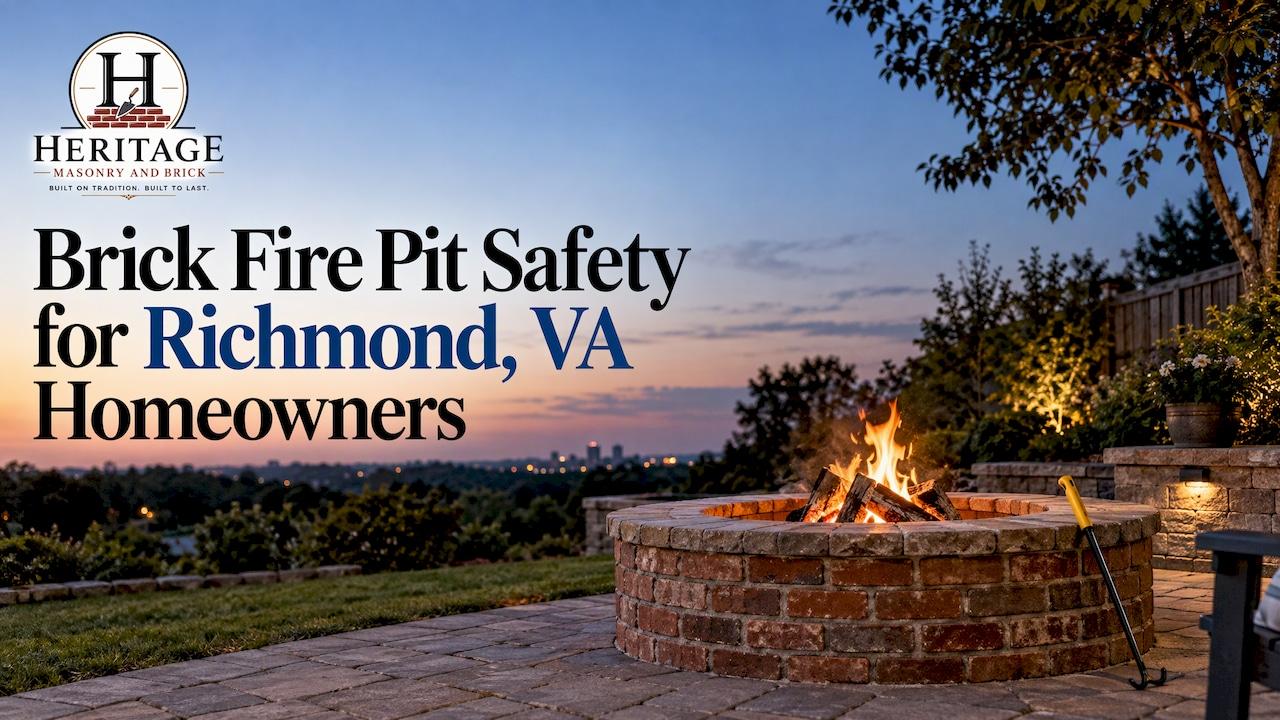
A brick fire pit is safe when four things are right: firebrick lining the inside, a non-combustible base, enough distance from your house and anything that can burn, and a routine for putting the fire out. In Richmond, Virginia, the distance rule depends on how the pit is classified, so it pays to settle that before the first brick is laid. This guide covers the materials, the mortar, the clearances, the local rules and the habits that keep a brick pit sound for decades.
TL;DR
- Line the inside of the pit with firebrick set in refractory cement. Ordinary clay brick can crack at high temperatures.
- NFPA advises at least 10 feet from anything that can burn. Richmond's fire code page sets 15 feet for pre-manufactured fireplace devices, and the Virginia code sets 25 feet for recreational fires. Plan for the larger distance.
- Build on brick, concrete or another surface that will not burn, and let it extend past the pit base.
- Never pour cold water on a hot masonry pit, and keep cooled ashes in a covered metal container.
- Cracked bricks and crumbling joints in an existing pit are repair jobs for a mason, not something to burn through another season.
Table of Contents
- Why brick is a good choice for a fire pit, and where it fails
- Firebrick details that affect safety
- Mortar: what goes where
- Distance: how far from the house, fences and trees
- Richmond rules you should know
- The surface underneath: patios, pavers and lawns
- Safe use, step by step
- Putting out the fire and handling ashes
- Checking an existing brick fire pit
- Our perspective
- Have us build or repair your brick fire pit
- FAQ
- Sources
Why brick is a good choice for a fire pit, and where it fails
Brick is dense, it holds heat, and it looks right next to a Richmond rowhouse, a Fan District garden wall or a Church Hill patio. The problem is that "brick" covers very different products. Face brick, the kind used on house walls, is made for weather and weight. It is not made to sit next to a wood fire day after day.
Firebrick, also called refractory brick, is kilned to withstand high temperatures. Family Handyman's updated brick fire pit build puts 25 firebricks set in refractory cement on the inside as the liner, and uses 80 face bricks in Type N mortar for the outer wall. It also notes that regular clay brick can crack at high temperatures, while firebrick can take them.
That split is the core of brick fire pit safety:
- Inside (the firebox): firebrick and refractory cement. This is the layer that meets the flame.
- Outside (the shell): face brick or other brick that looks good and holds the structure together.
- Between them: the liner and the shell should be built so the pit can expand and cool without pulling itself apart. A mason plans this as a single structure rather than stacking two walls.
A cracked liner does not always look dramatic. Hairline cracks, bricks that sound hollow and mortar that crumbles when you scrape it all mean heat is getting where it should not. We cover how to read those signs later in this guide.
Firebrick details that affect safety
Firebrick is denser and harder to split than regular brick. Family Handyman explains that standing it on end, which masons call soldiering, limits splitting and follows the curve of a round pit. The same build places four split firebricks opposite each other to leave gaps that draw in oxygen.
Two practical points follow from that:
- Cutting and fitting matter. A round pit needs cuts, and badly cut firebrick leaves wide joints. Wide joints are the weak points in a firebox.
- Airflow is part of the design. A pit that draws well burns cleaner and with less smoke, which also matters under Richmond's rules on smoke, covered below.
If you are planning a larger outdoor fireplace instead of a low pit, our homeowner code checklist for outdoor brick fireplaces walks through what the code expects.
Mortar: what goes where
Mortar is the part of a brick structure most people forget, and it is where many fire pits and old walls fail first. There are two separate jobs.
Inside the firebox, refractory cement is used to set firebrick. Regular mortar is not designed for direct flame.
Outside the firebox, the shell is laid in standard masonry mortar. Family Handyman's build uses Type N mortar for the outer face bricks. Mortar also comes premixed in the form of trowel-ready mortar, which saves mixing on site.
What the mortar is made of matters more than most homeowners expect. On older Richmond brick, many homes were built with soft, lime-based mortar. Lime mortar is softer and more flexible than modern cement-heavy mixes, so it lets a wall move slightly and dry out through the joints rather than through the brick. When a hard mortar is used to repair old brick, the brick can take the stress instead, and it starts to flake.
That is why on every repair we match the existing brick and mortar and use traditional lime mortar, the method old brick was built with. It matters for fire pits in two ways:
- If your pit or fire feature is tied into a historic garden wall, patio edge or foundation, the connection should be repaired in a mortar that suits the old work, not one that fights it.
- If an older pit has joints that have eroded, repointing, which means raking out the failed mortar and filling the joints with fresh mortar, restores the shell. Our guide on when to repoint brick explains the signs and the urgency levels.
The firebox liner is a separate job, and it follows firebrick and refractory cement practice, not lime mortar practice.
Distance: how far from the house, fences and trees
No single number applies everywhere, so here is how the main ones line up.
| Source | Distance | What it covers |
|---|---|---|
| NFPA | At least 10 feet | Fire pits, from anything that can burn |
| City of Richmond Fire-EMS | At least 15 feet | Pre-manufactured fireplace devices, from any structure or combustible material |
| Virginia Statewide Fire Prevention Code, as posted by a Virginia fire department | 25 feet | Recreational fires, from a structure or combustible material (section 307.4.2) |
| Raleigh, NC Fire Department | 25 feet | Fire pits, from any structure (a neighboring state's city, shown for comparison) |
A masonry pit built on your property is not a pre-manufactured device, so the safest plan is the larger figure: 25 feet from the house, sheds, fences, overhanging branches and anything else that burns. On a narrow Richmond lot that may be impossible. In that case, call the Richmond Fire Marshal's Office at (804) 646-6640 before you build and ask how your design is classified. Do that before any brick is bought, because moving a finished masonry pit is not practical.
Also keep furniture back. Raleigh's guidance calls for immovable seating 4 feet from the pit, and NFPA says to keep children and pets at least 3 feet away.

Richmond rules you should know
The City of Richmond's Fire-EMS prevention page says open burning is allowed only with approval from the Fire Code Official. It also says stoves, incinerators and controlled-burning devices, including patio fireplaces, are not classified as open burning and do not need an open-burning permit. The same page requires an approved way to put the fire out close at hand, and says open burning that is offensive or hazardous because of smoke or atmospheric conditions is prohibited. The Fire Department can extinguish a fire that creates a hazard, and repeated service calls to the same address can lead to the fire being put out.
In practical terms for a Richmond neighbor:
- Burn clean, dry, seasoned hardwood. Smoke complaints are the fastest way to attract a fire truck.
- Keep a hose or extinguisher within reach. The Virginia code requires constant attendance and a 4-A-rated extinguisher or approved extinguishing equipment (section 307.5, in the same Virginia code document).
- Check your HOA or historic district covenants if you live in a district with design review. A new masonry feature may need approval.
- Call 811 before you dig for a footing or a pad. Utility lines are common in older Richmond yards.
Virginia's 4 p.m. burning law
Virginia's 4 p.m. Burning Law applies every year from February 15 through April 30. Augusta County Fire-Rescue's notice says it bans open-air burning before 4 p.m. and that this includes fire pits. Check the Richmond Fire Marshal's Office for how it is applied inside the city, and plan spring evening fires accordingly.
The surface underneath: patios, pavers and lawns
NFPA advises placing a fire pit on even ground or a level surface that will not catch fire, and names patio blocks, bricks and concrete as examples. A brick or concrete patio works well. A wooden deck or a lawn does not.
A few points apply to a brick patio:
- Make the base larger than the pit. Plan a non-combustible apron around the pit so sparks and rolling embers land on brick, not grass or mulch.
- Check the patio's condition first. Loose pavers, a sunken area or crumbling joint sand mean the pit can tilt. A heavy masonry pit needs a firm, level foundation.
- Mind paver thickness. Pavers made for foot traffic are not always suited to carrying a heavy pit. Our guide to brick paver thickness explains what patios need.
- Think about how the pit sits on pavers. Our article on a fire pit on pavers covers what homeowners can do themselves and when a mason is needed.
If you are planning a new patio and fire pit together, building them as one project means the base, drainage and fire pit footing are all designed to work together. Our brick patios and walkways work covers the patio side.
Safe use, step by step
Safe habits matter as much as safe construction. NFPA's guidance gives a clear list:
- Use the pit only outdoors.
- Use a fire screen to stop sparks from escaping.
- Burn only clean, dry, seasoned hardwood in a wood-burning pit.
- Keep the area well lit so you can see where people, hoses and furniture are.
- Never use gasoline or any other flammable or combustible liquid to start or boost the fire.
- Keep children and pets at least 3 feet away.
- Never leave the fire unattended. Constant attendance is also a requirement of the Virginia code.
Avoid burning trash, painted wood or treated lumber. Besides the smoke problem, it makes the fire hotter and less predictable, and it is harder on the brick.
Putting out the fire and handling ashes
Most fire pit accidents happen after the party. The fire looks finished, but the ashes are not.
NFPA says to put the fire out completely and dispose of ashes only after they have cooled, in a metal container with a tight-fitting lid, placed away from anything that can burn. The fire code guidance posted by Raytown Fire Department adds detail:
- Hot ashes never go into a combustible container, such as a cardboard box or a plastic bin.
- Ashes must be dampened and cooled in a covered metal can sitting on a non-combustible surface. Ashes that are two or three days old can still hold enough heat to start a fire.
- Do not suddenly apply cool water to a masonry or metal fire pit. It may crack the device and cause loss of containment of hot ashes and embers.
That last point is specific to brick. Thermal shock, the stress from sudden temperature change, is what cracks a hot firebox. Let the fire burn down, spread the embers, and use water gradually on the ashes, not on the hot bricks. Then wait until everything is cool before you scoop.
Checking an existing brick fire pit
If you already have a pit, an annual look in spring, before the first fire, catches most problems. Walk around it and check:
- The liner. Look for cracked or missing firebrick, gaps at joints and bricks that have shifted.
- The shell. Look for loose or crumbling mortar, bricks that flake or crumble, and leaning or bulging sections.
- The base. Look for settled pavers, a tilted pit, water pooling near the footing and weeds growing through joints.
- Any connection to a wall, step or house. Moisture and heat both travel, and a failing joint beside a wall is a repair for the wall as well.
Soft old brick and eroded joints are common in Richmond's older neighborhoods, and the cause is often water rather than fire. Repointing and brick repair restore the structure before the next burn season. Where the pit connects to historic brickwork in the Fan, the Museum District or along Monument Avenue, matching the existing brick and mortar keeps the repair from standing out and keeps it compatible with the old wall. Our guide to matching old brick explains how that is done.
Do not keep burning in a pit with a cracked liner. Stop using it until a mason has looked at it.
Our perspective
We have spent over 25 years working on brick in Richmond, and the pattern is consistent: a fire pit is a small masonry structure that has to deal with heat, water and weight at the same time. Most of the failures we see in brick come down to the wrong material in the wrong place, or mortar that does not suit the brick around it.
That is why we think about a brick fire pit as two layers with different jobs. The firebox needs firebrick and refractory cement. The shell, steps and patio around it need brick and mortar matched to the surrounding work, and on older properties that means traditional lime mortar, the method old brick was built with.
Richmond's older neighborhoods have brick that has already stood for a century or more. A new fire feature should not shorten that life. Done properly, the work lasts for decades, and we stand behind it with a 5-year guarantee on materials and workmanship.
Thomas
Have us build or repair your brick fire pit
We are a family-run masonry company in Richmond, VA, and we repair and build brick for homes and businesses: repointing and tuckpointing, brick and structural repairs, chimneys, new brickwork, steps, patios and walkways. If you want a brick fire pit built to hold up, or an existing one inspected and restored, we can look at the site, the base and the brick around it.

Estimates are free. There are no deposits, and you pay when the work is complete. Start with our new brickwork page, browse our masonry advice, or call 804-324-6304.
FAQ
Is it safe to have a brick fire pit on a patio?
Yes, when the patio is made of a material that will not burn, such as brick, concrete or patio blocks. NFPA advises a level, non-combustible surface and at least 10 feet from anything that can burn. Make sure the patio is firm and level, and keep the pit well away from the house, fences and overhead branches.
Can I use regular brick instead of firebrick?
Not inside the firebox. Regular clay brick can crack at high temperatures, while firebrick is kilned to withstand them. Regular face brick is suitable for the outer shell, which is how the Family Handyman build is laid out. Firebrick is set in refractory cement.
How far should a brick fire pit be from my house in Richmond?
The City of Richmond's fire page sets 15 feet for pre-manufactured fireplace devices, while the Virginia code sets 25 feet for recreational fires. A site-built brick pit is safest at 25 feet. If your yard is too small, call the Richmond Fire Marshal's Office at (804) 646-6640 for guidance before you build.
Can I put water on a hot brick fire pit?
Not suddenly. Fire code guidance warns that cool water applied suddenly to a hot masonry fire pit can crack it and release hot ashes and embers. Let the fire burn down, dampen the ashes gradually, and store cooled ashes in a covered metal container.
Sources
- Wildfire Prevention Tips for Fire Pits and Outdoor Fires (NFPA)
- How to Build a DIY Brick Fire Pit for Your Yard (Family Handyman)
- Prevention (City of Richmond Fire-EMS)
- Regulations for Open Burning (Virginia Statewide Fire Prevention Code, 2024)
- Fire Pits and Open Burning Safety (Raleigh, NC)
- Fire-Rescue Department (Augusta County, VA)
- Portable Fireplace Requirements (Raytown Fire Department)
- Trowel Ready Mortar