
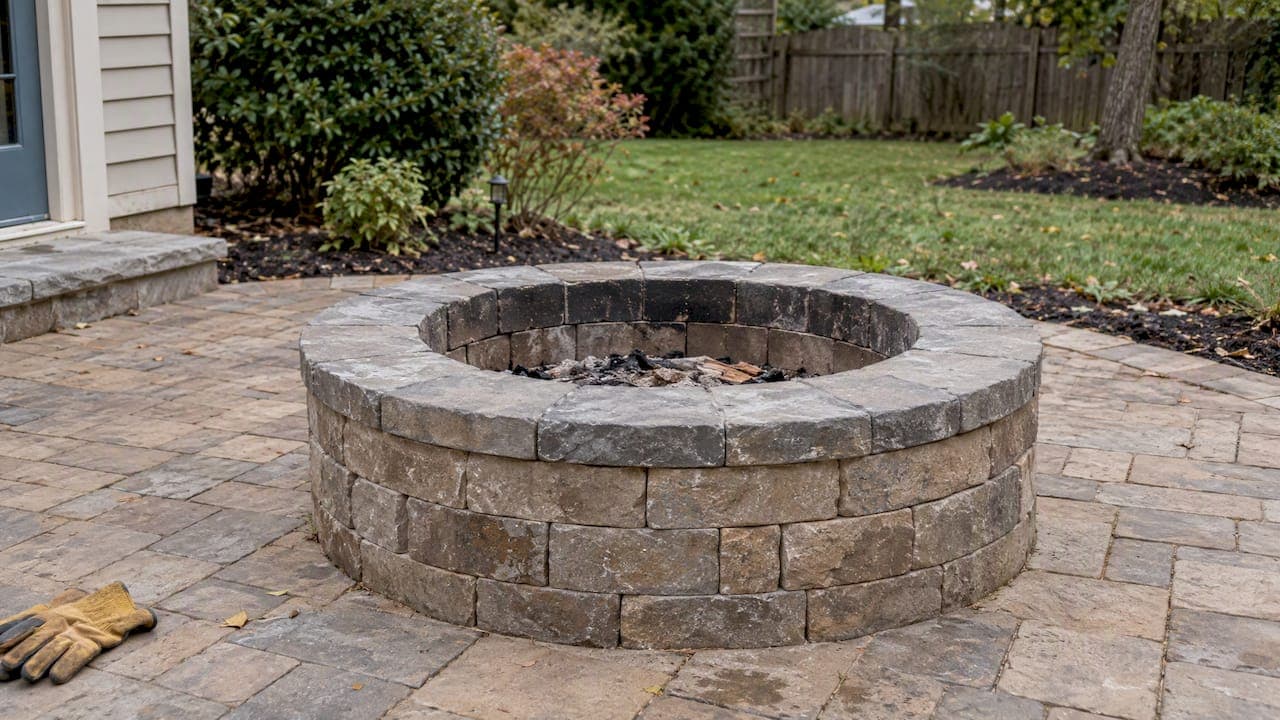
Yes, you can put a fire pit on pavers if you protect them with a heat-resistant barrier and keep safe clearances. You have three practical routes: a portable ring, a metal bowl on a protective base, or a built-in masonry pit lined with firebrick. Whichever you choose, check your local fire code before the first fire.
TL;DR:
- Keep the pit at least 10 feet from structures and combustibles, maintain 3 feet of clear space around it, and use a spark screen.
- Dense natural stone and many concrete pavers tolerate occasional warmth, but direct flame, porous materials, cracks, and trapped moisture increase damage risk.
- A metal ring or bowl on an insulating base with gravel balances mobility and protection; a portable ring alone offers the least protection.
- Confirm local fire and building rules, HOA restrictions, and buried utilities before choosing a site; permanent pits may face stricter review.
- Permanent pits need firebrick liners, at least 3 inches of compacted gravel, and adhesive rated for heat; hire a mason for drainage issues or settling.
Table of Contents
- What clearances and rules should you check first?
- Will a fire pit damage your pavers?
- Which installation approach fits your patio?
- How do you install a fire pit on an existing paver patio?
- Which materials protect pavers best?
- How do you keep a paver fire pit safe over time?
- When is it smarter to call a mason?
- Want a fire pit built right into your patio?
- FAQ
- Sources
What clearances and rules should you check first?
Placement matters as much as materials. FEMA's fire administration advises keeping fire pits 10 feet from your home or anything that can burn, and using a metal screen to stop sparks from floating away. For smaller heat sources, the agency also promotes a 3-foot safety zone away from siding, deck railings, eaves and overhanging branches.
Before you buy anything, run through this checklist:
- Call your local fire department or building office to confirm fire pits are allowed on residential lots.
- Read your HOA rules, since many restrict permanent structures or open flames.
- Call 811 before cutting into pavers so buried utilities are marked.
- Pick a spot with no overhangs, no dry shrubs or mulch nearby, and a clear view of wind direction.
- Keep the pit away from eaves, fences and pergolas that can catch radiant heat.
Will a fire pit damage your pavers?
It can, if the pavers take direct heat. Fire and radiant heat cause thermal shock: the surface heats quickly while the layer beneath stays cool, and the stress shows up as cracks or flaking called spalling. Moisture makes it worse. Water that soaks into a paver and freezes in winter widens any small crack the fire started.
Materials tolerate heat differently:
- Firebrick and refractory liners handle sustained high heat and belong inside any permanent pit.
- Dense natural stone and many concrete pavers usually tolerate occasional warmth but not direct flame at the base.
- Lightweight, porous or thin pavers, including some porcelain types, can crack or flake depending on how they are made.
- Pavers that are already damaged are the likeliest to fail, so inspect for hairline cracks, loose edges and settled spots first.
Pro Tip: Splash a little water on a paver in the shade. If it soaks in fast, the stone is porous and needs a barrier layer under the pit.
Which installation approach fits your patio?
Each approach trades mobility against protection and permanence.
- Portable ring set on top of the pavers: Quick and movable, but it offers the least protection. Pair it with a heat barrier beneath, never directly on the surface.
- Metal ring or bowl with an insulating base and gravel: This balances flexibility and safety. The metal acts as a sacrificial layer between flame and paver, and the pit can still be lifted out later.
- Built-in masonry pit cut into the pavers and lined with firebrick: The most durable and the best looking, but it needs more prep and usually a mason.
A kit makes sense for a portable or stacked-block pit on a stable, level patio. If you want something permanent, or your patio has settling or drainage problems, bring in a professional.
How do you install a fire pit on an existing paver patio?
This sequence covers the cut-out method, which gives the longest life. Each step builds on the one before it.
- Assess the site. Check slope, drainage, utilities and clearances. Our guide to diagnosing brick patio drainage shows how to spot pooling before you build on top of it.
- Choose your approach and gather materials. Decide between on-top and cut-out, then collect pavers or wall blocks, firebrick, gravel, a metal ring and heat-rated adhesive.
- Remove the pavers. Mark the footprint, lift the pavers inside it, and expose the base underneath.
- Rebuild the subbase. Add crushed gravel and compact it in layers. Our contractor tips on patio base preparation explain how deep to go and how to compact properly.
- Set the footing or ring. Depending on your design, install a metal ring on the gravel or pour a concrete footing. A footing is what Family Handyman builds under its brick pit, with a firebrick liner set in refractory cement.
- Line and stack. Set firebrick on the inside, or drop in a metal bowl. When fixing wall blocks to an existing paver surface, use heat-rated adhesive, because standard adhesive turns brittle from repeated heating and cooling.
- Re-lay the surrounding pavers. Cut and fit them tight around the pit, refill the joint sand, and let adhesives cure for the time the product label states.
- Test without fire. Check that everything is level, nothing rocks, and water drains away from the pit.
If you are starting a new patio rather than modifying one, This Old House recommends building the pit before laying the surrounding pavers.
Pro Tip: Do a full dry assembly of the top courses before you open the adhesive. Once it grabs, adjustments get messy.

Which materials protect pavers best?
The right layers keep heat from reaching the paver surface and keep water from pooling inside the pit.
- Firebrick or refractory liner: The correct inner surface for any pit that will see regular, hot fires.
- Crushed gravel base: At least 3 inches promotes drainage and spreads heat, so it does not concentrate in one spot.
- Heat-rated construction adhesive: Use it on block joints where the flame cycle makes the structure expand and contract.
- Metal ring or bowl: Works as a sacrificial barrier and keeps the pit movable.
Manufacturer guidance: Standard adhesive becomes brittle from repeated heating and cooling, while heat-rated adhesive keeps its flexibility and bond under high-temperature cycles.
How do you keep a paver fire pit safe over time?
Everyday habits protect both people and masonry. Use a spark screen with wood fires, supervise children, and keep the 3-foot safety zone clear of anything flammable, with the larger 10-foot distance kept from structures.
- Inspect each season for cracks, spalling, settlement and lost joint sand.
- Clean carefully: pressure washing pavers can strip joint sand if you are not gentle with the pressure.
- Wait until adhesives and mortars are fully cured before sealing, then follow our advice on when to seal paver patios.
- In the off-season, cover a metal bowl and store removable parts indoors.
When is it smarter to call a mason?
A permanent pit with a footing and refractory lining is masonry work, and mistakes are costly to undo once the pavers are re-laid. We recommend a contractor for built-in pits, tricky drainage, or patios where the brick needs to match what is already there. Our team brings extensive experience to patio and masonry work, and a good estimate should spell out footing depth, liner materials, drainage and the cleanup of removed pavers. For budgeting, see our notes on outdoor brick fireplace costs and codes.
— Thomas
Want a fire pit built right into your patio?
If you would rather skip the cutting, adhesive and compaction, we build permanent masonry fire pits with the firebrick lining and drainage described above. Here is what we bring to your project:
- Custom brick patios and walkways and new brickwork designed around your space
- Masonry-built fire pits with refractory installation
- Free estimates and a workmanship guarantee, with payment upon completion

Request an estimate through our brick patios and walkways page and we will walk your yard with you.
FAQ
How do you install a paver fire pit?
Start by checking clearances and local rules, then prepare a compacted gravel base and set a footing or metal ring. Line the pit with firebrick, re-lay the surrounding pavers, and let adhesives cure before the first fire. A paver fire pit tutorial from Making Manzanita suggests either cutting out the pavers to expose the base, or protecting the blocks with fire-rated bricks on top.
What pavers are heat resistant?
Dense concrete pavers and natural stone generally cope with occasional radiant heat better than thin or porous types. For the inside of the pit, firebrick is the right choice because it is made for sustained high temperatures. Whatever the surface, a barrier layer between flame and paver adds a margin of safety.
What kind of stone can I use for a fire pit?
For the pit walls, use dense natural stone or concrete wall blocks, and line the interior with firebrick. Avoid river rock and other stones that hold moisture, since trapped water can make stone crack under heat. Adhere blocks with heat-rated adhesive.
Do you need a permit for a fire pit on a patio?
Rules differ by city, fire department and HOA, so confirm before you build. A permanent masonry pit is more likely to need review than a portable ring. Call your local building or fire office to confirm.
Sources
- Outdoor Fire Safety
- Pictograph: Have a 3-foot Safety Zone Around Your Grill
- How to Build a DIY Brick Fire Pit for Your Yard | Family Handyman
- Meecomfg
- How to Build a Fire Pit Patio - This Old House