
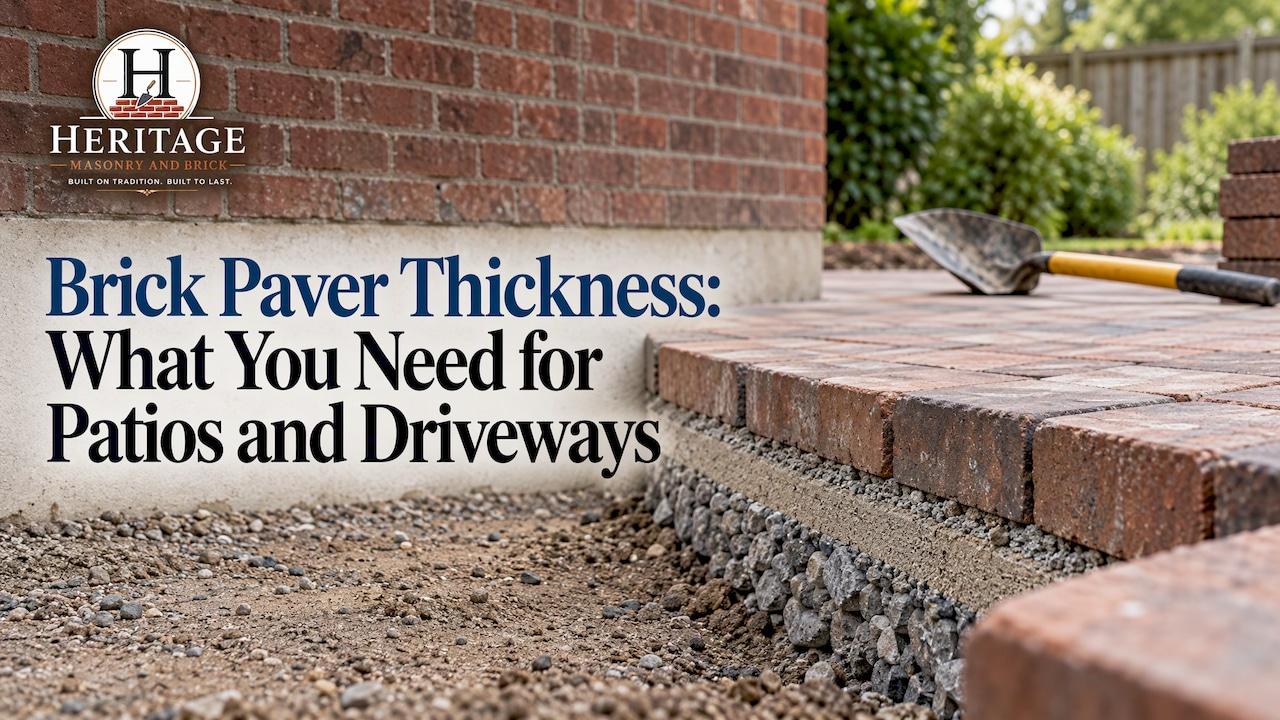
Most clay brick pavers are 2¼ inches thick, and that is the right choice for the typical Richmond patio or walkway. Thinner 1½-inch pavers are usually laid only over a rigid base. A driveway that carries heavy vehicles needs pavers at least 2⅝ inches thick. The thickness of the brick is only one layer of the system, though. The compacted gravel base underneath does most of the structural work.
We are a family of traditional masons in Richmond, Virginia, with over 25 years in the trade. This guide explains thickness the way we explain it on site visits, with the industry standards behind it.
TL;DR
- Clay pavers are commonly made in 1½ in. (38 mm) and 2¼ in. (57 mm) thicknesses, with 2¾ in. (70 mm) used for heavy vehicle areas.
- For a patio or walkway, 2¼ in. pavers over a compacted aggregate base of at least 4 in. is the usual build.
- Heavy vehicular paving brick under ASTM C1272 must be at least 2⅝ in. (67 mm) thick for Type F, so a 2-inch paver is not the answer for trucks.
- Base depth, drainage and soil matter as much as brick thickness. Richmond clay soils call for extra care below the pavers.
- Matching existing brick in the Fan, Museum District or Monument Avenue takes more than picking a thickness. Call 804-324-6304 for a free estimate.
Table of Contents
- How thick is a clay brick paver?
- What thickness suits a patio or walkway?
- Can you use a 2-inch paver on a driveway?
- Thickness is only one layer: the base
- Brick pavers beside historic brick in Richmond
- Why lime mortar matters when pavers meet old brick
- How to choose paver thickness for your project
- Plan your brick paving with Heritage Masonry & Brick
- FAQ
- Sources
How thick is a clay brick paver?
There is no single answer, because clay pavers are made to several thicknesses. The Brick Industry Association (BIA) notes that pavers meeting ASTM C902 are not required to have a minimum thickness, but they are commonly manufactured at 2¼ in. (57 mm) and 1½ in. (38 mm). Its guidance on paving over a bituminous setting bed adds that common specified thicknesses also include 2¾ in. (70 mm).
Manufacturer literature agrees. Pine Hall Brick lists beveled pavers in a standard 4 x 8 inch size at 2-1/4 in. thick, with a 2-3/4 in. option for heavy vehicular use and thin pavers at 1-3/8 in. for mortared installation or installation over concrete. Glen-Gery gives a nominal thickness of 2-1/4 in., with limited availability of 2-3/4 in. units for heavy vehicular work.
Here is how the common sizes line up:
| Thickness | Metric | Typical role |
|---|---|---|
| 1-3/8 to 1½ in. | 35 to 38 mm | Thin pavers, usually mortared over a rigid base such as concrete |
| 2¼ in. | 57 mm | The standard paver for patios, walks and residential use |
| 2⅝ in. | 67 mm | Minimum for Type F heavy vehicular pavers under ASTM C1272 |
| 2¾ in. | 70 mm | Heavy vehicular applications |
Note that a brick paver is not the same as a concrete paver. Concrete pavers are often sold in 60 mm and 80 mm thicknesses. Clay brick pavers follow the inch sizes above, so do not mix the two systems when you compare quotes.
What thickness suits a patio or walkway?
For foot traffic and normal residential use, 2¼-inch pavers are the safe default. They are the nominal thickness most clay paver makers build around, and they work on either a flexible sand-set base or a rigid base.
Thin 1½-inch pavers are more limited. The BIA explains that, except for patios or walks at one- or two-family homes in warm climates with limited frost exposure, 1½-in. pavers are usually installed only over a rigid base. Richmond has freeze and thaw cycles every winter, so for a sand-set patio here we lean toward the thicker unit and a properly built base.
The Mason Contractors Association of America lists pedestrian and light traffic paving brick under ASTM C902 with a minimum thickness of 2 3/8 inches. Standards documents are not all written the same way, which is one reason to ask your mason which spec the brick was made to before you order.
Walkways and steps
Walkways get the same 2¼-inch paver as patios. Width matters as much as thickness for comfort and safety, and we cover it in our guide to masonry walkway width standards. Steps are a different build: they use solid brick laid in mortar on a footing, not pavers on sand. Our brick steps and step repair service covers both new steps and worn ones.
Can you use a 2-inch paver on a driveway?
Usually not for anything heavier than a family car, and it depends on the product rating, not the nominal number on the pallet.
Here is the logic. Pavers for heavy vehicle areas fall under ASTM C1272. The BIA states that for these areas Type F pavers require a minimum thickness of 2⅝ in. (67 mm), exclusive of chamfers, and that Type R pavers need at least 2¼ in. (57 mm). A 2-inch brick falls below both numbers.

For sand-set heavy vehicle pavement, thickness has a mechanical purpose. The BIA's heavy duty paving guide says pavers need 2-5/8 in. (67 mm) to achieve interlock, and that thinner pavers will not interlock and may move under load.
What counts as heavy? The BIA defines it as pavement exposed to more than 251 daily equivalent single axle loads from trucks or combination vehicles with three or more loaded axles. A household driveway is not usually in that class, but a delivery route to a commercial property can be.
So for a driveway, ask these three questions:
- What is the product rated to: C902 or C1272?
- Is the base sand-set over aggregate or rigid, such as concrete? Rigid bases change what thickness is acceptable.
- Will anything heavier than cars use it, such as trash trucks, moving vans or delivery trucks?
A 2¼-inch paver on the right base is a standard residential pairing. A true 2-inch product needs its manufacturer's rating confirmed before it goes anywhere near a drive. If you want a brick driveway or drive apron in Richmond, we will specify the brick and base together.
Thickness is only one layer: the base
Homeowners often ask about thickness when the real question is depth. A paver is the surface. Beneath it sit the setting bed, the base, and sometimes a subbase.
The BIA describes the roles this way: the setting bed adjusts for variations in paver height and transfers load, and the base is the primary structural layer. Pedestrian loading needs only a 4-in. (102 mm) base when site conditions do not call for more. Vehicle loading needs a thicker one.
For a residential patio or walk on sand, the BIA specifies a sand setting bed spread about 1 in. (25 mm) uncompacted, compacted to between ¾ and 1 in., over a compacted aggregate base of at least 4 in. Add a 2¼-inch paver and the whole assembly runs roughly 7 to 8 inches from the surface to the soil, before any subbase.
Here is the build, top to bottom, for a typical patio:
- 2¼ in. clay paver
- About ¾ to 1 in. compacted sand setting bed
- At least 4 in. compacted aggregate base
- Geotextile fabric over the subgrade where soil is silty or clayey
- Compacted native subgrade, sloped for drainage
That geotextile line matters in Richmond. The BIA says that on silty or clayey soils a geotextile should be placed on the compacted subgrade so fine particles do not contaminate the aggregate. Much of our region sits on clay, and a base that mixes with clay loses its strength.
We go deeper on gravel depth in our patio base preparation guide, and on water problems in our brick patio drainage guide. If you are removing an old patio first, plan where the old brick and spoil will go. Services for brick waste removal exist for exactly this stage of a rebuild.
Driveways and rigid bases
Heavier use changes the base more than the brick. For light vehicular traffic on a bituminous setting bed, the BIA calls for a minimum 4 in. of reinforced concrete over a 4 in. compacted subbase, or 8 in. of reinforced concrete as base and subbase. An asphalt base needs a minimum 4 in. of asphalt over an 8 in. subbase, or 12 in. of asphalt overall. For parking areas and neighborhood streets the BIA says a concrete base or a thicker aggregate or asphalt base is required.
The takeaway: a thicker paver cannot fix a thin base. A driveway fails from below.
Brick pavers beside historic brick in Richmond
Richmond homes in the Fan District, the Museum District and along Monument Avenue were built with brick that varies in color, size and texture. New pavers laid beside that brick should look at home, not stand out.

The BIA describes Application PA pavers as having variability in size, color and texture, and says they have performed successfully in historic clay paving where a distinctive architectural character is wanted. These are often installed with mortar joints, though they can succeed with sand-filled joints when laid by workers experienced with them.
That last point is a real craft issue. Pavers that vary in size need a mason who adjusts the setting bed and joints as the work goes.
When we work on historic brick, we match the existing brick and mortar so the repair blends in. For joints that need to be reworked beside a new patio or steps, we use traditional lime mortar. Our historic brick repair in the Fan and Museum District page explains how we approach older homes.
Why lime mortar matters when pavers meet old brick
Many Richmond houses and garden walls were laid with lime mortar, a soft, breathable mix. A lime mix mortar is made from lime and sand, and it is typically softer than the brick around it. That is the point: the mortar takes the wear and movement so the older, softer brick does not crack or spall.
This matters on paving projects in three ways:
- Steps and risers. Where a new paver patio meets old brick steps or a foundation wall, joints and repairs on the old brick should be made in a compatible mortar.
- Garden walls and edges. A new patio often ties into a retaining or garden wall. Hard modern mortar next to old brick can cause damage over time.
- Mortared pavers. Where pavers are set in a mortar bed on a rigid base, the joint material and color should suit the surrounding brickwork.
We use traditional lime mortar for lasting repairs on historic brick, and we match the color and texture of the existing mortar. If your old brickwork has loose or crumbling joints, our brick repointing and tuckpointing service is the place to start.
How to choose paver thickness for your project
Use this short decision path:
- Foot traffic only (patio, walkway, garden path). Choose 2¼ in. pavers on a compacted base of at least 4 in. Use a rigid base if you want thin 1½ in. pavers.
- Passenger cars (residential driveway). Choose pavers rated for the use, with a base built for vehicles. Ask for the standard and class on the spec sheet.
- Heavy trucks or commercial service routes. Use ASTM C1272 pavers, at least 2⅝ in. thick for Type F, with the engineered base and edge restraint the system calls for.
- Mortared pavers over concrete. Thin pavers of about 1-3/8 to 1½ in. are designed for this.
- Beside historic brick. Choose the paver for character and size variation, then match the mortar and joints.
Two more details we check on every job: drainage, since standing water is what lifts and stains brick, and edge restraint, since pavers shift at open edges. Our brick patio cost guide explains how base depth and brick choice affect budgets, and our brick patio maintenance guide covers care in Richmond's climate once the work is done.
Our point of view as Richmond masons
Homeowners ask us how thick a paver should be, and we always turn the question around: what is going on under it? In Richmond, with clay soil and a freeze each winter, a good paver on a poor base will settle, hold water and heave. A well-built base under a standard 2¼-inch paver will outlast a thicker paver on a rushed one.
We build and repair brick the traditional way. That means matching existing brick and mortar, using lime mortar where old brick calls for it, and doing the job right the first time so it lasts for decades. We back our work with a 5-year guarantee on materials and workmanship, take no deposits, and ask for payment on completion.
If your patio, walkway or steps sit beside historic brick in the Fan, the Museum District or along Monument Avenue, the best result comes from one crew who understands both the new paving and the old brickwork.
Thomas
Plan your brick paving with Heritage Masonry & Brick
We build brick patios and walkways in Richmond, VA, and repair existing ones. We handle the base, the pavers, the joints and the tie-in with older brick, and we offer free estimates. Details are on our brick patios and walkways page, and our new brickwork page covers custom features.

Call 804-324-6304 today for a free estimate. There are no deposits, and payment is due on completion.
FAQ
Can you use 2-inch thick pavers for a driveway?
It depends on the product rating and the traffic. Heavy vehicular clay pavers under ASTM C1272 must be at least 2⅝ in. thick for Type F, so a 2-inch unit does not qualify. For a family car driveway, confirm the paver's standard and the base design before buying.
How thick should brick pavers be for a patio?
A 2¼-inch clay paver is the usual choice. Lay it on a setting bed of about ¾ to 1 in. of compacted sand over at least 4 in. of compacted aggregate. Thinner 1½ in. pavers are usually set over a rigid base.
Are there 1 inch thick pavers?
Thin pavers exist, but clay pavers are commonly made in 1½ in. and 2¼ in. thicknesses, with thin units around 1-3/8 in. for mortared installation. Very thin products are suited to mortar over a rigid surface, not to sand-set patios.
Do I really need gravel under pavers?
Yes, for a sand-set installation. The compacted aggregate base is the structural layer that carries the load, and the BIA calls for at least 4 in. under pedestrian paving. A rigid base such as concrete is the alternative for mortared pavers.
Sources
- Paving Systems Using Clay Pavers (BIA Technical Note 14)
- Paving Systems Using Clay Pavers on a Sand Setting Bed (BIA Technical Note 14a)
- Paving Systems Using Clay Pavers on a Bituminous Setting Bed (BIA Technical Note 14b)
- Flexible Vehicular Brick Paving (BIA Heavy Duty Paving Applications Guide)
- Pine Hall Brick Paver Brochure 2025
- Glen-Gery Interlocking Clay Unit Pavers
- Brick paver installation methods (Mason Contractors Association of America)