
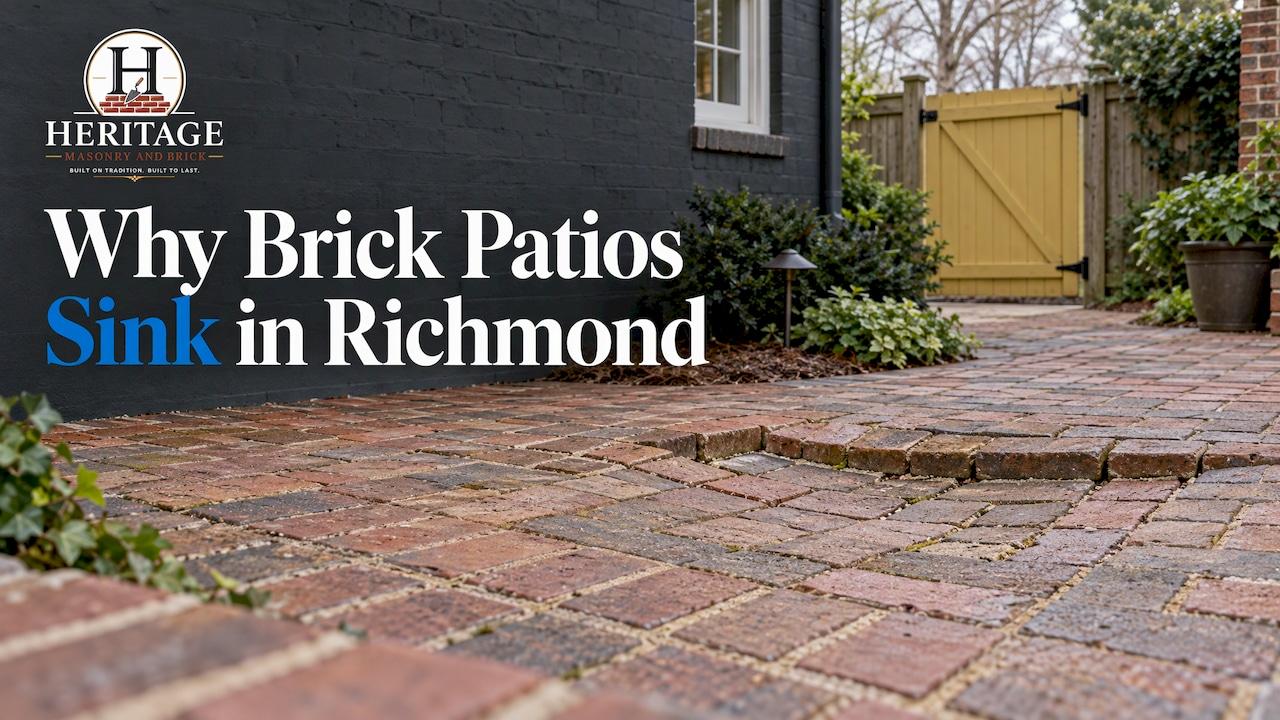
A brick patio settles because something underneath it has moved: a base that was never fully compacted, bedding sand washed away by water, edges that let the pavers spread, or soil that shifts as it wets and dries. The surface is rarely the problem. In Richmond, Virginia, where heavy clay soil, summer storms and freeze-thaw winters all work on a patio, the cause is usually a mix of two or three of these.
This guide explains each cause, how to read the signs on your own patio, and when a repair needs a mason rather than a weekend of re-leveling.
TL;DR
- Most sinking comes from below the bricks: poor base compaction, lost bedding sand, weak edge restraints or soil movement.
- Water is the common thread. Where it collects or runs underneath, the patio tends to drop first.
- Settlement deeper than 1/2 inch is the point where federal paving guidance treats the surface as needing repair.
- Re-laying bricks without fixing the cause means the patio sinks again. The base has to be corrected too.
- We repair and rebuild brick patios across Richmond, VA, with free estimates and a 5-year guarantee on materials and workmanship.
Table of Contents
- How a brick patio is supposed to be built
- Cause 1: A base that was not compacted or not deep enough
- Cause 2: Water washing out the bedding sand
- Cause 3: Failing edge restraints
- Cause 4: Soil that compacts, swells or stays wet
- Cause 5: Failing joints and lost jointing material
- Why mortar type matters on brick work around the patio
- How to tell which cause you have
- Why re-leveling often fails
- Perspective: why we dig before we re-lay
- Prevent the next round of settling
- Brick patio repair in Richmond, VA
- FAQ
- Sources
How a brick patio is supposed to be built
It helps to know what is under your feet. A properly built brick or paver patio is a layered system: the surface units sit on a thin bedding layer, which sits on compacted aggregate base, which sits on prepared soil. FHWA describes this layering as pavers and bedding over base and subbase aggregates. Every layer has a job. The soil carries the load, the base spreads it, the sand levels the bricks, and the joints and edges lock the whole thing together.

Settling is what happens when any one layer stops doing its job. That is why the same visible symptom, a dip in the bricks, can have very different causes, and why the right fix depends on finding the right one.
If you want the construction side in detail, our contractor guide to patio base preparation with 4 to 6 inches of gravel walks through it.
Cause 1: A base that was not compacted or not deep enough
This is the most common reason a patio sinks within the first few years. Loose base material compresses under foot traffic, furniture and rain, and the bricks drop with it.
The Interlocking Concrete Pavement Institute makes a useful distinction. Compaction is quick, mechanically induced densification, while settlement is long-term volume reduction driven by loads, seepage and freeze-thaw cycling. If a base is not compacted properly at the start, the settlement that should have been done by a plate compactor in an afternoon happens slowly, under your patio, over seasons.
The same ICPI article says aggregate does not reliably compact itself just because it was dumped and spread, and that uncompacted open-graded aggregate can settle later. It needs suitable compaction equipment. FHWA's construction guidance goes further and calls for written field verification of compaction before bedding material is placed.
Common shortcuts that lead to this problem:
- Digging too shallow, so the base is thin or skipped
- Compacting one thick layer instead of building the base in thinner lifts
- Leaving topsoil, roots, debris or builder trash under the base
- Placing base on soil that was wet and soft at the time
On older Richmond homes, we also see patios laid directly over fill soil left from earlier construction. The surface looks fine for years, then one section drops.
Cause 2: Water washing out the bedding sand
Water is the quiet culprit behind a large share of sunken brick patios. When water reaches the underside of the bricks and moves, it carries away fine material. The bedding sand goes first because it is the finest layer.
A professional paving guide from the clay brick industry lists inadequate subbase preparation, loss of bedding sand from poor subsurface drainage, and movement at edge restraints as causes of localized rutting. Sand loss leaves voids, and bricks drop into voids.
Where does the water come from?
- Downspouts that discharge onto or beside the patio
- A patio surface that slopes toward the house or toward a low spot
- Joints that have lost their sand and let water straight through
- Runoff from a neighboring slope, driveway or roof
- Gaps along a wall or step where water runs behind the bricks
Richmond gets heavy summer thunderstorms, so a drainage flaw that stays hidden in dry weeks shows itself fast. For a closer look at slope, base and drain specifications, this breakdown of paver patio drainage specs is worth reading alongside our own 20-minute brick patio drainage check.
Cause 3: Failing edge restraints
A brick patio holds its shape only because the edges stop the bricks from spreading. If the edge gives way, the bricks creep outward, the joints open, and the surface drops.
FHWA notes that damaged edge restraints can produce movement in pavers and may require removal and reinstatement of the adjacent units. The clay brick paving guide adds that outward movement at the edge causes sand loss, shunting and chipping.
Signs your edges are the problem:
- The outer rows are lower or wider-jointed than the middle
- A visible gap has opened between the patio and a wall, step or curb
- Bricks along the perimeter rock when you step on them
- Soil or mulch has pushed in over the edge, or the edge material has shifted
Retaining walls and brick edging deserve special attention. If a wall at the edge of your patio is bulging, leaking or losing mortar, the patio will follow it. One forum post that ranks for this topic makes the same point in plain terms: fix the leaking wall first, or whatever you put on top will want to settle. We agree. A patio with a failing brick wall beside it needs both repaired. See our guide to fixing loose driveway brick edging for what edge failure looks like in practice.
Cause 4: Soil that compacts, swells or stays wet
The ground under the base matters as much as the base itself.
Disturbed and compacted soil
University of Florida IFAS explains that construction equipment and traffic compact urban soils, reducing pore space and water movement, and that the effect is worse when heavy equipment runs over wet soil. Compacted soil also increases runoff and erosion because less water soaks in. Around a new or renovated house, the ground next to the patio may be a mix of compacted and loosened areas, and they settle at different rates.
Heavy clay
Many yards in the Richmond area have clay-heavy soil. North Carolina State Extension notes that heavy clay soils move water slowly and can stay wet for long periods, and that construction compaction restricts drainage further. A patio on soil that stays saturated sits on a softer foundation.
Clay also changes volume with moisture. A university review of clay stabilization states that expansive clay soils change significantly in volume with water content and distort structures, at a cost of several billion dollars a year in the United States. On a patio, that shows up as uneven movement: one corner rises or drops while the rest stays put.
We cover the specifics of building on this ground in building a patio on clay soil in Richmond, VA.
Soil migrating into the base
Where a base sits directly on silt or clay with no separation, fine soil can work its way up into the aggregate and weaken it. ICPI explains that geotextile separates the base from the subgrade, lets water drain and keeps soil from migrating into the base, and it particularly recommends separation over silt and clay soils.
Tree roots
Roots can lift one area of a patio while the soil around them shrinks as the tree draws moisture, leaving dips and humps side by side. Mature trees are common in Richmond neighborhoods like the Fan and Museum District, so this is a frequent cause in older yards. Our page on tree roots under a patio covers the causes and fixes.
Cause 5: Failing joints and lost jointing material
Joint material is not decoration. It locks bricks to each other and keeps water and weeds out. When it washes out, bricks move independently, water gets under them, and the bedding sand starts to leave.

FHWA's maintenance checklist says joint aggregate should be replenished when it sits more than 1/2 inch below the paver chamfer. On a mortared brick patio, step or wall, the equivalent problem is open or crumbling mortar joints.
This is where traditional masonry knowledge pays off, and where our owner-requested focus on brick and mortar matters.
Why mortar type matters on brick work around the patio
Many Richmond patios are not freestanding. They meet brick steps, garden walls, foundations and retaining walls, some of them more than a century old. Water that gets into those structures ends up under the patio.
Old brick was built with soft, breathable lime mortar. In our experience as traditional masons, lime mortar is designed to be the sacrificial part of a wall: it is softer than the brick and lets moisture move out through the joints. A hard modern cement mortar packed into old joints can trap moisture and put stress on the brick face. That is why, on historic brick, we repoint with lime mortar mixed to match the original in color, texture and strength.
What that means for a settling patio:
- A wall beside the patio with failed joints lets water run behind and under the bricks. Repointing it stops the water at the source.
- A step that has pulled away from the patio needs its joints and its footing looked at together.
- Matching the existing brick and mortar means the repair blends in rather than showing as a patch.
Our brick repointing and tuckpointing work is built around this approach.
How to tell which cause you have
Walk the patio after a rainstorm, then again when it is dry. FHWA recommends inspecting after a storm and says its inspection should document settlement, ponding, cracked pavers, runoff changes, perimeter soil stability, edge restraints and sediment in the joints. That list works for a home patio too. Water that stays on the surface more than an hour signals a drainage problem.
Use this table as a starting point.
| What you see | Likely cause | What to look at |
|---|---|---|
| One broad dip in the middle | Base not compacted, or void from lost sand | Joint condition, downspouts, slope |
| Dip near the house or a wall | Water running along the structure | Gutters, grading, wall joints |
| Outer rows low and gaps at the edge | Edge restraint failure | Perimeter, soil behind the edge |
| Open joints and exposed sand lines | Sand washout | Where water enters under the surface |
| Hump next to a dip | Tree roots or swelling clay | Nearby trees, soil moisture |
| Whole patio sinks evenly over years | Soil compression or thin base | Original build depth |
| Cracked bricks with movement | Overload on a weak base | Base and bedding below the cracks |
Two numbers help you judge severity. Both FHWA documents treat localized settlement greater than 1/2 inch as a repair condition, and the maintenance checklist says surface deformation beyond 1/2 inch should be repaired. Lay a straight board across the dip and measure the gap. If it passes 1/2 inch, or if it is a trip hazard, treat it as a repair, not a watch-and-wait item.
Why re-leveling often fails
The tempting fix is to lift the sunken bricks, pour in sand and put them back. That works only if the cause was a small amount of lost sand. If water is still reaching the underside, or the base is thin, or the edge is moving, the same dip returns, often within a season or two.
A lasting repair follows an order:
- Stop the water: redirect downspouts, correct slope, repair adjacent walls and joints.
- Find out how far the problem extends, which often means lifting more bricks than the visible dip.
- Rebuild the failed layer: excavate soft material, add separation fabric where soil calls for it, rebuild and compact the base in lifts.
- Reset the edges so the bricks cannot spread.
- Re-lay the original bricks, matching any replacements to the existing brick, then fill the joints.
Reusing your existing bricks keeps the patio's age and character, which matters on a historic Richmond property.
Perspective: why we dig before we re-lay
We have spent more than 25 years working on Richmond brick, and the pattern is consistent: when a patio sinks, the homeowner has usually already tried to fix the top. They have swept in sand, reset a few bricks, maybe added a bag of gravel. It helps for a month.
The truth is in the layers. We lift the bricks, look at what is under them, and let that tell us the cause. Sometimes it is a downspout that has been dumping on one corner for ten years. Sometimes the base is two inches of loose stone over clay. Sometimes the wall beside the patio is leaking through failed joints, and the patio is just the place where the damage shows.
That is why we treat patios as masonry, not landscaping. We repair the walls and steps that surround them, repoint with lime mortar where the structure calls for it, and rebuild the base so the repair holds. We match the existing brick and mortar so the finished patio looks like it has always been there. Because we stand behind our work with a 5-year guarantee on materials and workmanship, we would rather do it once and do it right.
Thomas
Prevent the next round of settling
Once a patio is stable, a few habits keep it that way:
- Keep gutters clear and downspout extensions pointed well away from the patio.
- Top up joint material as it washes out, before gaps open.
- Check the patio after heavy storms for ponding and new low spots.
- Keep soil and mulch from burying the edge, and keep edging tight.
- Repoint nearby brick walls and steps when mortar joints start to crumble.
- Watch trees close to the patio, since root growth is slow and easy to miss.
Our Richmond brick patio maintenance guide gives a seasonal routine, and our advice on when to seal paver patios covers the surface side.
Brick patio repair in Richmond, VA
If your patio is sinking, pooling or pulling away from a wall or step, we can open it up, find the cause and rebuild it so the repair lasts. We work on brick patios, walkways, steps and retaining walls for homes and commercial properties across Richmond, including the Fan District, Museum District and Monument Avenue area.

We offer free estimates, require no deposit and ask for payment on completion, with a 5-year guarantee on materials and workmanship. See our brick patios and walkways service or call 804-324-6304 today. If the problem is crumbling joints or a leaking wall next to the patio, our brick repair team handles that too.
FAQ
Why is my brick patio sinking after only a year or two?
The usual reasons are a base that was not compacted well, a base that is too thin, or water washing sand out from under the bricks. Settlement that appears early typically points to the original build rather than age. A mason can lift a few bricks and show you what is underneath.
Can I just add sand and reset the bricks?
Only if a small amount of sand was lost and the water source is already fixed. If the base is soft or the edge is moving, the dip will come back. Measure the dip with a straight board: past 1/2 inch, it needs a proper repair.
Does clay soil make patios settle?
It can. Heavy clay drains slowly and can stay wet, and expansive clay changes volume as moisture changes, which moves whatever sits on it. Many Richmond yards have clay, so a well-built base with good drainage matters. Separation fabric between soil and base is often recommended over clay.
Should I repair a retaining wall or step before the patio?
Yes. If a nearby wall or step is leaking through failed joints or moving, water and movement will keep undermining the patio. Repairing the structure first, including lime mortar repointing where it suits the brick, protects the patio work.
Is a sinking patio dangerous?
It can be a trip hazard once bricks sit unevenly, and ponding water can make surfaces slippery. If you see uneven edges, rocking bricks or a dip that holds water, have it looked at before someone is hurt.
Sources
- Clay Paving Guide (Clay Brick Association)
- Permeable Interlocking Concrete Pavement, 2015 (FHWA)
- Permeable Interlocking Concrete Pavement, 2019 (FHWA)
- Soil Compaction in the Urban Landscape (UF/IFAS)
- Modifying Soil for Plant Growth around Your Home (NC State Extension)
- Review of Stabilization of Clays and Expansive Soils