
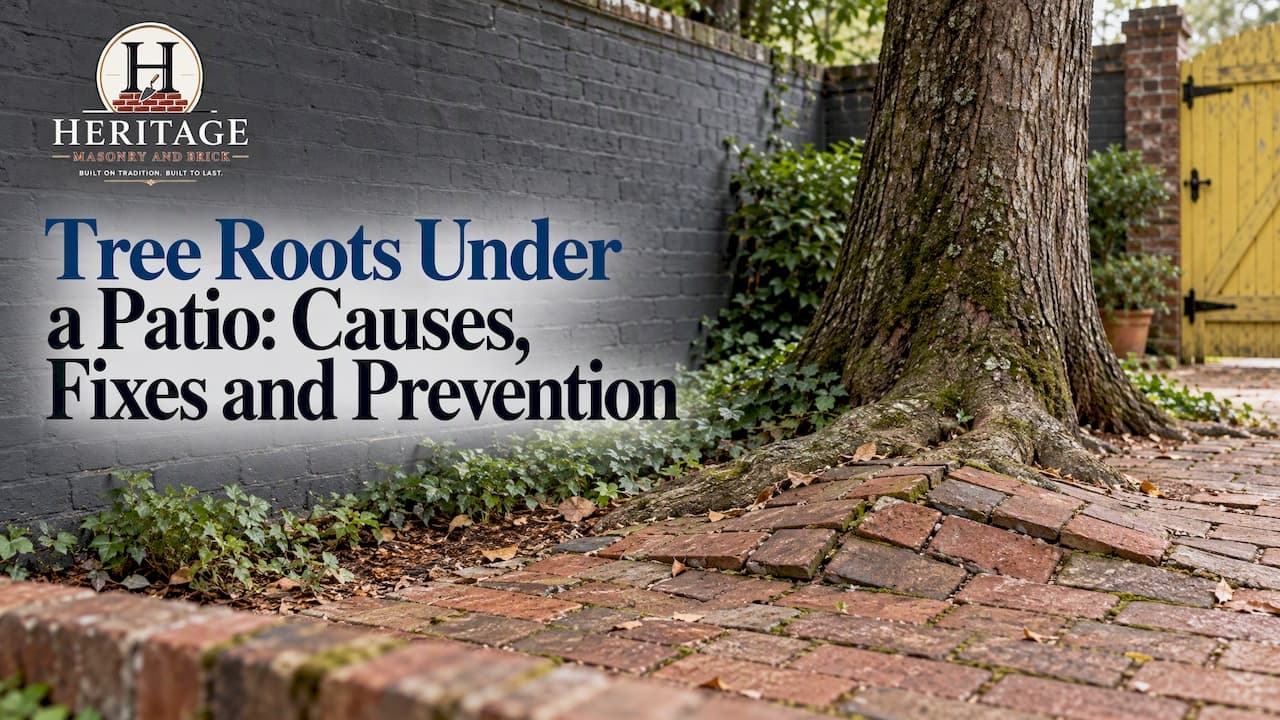
Tree roots under a patio lift pavers and crack slabs because they grow near the surface and thicken every year. The fix is rarely just cutting the root. The right repair depends on how big the root is, how close it sits to the trunk, and whether the patio is rigid concrete or flexible brick. For Richmond, Virginia homeowners with mature trees, the usual answer is to reset the surface so it moves with the roots, not against them.
This guide explains why roots end up under a patio, what you can safely do, what you should leave to a certified arborist, and how a mason rebuilds the patio so the problem does not return.
TL;DR
- Roots grow sideways in the top layer of soil, where water and air are. When a patio sits there, roots slip underneath and push up as they thicken.
- Do not cut large roots on your own. Roots over 4 inches across are likely structural, and cutting them can harm the tree or make it unstable.
- Flexible surfaces such as brick or pavers forgive small root movement better than rigid concrete, and they can be lifted and reset.
- A good repair combines a proper base, a ramp or bridge over big roots, and a clear plan for the tree. A mason handles the first two, and an arborist advises on the third.
- In Richmond, call Heritage Masonry & Brick at 804-324-6304 for a free estimate on brick patio repair and rebuilds.
Table of Contents
- Why roots grow under a patio
- How to tell what is happening under your patio
- What not to do first
- Repair options, from least to most invasive
- How a mason rebuilds a patio near roots
- Why Richmond brick patios lift in particular
- Brick, mortar and lime: why the materials matter
- Preventing the problem at planting and at design
- Perspective: what we see on Richmond patios
- Brick patio repair in Richmond, VA
- When to call whom
- FAQ
- Sources
Why roots grow under a patio
Most people picture roots as a mirror image of the tree, plunging deep. They don't. Tree roots seek water and nutrients horizontally, near the soil surface, and when they meet a hardscape they can grow beneath it. Roots need soil, air and water, and they commonly occupy shallow soil close to the surface.
A patio makes that top layer attractive. Moisture collects under the slab or pavers, and the ground stays cooler and less dry than open lawn. Roots follow.
The damage is slow. Roots begin very small beneath pavement, then increase in diameter as the tree grows, which lifts or cracks the surface above. You may see nothing for years, then notice a rocking paver or a ridge across the patio after one season.
Which trees cause the most trouble
Shallow-rooted trees have the most potential to disturb concrete, and faster-growing trees tend to do more damage. A tree planted right beside a slab can crack and raise it as the trunk and crown grow with great force.
In Richmond, that often means mature street and yard trees in older neighborhoods: the Fan, the Museum District, Church Hill and along Monument Avenue, where brick patios, walkways and steps were laid decades ago and the trees have had a long time to catch up.
Roots are not always the whole story
Before blaming the tree, rule out other causes. Chicago's transportation department points out that not every crack or heave comes from roots. Freeze-thaw cycles can expand cracks and heave concrete, and roots may then grow into the new gap. Poor drainage and a weak base do similar harm. If water pools on your patio, read our guide to diagnosing brick patio drainage before assuming roots are the only culprit.
How to tell what is happening under your patio
Walk the patio slowly and look for these signs:
- A ridge or hump running from the tree toward the house or the far edge. This is the classic root line.
- Pavers or bricks tilting in one direction, with joints open on the high side.
- Cracks that radiate from one point on a slab, usually where a root has grown thick.
- Trip edges where one section sits higher than its neighbor.
- Surface roots poking through the lawn near the patio edge.
Measure how high the lift is. A lip of under half an inch can sometimes be reset. Anything bigger, or a patio that has lifted in several places, usually calls for taking up the surface and rebuilding the base.
Note the distance to the trunk and, if you can, the trunk diameter. An arborist will ask for both, and they decide what can be done safely.
What not to do first
The tempting move is to grab a saw or an axe and cut the root that is causing the lift. That can be a costly mistake.
Damaging roots could harm or even kill the tree. Roots over 4 inches in diameter are likely structural, and cutting them may affect the tree's stability and create a risk of falling. A tree that drops onto a house or a neighbor's yard costs far more than any patio.
A few more cautions:
- Buttress roots should not be cut closer to the trunk than three times the trunk diameter. On a trunk 12 inches across, that is 36 inches.
- The loss of stability from root shaving, and how fast shaved roots decay, are not known. If shaving happens closer than three times the trunk diameter, the same source advises inspecting the tree every year for health and stability.
- Have a qualified arborist present for any root cutting. Pruning decisions belong to them, not to the person laying the surface.
If the tree is on public property or a right-of-way, stop. Arlington County, for example, prohibits injuring or removing trees in public rights-of-way without written permission, and violations are misdemeanors. Richmond has its own rules for city trees, so call the city before touching a tree in the street strip.
Repair options, from least to most invasive
The goal is to give the patio a level, stable surface without hurting the tree. The Bartlett Tree Research Laboratories lists several approaches in its sidewalk repair guidance: shaving or ramping raised concrete, widening or rerouting the pavement, bridging over roots, or replacing concrete with interlocking pavers. Root barriers or root-excluding bases may help reduce recurrence.
Here is how those ideas translate to a residential brick or paver patio.
| Option | Best for | What it involves | Effect on the tree |
|---|---|---|---|
| Lift and reset pavers | Minor lifting, brick or paver patio | Take up units, remove the high spot, rebuild the base, relay | Low, if no roots are cut |
| Ramp or wedge | A single raised root | Taper the surface over the root so the transition is gradual | Low |
| Bridge over roots | Large roots you must keep | Build the surface above the roots with a bed that does not press on them | Low |
| Reroute or narrow the patio | Roots near the trunk | Move the edge or path away from the root zone | Lowest |
| Replace slab with pavers or brick | Cracked concrete | Remove the slab and lay flexible units on a proper base | Depends on excavation depth |
| Root pruning with an arborist | Smaller, non-structural roots | Selective cuts, guided by the arborist | Moderate, needs professional judgment |
Ramps, wedges and bridging are worth asking about because they avoid root pruning entirely.
Why brick and pavers cope better than concrete
Flexible materials such as pavers, bricks or rubber paving can accommodate minor root-related movement better than rigid concrete. A slab cracks. A brick patio shifts, and the units can be lifted and relaid. Interlocking pavers can be removed when they lift, so you repair one area instead of replacing the whole surface.

That is one reason brick is a sensible choice near trees in Richmond. It is also the material our family has worked with for over 25 years.
How a mason rebuilds a patio near roots
The steps below describe the general approach for a brick or paver patio that has been lifted by roots. Each job differs, and the tree comes first.
- Assess the tree and the root zone. Note species, trunk size, and distance from the patio. Bring in an arborist if large roots are involved.
- Mark and photograph the existing pattern. On a historic brick patio, the bond pattern and the brick itself matter. Photos let the work go back the way it was.
- Lift the affected area. Take up the bricks or pavers by hand and stack them in order. Clean and sort them so sound units are reused.
- Expose the roots carefully. Hand tools only. Avoid machines that tear roots.
- Decide: ramp, bridge or reroute. If a large root must stay, the new base can pass over it, or the surface can taper across it.
- Build the base. A compacted, well-drained base keeps the surface stable. Our guide to patio base preparation with 4 to 6 inches of gravel explains how depth and compaction work.
- Relay the brick. Set the units to the original pattern, fill the joints, and compact.
- Check drainage. Water should leave the patio, not sit under it. Standing water draws roots back.
A thick compacted gravel layer also matters for roots. One landscaper explains how a 4 inch gravel base can discourage roots from moving in under a patio and how the surface is repaired once roots have displaced it.
Do not bury roots under fill
A common question is whether it is fine to cover roots with extra soil and lay the patio on top. Usually it is not. Piling soil over the root zone suffocates roots and can stress the tree. A thin layer of mulch or a bridge that leaves air and water access is a safer idea. Ask the arborist before adding any fill within the tree's drip line.
Why Richmond brick patios lift in particular
Richmond sits in a climate with humid summers and winters that dip below freezing often enough to matter. That gives you two forces working together: roots swelling in summer and frost opening gaps and loosening base material in winter. A patio with sand joints that have washed out lets water in, which softens the base, and roots move into the softened zone.
Freeze-thaw is an issue by itself too. For a look at how it damages pavers, see this overview of freeze-thaw paver damage.
Moss and shade add to it. Mature trees shade the patio, which keeps it damp. If your patio is green and slick, our guide on cleaning moss from a brick patio without losing joint sand shows how to clean it without making joints worse.
Brick, mortar and lime: why the materials matter
Because the owner of an older Richmond home often has more than a patio at stake, a word on materials. Roots do not stop at patios. They can also push on steps, garden walls, foundations and brick walkways. Repairs in those places depend on the mortar you use.
What lime mortar is
Lime mortar is a mix of lime, sand and water. Older brick, including much of the brick laid in Richmond's historic neighborhoods, was built with it. It is softer and more flexible than modern Portland cement mortar, and it lets moisture move out through the joint instead of through the brick.
That softness is the point. Mortar is meant to be the sacrificial part of a wall or walkway: the joint takes the wear, not the brick. When a hard cement mortar goes into old, soft brick, the brick can crack and spall at the edges because the joint is stronger than the unit it holds.
Where lime mortar helps near trees
- Brick walls and steps that move slightly as roots grow or the soil shifts. A flexible lime joint tolerates small movement better than a rigid cement joint.
- Historic garden walls and foundations where repointing is needed and the original look must be kept.
- Walkways and step risers that need repointing after being disturbed.
We match the existing brick and mortar on every repair so new work blends in. On older brick that means lime mortar and the traditional methods the brick was built with. Our page on brick repointing and tuckpointing explains the process.
Not every job needs lime. A new patio laid dry on a gravel base uses sand joints, not mortar. The mortar choice follows the age and type of the brick and how the structure was built.
Preventing the problem at planting and at design
The best time to deal with roots is before the patio exists. Bartlett says the best opportunity to address sidewalk lifting is at tree planting or concrete installation. The same logic applies to a patio.
If you are planning a new patio or replanting around an old one:
- Choose smaller tree species where space is tight.
- Give large trees a rooting area at least 10 feet wide.
- Keep at least 4 feet between the tree and pavement, or use mechanical barriers to stop roots growing under it.
- Use flexible materials such as brick or pavers instead of rigid concrete.
- Leave room around the base of the trunk. One landscape supplier suggests at least 12 to 18 inches between the trunk and the patio edge to protect the root flare, though a larger gap is better for large trees.
Perspective: what we see on Richmond patios
We are a family of masons, and we see root damage most often on patios that were built in a hurry. The pavers were laid on a thin base, or the patio was poured right up to a mature tree. Years later the homeowner sees a ridge and calls us.

Our view is simple. The tree has been there longer than the patio in most older Richmond yards, so the patio should adapt. We would rather ramp over a root, narrow the patio or rebuild with brick that can be reset than cut something that holds up a 60 foot tree. When a root has to be dealt with, we want an arborist beside us.
We also do not believe in quick fixes. Filling a gap with sand or setting a paver back down without fixing the base looks fine for a season. Then the root keeps growing and you pay twice. We rebuild the base, match the existing brick, and stand behind the work with a 5-year guarantee on materials and workmanship.
— Thomas
Brick patio repair in Richmond, VA
If roots have lifted your brick patio, walkway or steps, we can take the surface up, build a stable base and relay it so it blends with what was there. We work on homes and commercial properties across Richmond, including the Fan District and Museum District. Estimates are free, no deposit is required, and payment is due when the work is complete.

See our brick patios and walkways service, or look at brick steps and step repair if roots have shifted your entry. For historic neighborhoods, read about historic brick repair in the Fan and Museum District. Call 804-324-6304 today to book your free estimate.
If the lifted section is a walkway, our brick walkway repair guide shows what a good repair looks like. For loose edging along a driveway, see the driveway brick edging steps.
When to call whom
Different problems need different professionals:
- Certified arborist: any root bigger than a few inches, any cutting near the trunk, a leaning tree, or a tree that looks unhealthy. Ask for an ISA certified arborist.
- Mason: lifted brick or pavers, cracked mortar joints, a failing base, drainage under the patio, and rebuilding the surface.
- City of Richmond: any tree in the public right-of-way.
- Structural engineer: cracks in the house foundation or walls near a large tree. Patio work does not replace a structural check.
FAQ
Am I responsible for damage caused by my tree roots?
It depends on the facts. In Virginia, a neighbor generally cannot succeed in suing over damage from naturally growing roots unless the tree is a nuisance or unhealthy, or there is clear negligence, according to a summary of Virginia tree law. If roots are affecting a neighbor's property, talk to them early and consider asking an attorney for advice on your situation.
Why are tree roots growing under my concrete slab?
Roots follow water, air and nutrients, and these are concentrated in the top layer of soil. A slab holds moisture underneath, so roots move in. As they thicken, they push the slab up or open cracks. Freeze-thaw cracking can also open gaps that roots then fill.
Is it okay to cover up tree roots with dirt?
Usually not. Adding fill over roots can cut off air and water and stress the tree. If you need to level an area, ask an arborist first. A bridge or ramp over the roots, or a thin layer of mulch, is generally safer.
How long does it take for tree roots to break down?
There is no single answer. Small roots decay within a few years, while large roots from a big hardwood can last a decade or more, depending on species, soil moisture and temperature. Dead roots under a patio also leave voids that can settle, so rebuild the base after a tree is removed.
Sources
- How to Manage Trees Near Sidewalks, Iowa State University Extension
- Sidewalk Repair Near Trees, Bartlett Tree Research Laboratories
- Walkways, Driveways, Patios and Roots, City of Chicago
- Ask Extension: tree roots and driveway, University of Illinois Extension
- Tree roots and patios, Ask Extension
- Tree Root Problems, The Morton Arboretum
- Trees & Shrubs Ordinance, Arlington County
- Virginia Tree Laws: Removal, Disputes & Your Rights
- 4 inch gravel base and tree roots under a patio
- Freeze-thaw paver damage
- How to Level Land When Roots are in the Way