
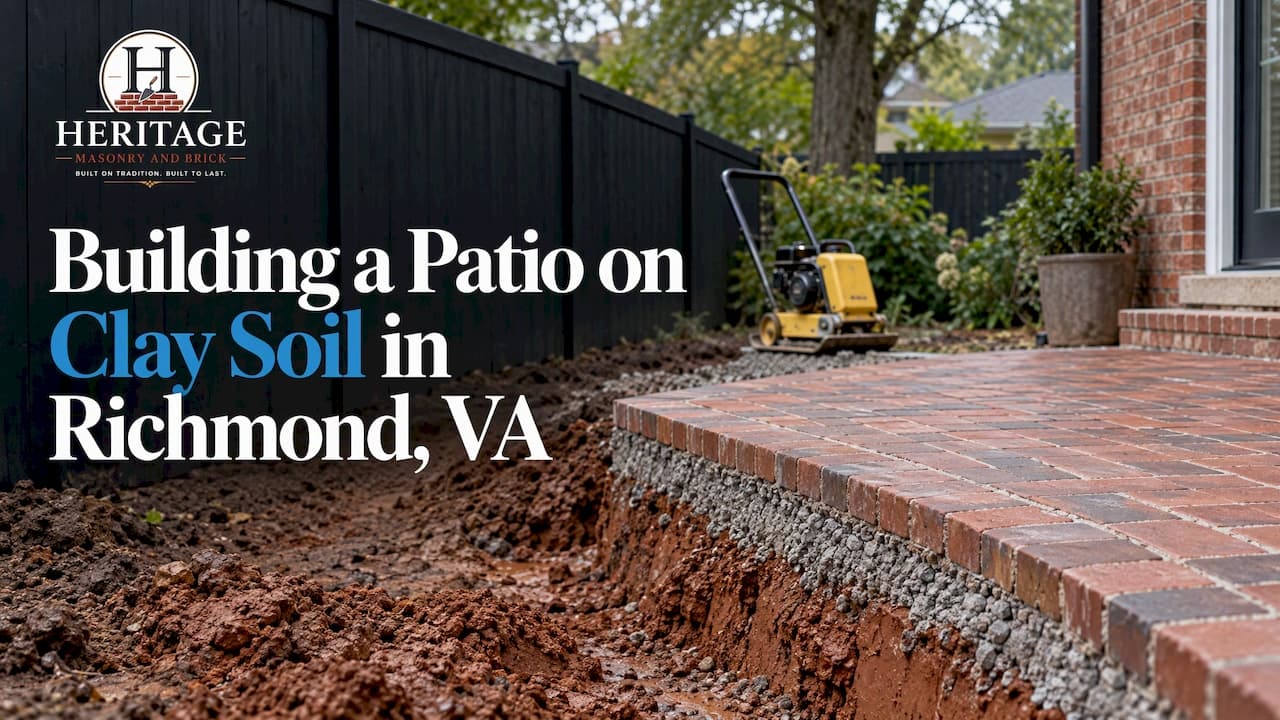
You can build a lasting patio on clay soil, but not on the clay itself. The patio needs a deep, well-compacted gravel base, a slope that sheds water, and a layer that keeps clay from working its way up into the stone. Here in Richmond, Virginia, where many yards sit on dense clay, that base is the job. The bricks or pavers on top are the easy part.
TL;DR
- Never lay pavers or pour concrete straight onto clay. Clay holds water, shifts as it wets and dries, and does not compact the way gravel does.
- Dig deeper than you would for sandy ground, then build a base of compacted crushed stone in thin layers. Professional guidance calls for compacting clay subgrade to at least 95% Standard Proctor density.
- Add a geotextile fabric between clay and stone, and slope the surface away from the house at least 1/4 inch per foot.
- Brick patios built on a sound base last for decades. Bricks laid on a weak base settle, tilt and pool water within a few seasons.
- A Richmond mason can assess your soil, build the base and match the brick to your home. We offer free estimates.
Table of Contents
- Why clay soil is hard on patios
- Can you put pavers or brick over clay?
- Can you pour concrete on clay?
- Step by step: how a clay-soil patio base is built
- Getting the slope and drainage right
- Frost, freeze-thaw and why a flexible system helps
- Brick on clay: what to know about the material
- Where lime mortar fits
- Signs your existing patio was built on a weak base
- Perspective
- Hire a Richmond mason for your clay-soil patio
- FAQ
- Sources
Why clay soil is hard on patios
Clay is made of very fine particles that hold water. When it is wet it swells and turns slick. When it dries it shrinks and can crack. A patio sitting on top feels every one of those cycles. The result is the familiar list of problems: low spots where water collects, pavers that rock underfoot, joints that open, and slabs that crack along the line where one section settled more than the next.
If you are not sure what you have, a simple hand test helps. Municipal paver specifications describe clay as feeling slick when wet, while granular soil feels gritty. Roll a damp handful between your fingers. If it forms a smooth ribbon and stains your skin, you are working with clay, and you should plan the patio accordingly.

The same specification notes that clay soils are weak and call for a thicker gravel base, such as 3/4-inch crusher run or dense-graded gravel. That one line explains most of what follows.
Can you put pavers or brick over clay?
Yes, with the right preparation underneath. The Concrete Masonry & Hardscapes Association (CMHA) states that pavers can be installed over clay when the subgrade is properly prepared. The key words are "properly prepared." Clay is the foundation of the patio, and a patio is only as steady as what is under it.
The same guide points out that soil subgrade and base preparation can take up to 70% of the total labor time of an interlocking paver installation. If a quote for a clay-soil patio looks like it spends most of its hours on digging, hauling stone and compacting, that is a sign the contractor understands the work. Rutgers extension educator Alex Burke makes the same point: base preparation is where the most effort belongs.
Can you pour concrete on clay?
Concrete can go over clay, but not directly on it. A slab needs a compacted layer of crushed stone between the clay and the concrete, so water has somewhere to go and the slab is not sitting on a soil that swells and shrinks. Building authorities in cold regions say the same. The Régie du bâtiment du Québec, for example, says that for slabs on clay it is preferable to use a cushion of sand or well-compacted gravel at least 300 mm (about 12 inches) thick, along with frost protection. That is a Canadian code reference, and Virginia conditions are milder, but it shows how seriously a clay base is treated where winters are harsh.
For a brick patio, a rigid concrete slab under the brick is one option and a flexible compacted-stone base is another. Both work. What fails is either one placed on unprepared clay.
Step by step: how a clay-soil patio base is built
Every site differs, but the sequence below is how a careful mason approaches a patio on clay.
1. Mark the area and excavate deep enough
Strip the sod and topsoil, then dig down through the soft soil to firm ground. The depth depends on the base thickness, the bedding layer and the thickness of the brick or paver. Clay generally means a thicker base than sandy soil, so expect to remove more than you would on a well-draining lot. Extend the excavation beyond the finished edge so the base reaches under the edge restraint. For a closer look at base thickness, our guide on patio base preparation with 4 to 6 inches of gravel walks through the layers.
2. Compact the clay subgrade
The exposed clay needs compacting before any stone goes on it. For cohesive soils such as clay, CMHA technical guidance recommends compacting the subgrade to at least 95% Standard Proctor density, and says effective compaction should reach at least the top 12 inches. The CMHA guide also explains why: compaction raises the soil's load-bearing strength, prevents settlement and rutting, and reduces seasonal movement.
Moisture matters here. Canadian research on sidewalk construction notes that wetting a clay subgrade above its optimum moisture before compaction can reduce later swelling, although it increases shrinkage. In practice, this is a judgment call that experienced crews make on the day, and it is one reason clay work should not be rushed after a heavy rain.
3. Lay geotextile fabric
Water pushing through clay carries fine particles with it. Without a barrier, those fines migrate upward into the stone and weaken the base over time. CMHA recommends geotextiles over silt and clay subgrades to separate the fine particles from the base. The fabric is inexpensive compared with the cost of redoing a patio, and it goes down before any stone.
For very soft clay, the same CMHA document says soils with low strength values (a CBR of 3% or less, for example) should be evaluated for replacement, a capping layer of aggregate, stabilization or geogrid. Most residential yards do not need lab testing, but a mason who finds soft, pumping ground under the first pass of the plate compactor will stop and fix it rather than build over it.
4. Build the stone base in thin layers
Use crushed stone, such as 3/4-inch crusher run or dense-graded aggregate. Spread it in lifts of a few inches at a time and compact each lift before adding the next. One big dump compacted from the top leaves soft pockets underneath. Thin layers are what make the base actually stable on clay.
5. Set the bedding layer and the brick
On top of the compacted stone goes a thin leveling bed. Rutgers advises using coarse sand rather than stone dust for the bedding, which helps drainage and gives a tighter bond. Then the brick or pavers are laid, edged with a restraint, and the joints are filled and compacted.
Getting the slope and drainage right
Clay does not drain, so your patio has to. The Brick Industry Association recommends a minimum slope of 1/4 inch per foot (2%) for clay paving systems, with drainage that protects every layer of the system. Oregon State University Extension gives a similar rule: slope away from buildings with a drop of at least 1 inch for every 4 feet.
That slope should point away from your foundation and toward a place where water can leave: a lawn edge, a swale or a drain line. On a clay lot, water that is allowed to sit against a house wall can end up in a crawl space or against brick piers, so drainage is a masonry issue as well as a patio issue. If you already have a patio that holds water, our 20-minute brick patio drainage check shows how to find the cause, and our comparison of PVC and corrugated pipe helps if a drain line is part of the fix.
Permeable pavements are a special case. University of Nevada, Reno Extension notes that when permeable pavement goes over clay, an underdrain or an impermeable liner may be needed, depending on whether you want water to soak into the ground. Because clay will not absorb it, standard solid-surface patios with a good slope are usually the simpler answer.
If you plan to place planters on the finished patio, think about where their runoff goes as well. A guide on patio planter maintenance covers daily checks and seasonal care, and it is worth reading before you decide where planters sit relative to your slope.
Frost, freeze-thaw and why a flexible system helps
Trapped water under a rigid slab can heave when it freezes. Central Virginia winters are milder than those in the northern states, but Richmond does see freezing nights, and clay that stays saturated is the problem. A stone base gives that water a path out. CMHA notes that flexible interlocking paver systems are often preferred in colder climates because they offer greater protection against frost heaving than rigid pavement, since individual units can move slightly without cracking.
That is one reason we like brick on a compacted base for Richmond yards. It tolerates small movement, and a single unit can be lifted and reset if needed.
Brick on clay: what to know about the material
Brick is a good match for clay-soil patios because it is modular, repairable and ages well. A few practical points from our work in Richmond:
- Choose brick that suits the exposure. Not every brick is made for paving. A patio brick sees traffic, standing water and freeze-thaw. Ask the supplier or your mason whether the unit is rated for paving use.
- Match what you already have. On older Richmond homes, a patio or walkway that picks up the color and texture of the house brick looks like it was always there. We match existing brick whenever we build or repair.
- Pick the laying method for the job. Sand-set brick on a compacted base is flexible and easy to repair. Mortared brick on a slab is more rigid and needs the right joints, drainage and expansion detailing.
- Seal only if it suits the surface. Sealing can help in some cases and cause haze in others. See our guide on when homeowners should seal paver patios.
Where lime mortar fits
A patio on sand and stone does not need mortar. But many Richmond brick projects around a patio do: the steps leading to it, a retaining wall that holds back a slope, a garden wall, or the existing house wall the patio meets. On historic brick, that mortar matters.
Traditional lime mortar is softer and more permeable than hard modern cement mixes. It is designed to give a little as the structure moves and to let moisture leave through the joint rather than the brick. That is our practice on older brick, and it is why we use it for repointing and repairs on historic properties in the Fan District, the Museum District and along Monument Avenue. On a clay-soil lot, where ground movement and moisture are part of life, the mortar that moves and breathes tends to be the kinder choice for old brick than a hard mortar that cracks the brick face instead of the joint.
The mix should suit the brick it is joining. Mortar harder than the brick it surrounds can force the brick, not the joint, to take the stress. This is why we match the mortar as well as the brick on every job. If your patio meets an older wall, a step or a foundation, look at those joints at the same time. Our guide to parging a brick foundation explains why the mortar type for brick matters, and our brick repointing and tuckpointing service covers the joints themselves.

Signs your existing patio was built on a weak base
If your patio is already down and something is off, these are the usual signs:
- Pooling after rain. The surface has settled or was never sloped enough.
- Rocking or sinking bricks. The bedding sand has washed out, or the base has compacted unevenly.
- Open joints and weeds. The units have moved apart.
- Cracks across a slab. The slab sat on soil that moved, or had no stone cushion.
- Edges drifting. The edge restraint failed or was never installed. Our guide to fixing loose brick edging shows the pattern.
Minor settling can sometimes be fixed by lifting the brick, regrading the bed and relaying. Widespread sinking usually means the base needs rebuilding, and no surface fix will last on a weak base. A mason can tell which situation you have by looking at how and where the movement occurs.
Perspective
We have worked on brick in Richmond for over 25 years, and the pattern is consistent: when a patio, walkway or set of steps fails, the problem is almost never the brick. It is what is under it.
Richmond clay holds water and moves. We do not treat that as a reason to avoid brick. We treat it as a reason to do the base properly: dig deep enough, compact in thin layers, separate the clay from the stone, and give water a clear path away from the house. Skipping any of those steps saves a day and costs the homeowner years.
The same thinking applies to the mortar. Traditional lime mortar and well-matched brick are how old Richmond buildings have lasted, and we build new work the same way, so repairs and additions blend with what is already there. That is why we stand behind our work with a 5-year guarantee on materials and workmanship.
Thomas
Hire a Richmond mason for your clay-soil patio
Heritage Masonry & Brick is a family masonry company in Richmond, Virginia, with more than 25 years in the trade. We build brick patios and walkways, steps and retaining walls, and we repair and repoint older brick. On every job we match the existing brick and mortar so the new work blends in.

Our offer is simple: free estimates, no deposit required, payment on completion, and a 5-year guarantee on materials and workmanship. To see what we build, visit our brick patios and walkways page, or call 804-324-6304 to book an estimate for your Richmond property. For general guidance, our masonry advice page is a good start.
FAQ
Can I put pavers over clay soil?
Yes, as long as the clay is not what the pavers sit on directly. The clay subgrade must be compacted, covered with geotextile fabric, and topped with a thick base of compacted crushed stone and a bedding layer. CMHA guidance supports this approach.
Can you pour concrete on top of clay?
Yes, but put a compacted layer of crushed stone between the clay and the slab. The stone gives the slab a stable bed and lets water drain, which reduces cracking and heaving as clay swells and shrinks.
Can you lay a patio directly on soil?
On clay, no. Pavers or bricks placed directly on the soil will settle unevenly and hold water. Even on better soils, a compacted stone base is what keeps a patio level over time.
How much slope does a patio need on clay?
At least 1/4 inch per foot (2%), sloping away from the house. Oregon State University Extension gives a matching rule of 1 inch of drop per 4 feet. On clay, which will not absorb water, that slope is what moves rain off the surface.
Should I build a patio on clay myself?
Small, simple patios are within reach for some homeowners, but clay raises the stakes on digging, compaction and drainage. If the site is near the house, on a slope, or against historic brick, hiring a mason is the safer choice. Call us at 804-324-6304 for a free estimate.
Sources
- Concrete Pavement to Last a Lifetime (CMHA, 2024)
- Structural Design of Interlocking Concrete Pavement (CMHA)
- Structural Design of Interlocking Concrete Pavement, Tech Spec 4 (CMHA, 2023)
- Permeable paver specifications (Town of Reading, MA)
- Clay soils (Régie du bâtiment du Québec)
- Concrete Pavers: Tips and Shortcuts (Rutgers NJAES)
- Paving Systems Using Clay Pavers (Brick Industry Association)
- 10-step guide to installing pavers (Oregon State University Extension)
- Best practices for concrete sidewalk construction (NRC Canada)
- Low Impact Development in Northern Nevada: Porous Pavement (UNR Extension)
- Patio planter maintenance