
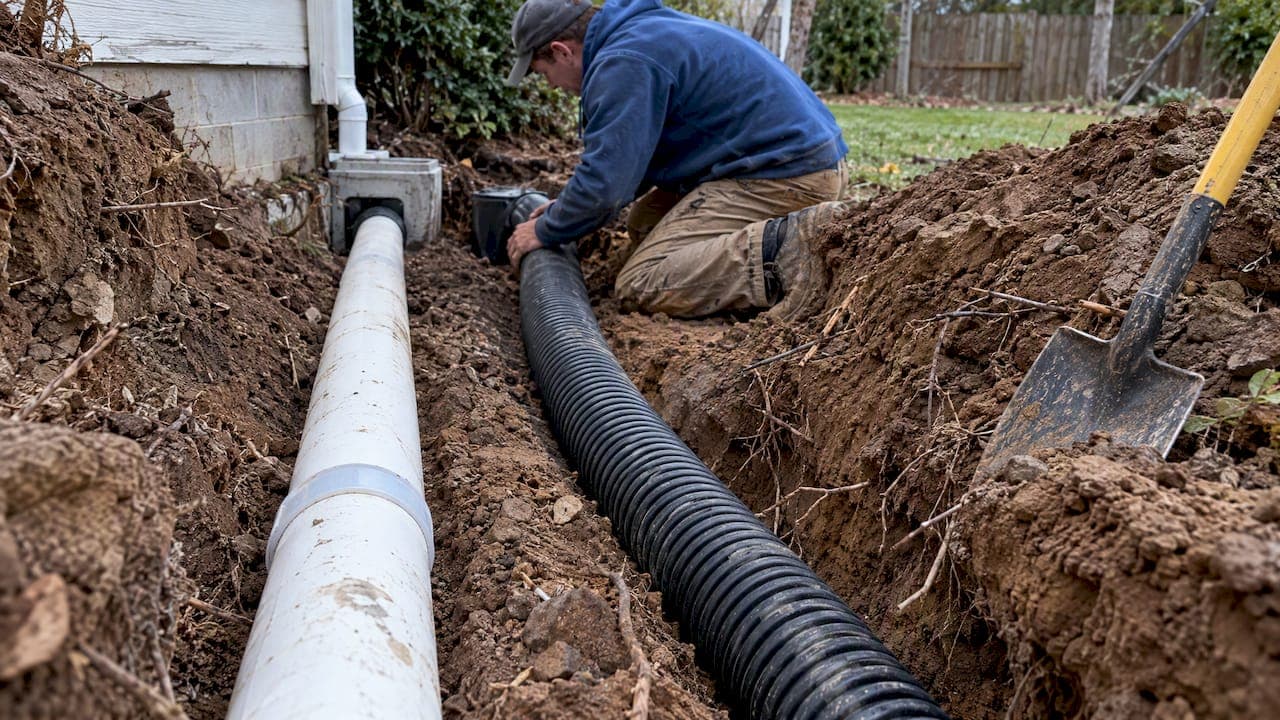
For most buried French drains, downspout extensions, and permanent yard drainage, smooth-wall PVC is the stronger long-term choice because it resists clogging and moves water more efficiently. Corrugated pipe earns its place in flexible, low-budget, or irregular trenching where bend tolerance matters more than decades of maintenance-free service. Both are legitimate options; the right pick depends on the job, the trench, and how long you need the system to last.
TL;DR:
- PVC’s Manning roughness coefficient is about 0.012, compared with 0.024 for corrugated pipe; switching materials may require changes to diameter or slope.
- Use corrugated pipe for short, steep downspout runs or tight bends; choose PVC for long French drains, buried gutters, and flatter grades.
- Under pavement, either pipe needs suitable cover and compacted bedding; flexible corrugated pipe especially depends on a packed granular envelope to resist deformation.
- Filter fabric around perforated sections, inlet guards or catch basins, and cleanouts at bends can reduce sediment problems and make either system easier to maintain.
Table of Contents
- 1. Comparing flow, durability, and cost side by side
- 2. Getting the installation right: trenching, joints, and slope
- 3. Preventing clogs and planning for the pipe's working life
- 4. Matching the pipe to the project: downspouts, French drains, and pavement crossings
- 5. Contractor perspective: drainage lessons from Heritage Masonry & Brick
- 6. Balancing upfront cost against lifetime performance
- 7. How we help when drainage problems reach your masonry
- FAQ
- Sources
1. Comparing flow, durability, and cost side by side
The two materials solve the same problem differently, and the differences show up the moment water starts moving through the pipe. Smooth-wall PVC has an interior design engineers rate at a Manning roughness coefficient near 0.012, while corrugated pipe's ridged interior carries a coefficient closer to 0.024, according to NDOT's drainage design manual. That lower number means water slides through PVC with less friction, so a given slope moves more water through a smaller pipe.
That hydraulic gap has a practical payoff. Because PVC moves water more efficiently, a 4-inch smooth-wall run can often handle the same flow as a larger corrugated pipe, according to vinyl industry guidance on PVC pipe advantages. Homeowners swapping one material for the other should expect to adjust diameter or slope to keep performance equal.
| Attribute | Smooth-wall PVC | Corrugated pipe |
|---|---|---|
| Hydraulic efficiency | Higher (Manning n ≈ 0.012) | Lower (Manning n ≈ 0.024) |
| Clog resistance | Better, fewer ridges to trap debris | Lower if perforated or poorly wrapped |
| Structural strength / fill height | Rigid, strong under compacted bedding | Flexible, tolerates settlement well |
| Typical lifespan | Long service life, often cited above a century for pressure-rated products | Shorter in demanding conditions, UV-stabilized options available |
| Installation | Glued joints, less forgiving of bends | Flexible couplings, easier around obstacles |
| Cost and life-cycle view | Higher material cost, often lower long-term cost | Lower upfront cost, more frequent upkeep |
| Slope and diameter | Can run flatter or smaller | Often needs steeper slope or larger diameter |
Utility-grade guidance backs PVC's durability claim directly: PVC pipe is widely chosen for pressure and gravity systems because of corrosion immunity and a design life commonly cited above 100 years for pressure applications, according to Uni-Bell's summary for water utilities. Corrugated plastic pipe counters with weight and flexibility: it is lighter, easier to handle in tight trenches, and tolerates ground movement better than rigid pipe, according to drainage pipe comparison resources from NDS and ADS.
- PVC's strongest advantage: a smooth bore that resists sediment buildup and moves water efficiently at a flatter slope.
- Corrugated pipe's strongest advantage: flexibility and light weight that make it far easier to install around obstacles or in uneven trenches.
2. Getting the installation right: trenching, joints, and slope
Installation differences explain why contractors reach for one material over the other. Corrugated pipe thrives in constrained trenches because it bends around roots, utility lines, and foundation footings without extra fittings. PVC needs straighter runs and more fittings for direction changes, but it rewards that rigidity with a trench that stays true over time.
Bedding matters more than most homeowners expect. Flexible corrugated pipe depends on a granular envelope packed around it to hold its shape under load, especially beneath driveways or patios, according to NDOT's drainage manual. PVC also needs compacted bedding, but its rigidity gives it more built-in resistance to deformation before backfill settles.
Joint types follow from the same logic. Corrugated systems typically use split-collar or snap couplings that flex with the pipe. PVC uses solvent-glued bell-and-spigot joints that create a rigid, watertight connection but require careful alignment before the glue sets.
Here is a short checklist to verify before you install or sign off on a contractor's quote:
- Confirm trench depth and minimum cover match the pipe type and the load above it (driveway, lawn, or planting bed).
- Ask whether bedding will include a compacted granular envelope, especially under pavement.
- Check that slope meets the pipe's hydraulic needs: flatter for PVC, steeper for corrugated.
- Verify joint and coupling type matches the pipe (glued bell-and-spigot for PVC, split-collar or snap couplings for corrugated).
- Ask how the contractor plans to protect inlet points from sediment and debris.
Pro Tip: If you are replacing corrugated pipe with PVC on an existing slope, recheck your diameter and grade first. A smaller, smoother pipe can often match the old pipe's capacity, but only if the slope still meets minimum flow requirements.
3. Preventing clogs and planning for the pipe's working life
Corrugated pipe's ridged interior is more likely to trap sediment, and perforated sections can let roots or fine soil particles work their way inside if the filter fabric wrap fails, according to drainage pipe guidance from NDS and ADS. PVC's smooth bore gives sediment less to grab onto, which is one reason it holds up better in long, low-maintenance runs.

A properly selected geotextile fabric paired with planned catch basin and cleanout spacing meaningfully narrows the maintenance gap between the two materials, according to the same drainage pipe guidance. Good filter fabric and basin placement matter as much as the pipe material itself.
A few habits keep either system working longer:
- Install filter fabric around perforated sections to block fine sediment without choking water flow.
- Add a catch basin or leaf guard at surface inlets to intercept debris before it reaches the pipe.
- Place cleanouts at bends and long straight runs so you can flush the line without digging.
- Walk the drainage path after heavy storms to check for standing water or slow drains, a sign of a developing clog.
Buried plastic pipe generally fails through crushing from inadequate bedding, joint separation from ground movement, or blockage rather than material breakdown. A quick visual check once or twice a year, especially near downspouts and low points in the yard, catches most problems before they become expensive.
4. Matching the pipe to the project: downspouts, French drains, and pavement crossings
The right pipe changes with the job, not just the budget. Here is how the technical differences translate into project-specific choices:
- Downspout extensions: corrugated pipe is often fine here since runs are short, slope is usually steep, and flexibility helps route around landscaping.
- Buried French drains: smooth-wall PVC wrapped in filter fabric is the stronger choice for long runs where clog resistance and flat slope matter most.
- Buried gutters or yard drainage systems: PVC again, particularly where the run is long, straight, or carries runoff from a large roof area.
- Driveway or pavement crossings: PVC under load-bearing pavement needs careful bedding and minimum cover; corrugated pipe can work if it meets the fill-height and bedding rules your local code requires.
A few conditions flip the recommendation. Tight bends around tree roots or utility lines favor corrugated pipe even in a French drain. Shallow cover under light foot traffic can work with either material if bedding is done correctly. Heavy vehicle traffic above the pipe generally calls for stricter bedding and fill-height compliance regardless of which pipe you choose.
As a sizing rule of thumb, corrugated pipe often needs one size larger than PVC to match the same flow capacity, while PVC's smooth bore can run smaller or flatter for the same job. Before hiring anyone, ask your contractor: What bedding will you use under pavement? What slope are you designing for? How will you protect inlet points from sediment?
5. Contractor perspective: drainage lessons from Heritage Masonry & Brick
Drainage pipe choice affects more than the yard. Water that pools near a foundation or retaining wall because of an undersized or clogged pipe eventually finds its way into mortar joints and brick, which is often where masonry repair work starts. Experience shows that a surprising share of water intrusion damage traces back to drainage that was never routed properly in the first place.
Good drainage design protects the masonry above it just as much as the yard around it.
Near retaining walls and foundations, pipe systems that route water well away from footings and are sized to handle roof and surface runoff without backing up are recommended. If drainage is suspected of undermining a wall or foundation, free estimates and repair work with a workmanship guarantee may be available to help ensure durable fixes.
6. Balancing upfront cost against lifetime performance
Homeowners planning a drainage system for the long haul should lean toward PVC for buried, permanent runs. The higher material cost tends to pay for itself over decades through fewer clogs and less digging. Corrugated pipe remains a reasonable choice for shorter runs, temporary setups, or tight budgets, provided it gets the bedding and filter fabric it needs. Whichever material you choose, proper installation protects that investment more than the pipe itself does.
— Thomas
7. How we help when drainage problems reach your masonry

When drainage failures start showing up as cracked mortar, efflorescence, or a leaning retaining wall, a pipe fix alone will not solve the underlying damage. We handle the masonry side of that equation: diagnosing water intrusion, repairing structural brick, and rebuilding retaining walls so water has somewhere safe to go.
During an on-site assessment, water movement around your foundation, walls, and walkways can be evaluated before recommending a repair plan. Estimates may be free, with repairs carrying a workmanship guarantee.
- Structural Brick & Masonry Repairs for foundations affected by water intrusion.
- Retaining Walls built or repaired with proper drainage behind them.
- Brick Patios & Walkways graded correctly from the start, with base prep detailed in our patio base preparation guide. For drainage under paved surfaces, this homeowner's guide to paving drainage covers slope and surface considerations worth reviewing alongside your pipe choice.
If drainage near your home has you worried about brick or foundation damage, request a free estimate and we will walk the property with you.
FAQ
Why use corrugated pipe instead of PVC?
Corrugated pipe is lighter, more flexible, and easier to install around roots, utilities, or uneven trenches than rigid PVC. It also tolerates ground settlement better, which makes it a practical choice for retrofit drainage jobs with limited digging room, according to drainage pipe guidance from NDS and ADS.
How long will corrugated pipe last underground?
Corrugated pipe's lifespan depends heavily on bedding quality, soil conditions, and whether it is perforated and wrapped in filter fabric. Properly bedded corrugated pipe with UV-stabilized material and good sediment protection can perform for many years, though it generally has a shorter service life than smooth-wall PVC in demanding conditions.
What are the disadvantages of corrugated pipe?
Corrugated pipe's ridged interior creates more friction, so it needs a steeper slope than PVC to move the same volume of water, and it is more prone to sediment buildup if the filter fabric wrap fails, according to drainage pipe comparison resources. It also typically requires a compacted granular envelope under pavement to avoid settling, which adds installation labor.
Which is better for downspout drainage, corrugated or PVC?
Corrugated pipe works well for short, simple downspout extensions because of its flexibility and lower cost. For longer downspout runs or where clogging has been a recurring problem, smooth-wall PVC offers better flow and easier long-term maintenance.
Sources
- NDOT – Drainage Design and Erosion Control Manual October 2023
- Vinylinfo
- Drainage Pipe Types: PVC vs Corrugated Pipe Comparison (NDS / ADS resources)
- Reasons why water utilities choose PVC pipe (Uni-Bell)