
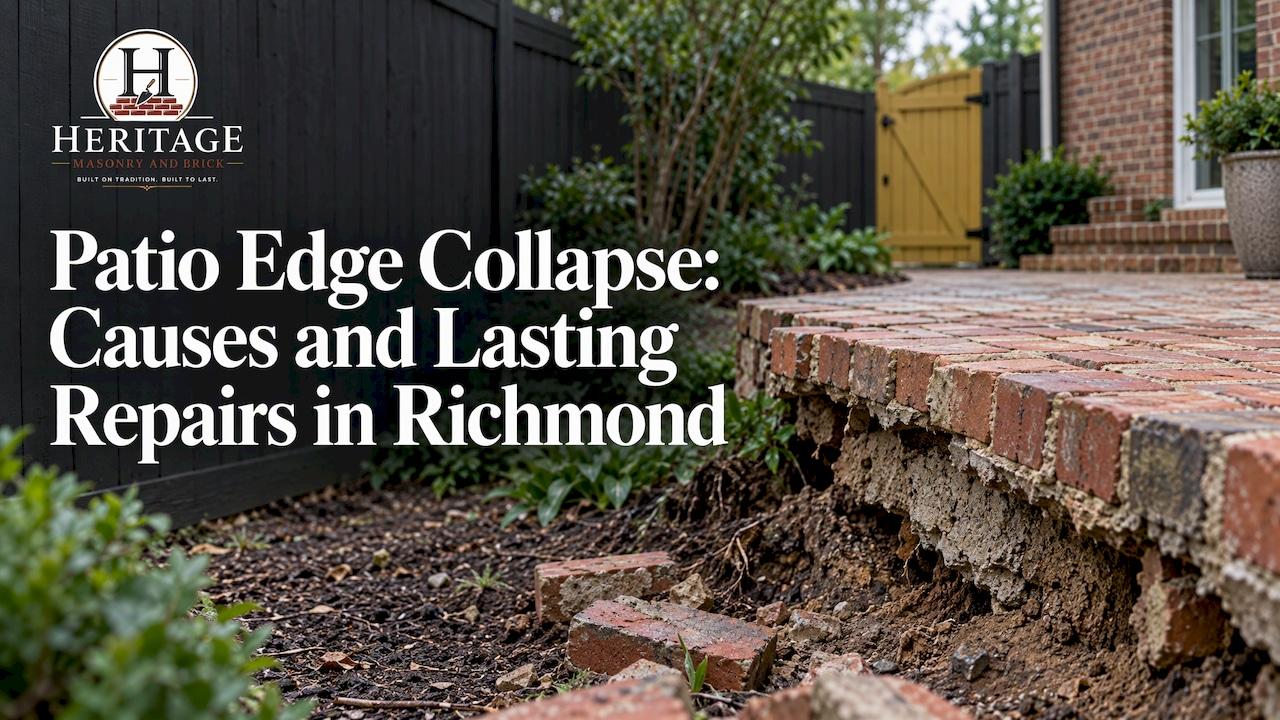
A patio edge collapses when whatever holds the outer row in place gives way: the compacted base under it, the restraint beside it, or the concrete or mortar that ties it together. Water is usually behind it. The lasting fix is to rebuild the edge from the base up, not to top up sand or patch the surface. For Richmond, VA homeowners, that means dealing with drainage and clay soil first, then rebuilding the restraint in materials that suit the brick. We are masons with over 25 years in the trade, and this is how we look at it.
TL;DR
- A collapsing edge is almost always a base, water or restraint problem. The visible sag is the symptom.
- Pavers need a restraint set on the compacted base, not on bedding sand. Without it the outer rows spread, rotate and sink.
- Widening joints at the perimeter, tilting pavers and settlement within 1 to 2 feet of the edge are the signs that the restraint has failed.
- Fix the water source (downspouts, grading, pooling) before you rebuild, or the edge will fail again.
- Brick patios and mortared borders in Richmond are best rebuilt by a mason who matches the brick and uses lime mortar. We offer free estimates, a 5-year guarantee on materials and workmanship, and no deposits.
Table of Contents
- What a collapsing patio edge looks like
- Why patio edges fail
- Which repair does your edge need?
- How a paver edge is rebuilt, step by step
- Why brick and lime mortar matter at the edge
- When the edge is concrete
- Drainage and grade: the repair that makes the repair last
- When to call a mason
- Get the edge rebuilt properly in Richmond
- Our view from the trade
- FAQ
- Sources
What a collapsing patio edge looks like
The word "collapse" covers several different failures, and each has a different cause. Before you plan anything, identify which one you have:
- Pavers or bricks along the edge sink, tilt or spread apart. The joints open up and the outer row sits lower than the rest of the patio.
- Soil spills onto the patio, or the patio drops away from the lawn or garden bed. The ground beside the patio has eroded, or the edging that held it back has moved.
- A concrete slab edge crumbles or breaks off. This is spalling, where the surface layer flakes or the corner breaks away.
- A mortared brick border or step edge cracks, loosens or leans. The mortar has failed, or the footing beneath it has moved.
Richmond has plenty of all four. Older brick patios and walkways in the Fan District, the Museum District and along Monument Avenue were laid long before modern edge details were common, and many have been settling for decades.
Why patio edges fail
The edge is the most exposed part of any patio. Nothing sits beyond it to hold it in, so it takes the sideways load from foot traffic, the push of the paving itself, and every drop of water that runs off the surface.
The Concrete Masonry & Hardscapes Association (CMHA), a U.S. trade body for paver and masonry products, lists the common causes of settlement in its guidance: inadequate compaction of the soil or base, water in the soil or base, bedding sand laid too thick, washed-out bedding or joint sand, and loose or inadequate edge restraints. Most failed edges involve more than one of these at once.
Missing or loose restraint
Pavers are an interlocking system. They stay tight because something confines them at the perimeter. CMHA explains that perimeter restraints keep pavers tightly together so they interlock and resist horizontal forces. When the restraint is missing, undersized or only sitting on sand, the outer pavers drift outward. Joint sand escapes through the gaps, and the rows behind begin to move too.
CMHA gives clear signs that the restraint has been lost: widening joints at the perimeter, pavers rotating, or local settlement within 1 to 2 feet of the edge. If you see those three things along one side of your patio, look at the restraint before anything else.
Water under the edge
Water is the usual cause of edge failure. Roof runoff from a downspout that ends on the patio, a surface that slopes toward a low spot, or a lawn sprinkler aimed at the edge will all soften the soil and wash fines out of the base. A base that is losing material cannot hold the edge up. We cover the diagnosis in our guide to checking brick patio drainage in 20 minutes.
Richmond clay, roots and freeze-thaw
Much of the Richmond area sits on clay that swells when wet and shrinks when dry, which moves a patio edge a little every season. Our article on building a patio on clay soil in Richmond explains why the base under a Richmond patio needs more care than the same patio would on sandy ground. Large trees nearby add another force: roots lift and undermine edges, as we describe in tree roots under a patio. For a wider look at the problem, see why brick patios sink in Richmond.
Which repair does your edge need?
Match what you see to the right fix. Using the wrong one is the most common reason an edge fails a second time.
| What you see | Likely cause | Repair |
|---|---|---|
| Outer pavers drifting, joints opening, sand gone | Missing or loose restraint | Reset the pavers and install a restraint on the compacted base |
| Edge pavers sunken, soft ground, pooling nearby | Washed-out or thin base, water | Fix the water source, rebuild the base, relay the pavers |
| Soil falling onto the patio from a raised bed | No retaining element | Build a small retaining edge or wall on a proper footing |
| Concrete corner or edge crumbling | Spalling, delamination | Cut out the unsound concrete and patch, or replace the section |
| Mortared brick border cracked or leaning | Failed mortar or moving footing | Rebuild the border, repoint with matching mortar |
One point deserves a warning. Decorative landscape edging is not the same thing as a structural paver restraint. A thin plastic or lightweight border that holds mulch in place does not confine a paved surface that takes foot traffic, furniture and the weight of the pavers themselves. Where there is a solid curb, foundation wall or slab beside the patio, it can serve as the restraint only if the base properly connects to it and it can resist the sideways push.
How a paver edge is rebuilt, step by step
Here is the sequence a sound repair follows. At each step we note where it usually goes wrong.
- Find and stop the water. Redirect downspouts away from the patio, correct low spots and check irrigation. If you skip this, the rebuilt edge sits on the same wet soil that failed the first time.
- Mark the repair area wider than the visible damage. Settlement spreads further than the eye sees. Repair only the sunken pavers and the neighboring ones start to sink next season.
- Lift and organize the pavers. Number or stack them in order so they can go back in the same pattern, and set aside any that are cracked or chipped.
- Inspect the base. Remove the bedding sand and look at the aggregate underneath. For stable settlement, CMHA advises to remove the pavers and sand, compact added base to the correct level, then add bedding sand and reinstate the pavers. The common mistake is filling a low spot with extra bedding sand. Sand is a thin leveling layer, not a structural one, and thick sand is itself listed as a cause of settlement.
- Rebuild the base in compacted layers. Our own notes on patio base preparation with 4 to 6 inches of gravel go through depth and compaction in more detail. Loose, uncompacted gravel settles under the first heavy rain.
- Install the restraint on the base, not on sand. CMHA's guide specification says restraints should be mounted directly on the finished base rather than on bedding sand. The same specification lists plastic, concrete, aluminum, steel, precast concrete and cut stone as restraint materials. Which one suits a given patio depends on its shape, its traffic and what sits beside it. The same logic applies to gravel driveways, where edge restraint and a compacted base do the same job of keeping loose material from creeping outward.
- Lay a uniform bedding layer, relay the pavers and refill the joints. CMHA recommends compacting and refilling the joint sand after the restraint and adjacent pavers are repaired or replaced.
- Check it each season. CMHA's seasonal guidance recommends inspecting for settlement, shifting, lost joint sand and loose edge restraints and correcting them when found. Catching a loose restraint early is a small job. Catching it after the outer row has collapsed is a rebuild.
If your patio is brick rather than concrete pavers, the same principles apply, with one addition: the bricks are often set in mortar, and the mortar has to be right.
Why brick and lime mortar matter at the edge
Brick is the heart of what we do, and it behaves differently from modern concrete pavers. Historic Richmond brick is typically softer and more porous than modern brick. It was laid in lime mortar, which is softer still. That pairing lets the wall or patio flex slightly and release moisture through the joints rather than through the brick faces.
On a brick patio edge, a step or a walkway border, we use traditional lime mortar and match the existing brick and mortar so the repair blends in. Our reasoning is simple. If a hard, dense mortar replaces the original, moisture has nowhere to go except through the brick. The face of the brick then flakes away, a failure we cover in our article on spalling brick repair. Lime mortar is designed to be the sacrificial, replaceable part, so the brick lasts.
A lime mortar mix also differs from a standard bagged mix in how it is prepared and cured. It is mixed to suit the brick and the exposure. It needs to be protected as it cures. It tends to be worked by hand rather than rushed. That takes experience, which is why we treat the mix as part of the repair and not an afterthought. When a Richmond homeowner calls about loose joints along a patio border or crumbling mortar on a step, the first thing we look at is what mortar is already there and what the brick can tolerate.

If the border or step edge in your yard is brick and the joints are failing, our brick repointing and tuckpointing service replaces the failed mortar with a matching lime mix. For the whole edge or a leaning brick border, brick repair covers the rebuild.
When the edge is concrete
A concrete slab that is crumbling at the edge calls for a different repair. The American Concrete Institute's spall repair guide sets out the procedure for a localized spall: locate delaminated areas, mark and saw-cut the repair perimeter, remove unsound concrete, prepare the substrate, place and consolidate the repair material, finish it and cure it. The guide describes wet burlap and polyethylene for at least seven days as one curing method for site-mixed or ready-mixed concrete. It also advises consulting a structural engineer when corroded reinforcing bars have lost cross section.

The steps people skip are the saw cut and the removal of everything unsound. A patch feathered over weak concrete lets go within a season.
If you remove a section of broken concrete, you will have rubble to deal with. Looking at concrete disposal options for homeowners before you start helps you plan the hauling.
Drainage and grade: the repair that makes the repair last
The most useful habit is to treat water first. Walk the patio during a heavy rain and look at where water goes. Check these points:
- Does a downspout discharge onto or beside the patio?
- Does the surface slope away from the house? A patio that slopes toward the house sends water against the foundation and a patio that holds water at the edge softens the base there.
- Does soil from a raised bed wash across the paving?
- Do sprinklers soak the edge?
The fixes are often modest: a downspout extension, regrading the soil beside the edge, a small drain or a corrected slope in the paving. Our drainage diagnosis guide goes through how to read the signs.
For edges that retain soil, such as a patio cut into a slope, the answer is a real retaining element on a proper footing, not a thin border. We build retaining walls in brick for Richmond yards where the ground drops away at the patio edge.
When to call a mason
Some edge failures are fair work for a careful homeowner: a few loose pavers on a stable base, topping up joint sand, redirecting a downspout. Others are not. Call a professional when:
- The settlement runs along a whole side or has returned after a previous repair.
- The edge retains soil or sits beside steps, a foundation or a wall.
- The edge is mortared brick, especially historic brick in the Fan, the Museum District or on Monument Avenue.
- The patio ties into a structure, or you see cracking in the house wall or foundation beside it.
CMHA recommends certified concrete paver installers for restoration and a geotechnical engineer when heave is not caused by frost. If you suspect ground movement beyond a local base failure, have an engineer look at it. For brick edges, steps and walls, our structural brick and masonry repairs service covers the rebuild.
A driveway edge in brick follows the same logic, which we cover in fixing loose driveway brick edging.
Get the edge rebuilt properly in Richmond
Heritage Masonry & Brick is a family of traditional masons in Richmond, VA. We repair brick patios, walkways, steps and retaining walls, and we match the existing brick and mortar so the repair blends in. Our brick patios and walkways and brick steps and step repair work covers failing edges, and our estimates are free. We offer a 5-year guarantee on materials and workmanship, we take no deposits, and you pay on completion. Call 804-324-6304 to book a visit.

If your property is in the Fan or Museum District, see our page on historic brick repair in the Fan and Museum District.
Our view from the trade
We have spent over 25 years working on brick in Richmond, and the patio edges we are called to are rarely a surprise. The ground beside the patio has been wet for years, the restraint was never anchored to the base, or the mortar was replaced at some point with something harder than the brick.
Our view is that an edge repair is only as good as what is under it. We would rather open the edge, look at the base, fix the water and rebuild properly than patch the top. That is why we do the job right the first time, so it lasts for decades.
On brick, we use traditional lime mortar and match the existing brick and mortar. Old Richmond brick was built to work with lime, and a repair that respects that blends in and keeps the wall or patio breathing. When we take on a job, we stand behind it with a 5-year guarantee on materials and workmanship, and you pay when the work is complete.
Thomas
FAQ
Why is the edge of my patio sinking?
Usually the base under the edge has lost support. Water washes out the aggregate and sand, the soil beneath softens, or the restraint has loosened and the outer pavers have spread. Widening joints and pavers that tilt within 1 to 2 feet of the edge point to a restraint problem.
Can I just add sand under the sunken pavers?
No. Bedding sand is a thin leveling layer and too much of it is a recognized cause of settlement. The base needs to be restored to the right level in compacted layers first, then a uniform sand layer goes on top before the pavers are relaid.
Do patio pavers need an edge restraint?
Yes, unless a sound curb, wall or slab already confines them and the base connects to it. A restraint keeps pavers locked together and limits sideways movement. It should sit on the compacted base, not on bedding sand.
Can a crumbling brick patio border be repaired in Richmond?
In most cases, yes. Loose joints are repointed in a matching lime mortar, and a leaning or failed section is rebuilt on a sound base. Our Richmond masons offer free estimates, so you can have the edge assessed before deciding.
Sources
- CMHA, Peak Performance from Concrete Pavers
- CMHA, Operation and Maintenance Guide for Interlocking Concrete Pavements
- CMHA, Edge Restraints for Interlocking Concrete Pavements
- CMHA, Guide Specification for the Construction of Interlocking Concrete Pavement
- CMHA, Hardscaping for All Seasons
- American Concrete Institute, Spall Repair of Horizontal Concrete Surfaces