
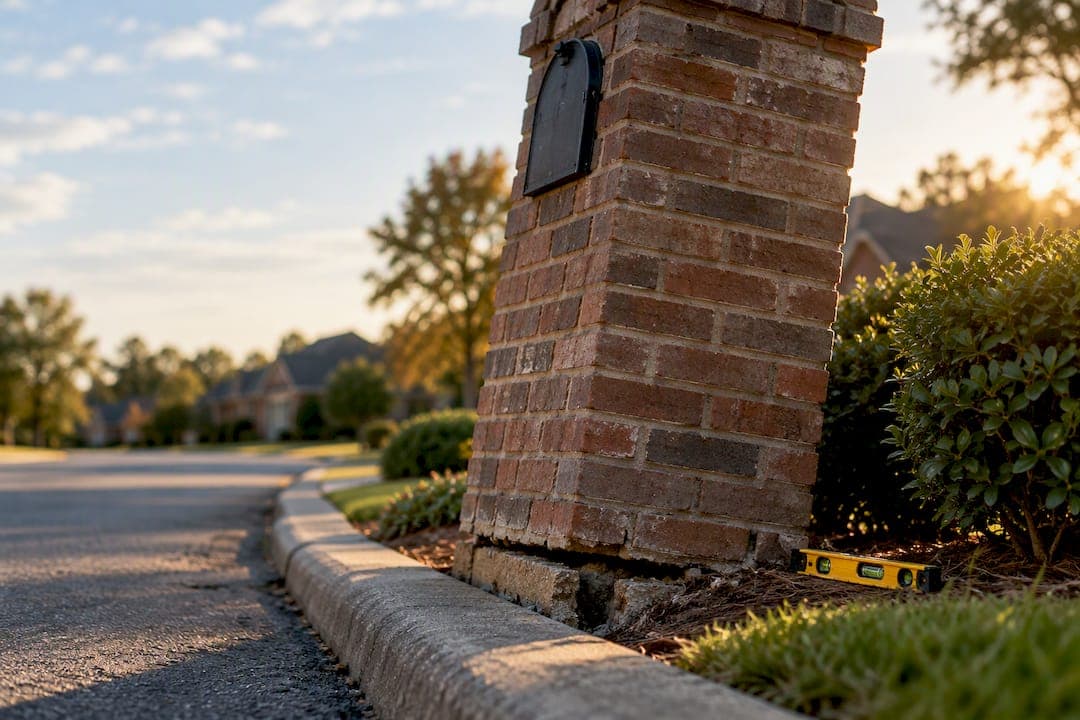
Most brick mailbox damage falls into one of two camps: repairable mortar and brick problems, or structural failure that calls for a rebuild. If your mailbox has small cracks, crumbling mortar, or a single loose brick, repair is usually the right call. If it leans, has a shifting footing, or took a direct hit from a vehicle, stop using it, secure the area, and contact a masonry contractor or your local postmaster before doing anything else.
TL;DR:
- Repair small cracks, loose bricks, and crumbling mortar if the mailbox has a stable footing and no signs of shifting or impact damage.
- Avoid patching if the base has voids, or if the mailbox leans more than two inches out of plumb, as underlying issues will likely worsen without professional intervention.
- Costs for minor repairs typically range from $150 to $400, but complete rebuilds with new footings can reach several thousand dollars depending on scope.
- Always confirm USPS placement, size, and design standards before replacing or modifying a mailbox to prevent delivery issues and comply with regulations.
- Hire a masonry contractor for shifting footings, multiple brick courses, or recurring leaners, ensuring they inspect the foundation, match materials, and provide warranties.
Table of Contents
- Decision checklist: repair vs rebuild and red flags
- Common damage types and why they happen
- DIY repair options: what you can do safely and how to do it
- When to hire a masonry contractor: services, questions to ask, and expected outcomes
- USPS placement and approval rules to follow when replacing or altering a curbside mailbox
- Typical costs and timelines for repairs and rebuilds
- Materials and tools used in brick mailbox repair
- Practical notes from Heritage Masonry & Brick: common pitfalls and what durable repair looks like
- Author perspective: why durable masonry matters more than short-term savings
- Heritage Masonry & Brick: how we help with brick mailbox repair
- Sources
- FAQ
Decision checklist: repair vs rebuild and red flags
Before you decide on a fix, walk around the mailbox and check four things: the footing, the lean, the mortar joints, and the metal insert. A stable base with only surface wear is a repair job. A shifting base is not.
- Lean test: if the mailbox visibly tilts more than a couple of inches out of plumb, the footing has likely moved.
- Mortar check: press a screwdriver into the joints. If it sinks in easily or crumbles, the mortar has failed.
- Brick count: one or two loose or cracked bricks is a patch job. Several loose courses point to a structural problem.
- Insert condition: a rusted or bent metal box can usually be swapped without touching the brick at all.
A temporary patch is fine when you are dealing with a hairline crack or a single loose brick and the structure is otherwise sound. It is not fine when the base has voids underneath it, when a car clipped the corner, or when water has saturated the mortar for an extended period. In those cases, patching hides a problem that will resurface, usually worse. Our guide on brick crack repair walks through how to judge crack severity in more detail.
Common damage types and why they happen
Brick mailboxes take a beating from weather, traffic, and time, and each type of damage points to a different root cause.
- Mortar erosion: age and freeze-thaw cycles wear down joints, especially on the side that faces prevailing wind and rain.
- Spalling: water trapped inside the brick freezes, expands, and pops off the face, often after mortar has already failed.
- Rusted insert hardware: cheap or older metal boxes corrode from the inside out, especially near coastal or high-humidity areas.
- Impact damage: mailbox posts and boxes sit close to the road, making them frequent casualties of snowplows, trash trucks, and distracted drivers.
- Poor original footing: a shallow or undersized footing shifts with frost heave, and the whole structure leans over time.
Drainage matters more than most homeowners expect. Mailboxes surrounded by mulch beds or planted too close to sprinklers stay wet longer, which speeds up both mortar erosion and spalling. Our post on spalling brick repair covers how to tell surface spalling from a deeper structural issue.
DIY repair options: what you can do safely and how to do it
Small, contained repairs are reasonable weekend projects if you have basic masonry tools and patience.
- Repointing loose joints: remove damaged mortar to a depth of about half an inch using a grinder or chisel, dampen the joint, and pack in a Type N mortar mix matched to the original color, tooling it to match the existing joint profile.
- Replacing a single brick: carefully chip out the damaged brick, clean the cavity, butter the replacement brick with mortar, and set it flush with the surrounding face.
- Swapping a rusted insert: remove the old mailbox unit, check that the mounting bracket or embedded anchors are still solid, and fasten a new rust-resistant insert with stainless screws.
Pro Tip: Buy a small tube of mortar dye or a pre-tinted mix rather than guessing at color. A repair that stands out visually is often more noticeable than the crack it replaced.
Stop and call a contractor the moment you see a pronounced lean, a footing that has shifted, or any damage tied to a vehicle strike. Those problems live below the surface, and a cosmetic patch will not hold. See our repointing and tuckpointing page for more on when joint repair alone is enough.
When to hire a masonry contractor: services, questions to ask, and expected outcomes
Once the damage involves the footing, multiple courses of brick, or a lean that keeps returning, it's time for a professional assessment. A qualified mason will inspect the footing depth, check for reinforcement, match brick and mortar, and correct any drainage issue feeding the problem.
Before hiring anyone, ask:
- How long is the workmanship warranty, and what does it cover?
- Are you insured, and can you provide proof?
- Can you show a sample of matched brick and mortar before starting?
- What is the realistic timeline, including cure time for new concrete?
- Do I need to contact the postmaster, or will you handle that if the design changes?
A responsible quote spells out the scope of work, materials, disposal of old brick and concrete, start and finish dates, expected cure times, and the warranty in writing. Our brick repair service page outlines what a typical inspection and repair scope covers.
USPS placement and approval rules to follow when replacing or altering a curbside mailbox
Any rebuild is a chance to get placement right, and USPS has specific rules for it. USPS guidance recommends mounting the mailbox a recommended height range from the road surface to the bottom of the box, and a typical setback distance from the curb face.
- Manufactured mailboxes should carry USPS approval, which you can typically find printed on the box or its packaging.
- Custom-built boxes, including brick structures, need local postmaster approval and must meet USPS size and strength standards, per engineering specifications covering durability and carrier access.
- Mailbox supports are also expected to yield safely on impact rather than stay rigid, according to Postal Bulletin guidance.
Calling your postmaster before you rebuild, especially if you're changing size or design, avoids a delivery dispute after the concrete has already cured.
Typical costs and timelines for repairs and rebuilds
Costs scale with how much of the structure needs to come apart. Minor mortar repair or single-brick replacement typically costs a few hundred dollars, based on common service pages and local contractor pricing data, commonly cited for small masonry jobs (https://about.usps.com/postal-bulletin/2026/pb22702/html/cover.htm). Resetting a leaning mailbox usually costs several hundred dollars, and a full rebuild with a new footing and matched brick may cost up to a few thousand dollars depending on the scope.
- Foundation work adds the most cost, since it involves excavation, forming, and curing time.
- Matched brick costs more when the original brick is discontinued or has to be sourced from a reclamation yard.
- Insert replacement and local labor rates are smaller line items but still shift the total.
Small repairs are often finished the same day, while any job involving new concrete footing needs curing time before the brickwork can bear weight, which can add several days to the total project timeline.
Materials and tools used in brick mailbox repair
Matching materials correctly is what separates a repair that lasts from one that fails again within a season.
- Brick: matched as closely as possible in color, texture, and size to the original.
- Mortar: Type N for most residential brick, or Type S when the original structure calls for higher strength, chosen based on the age and hardness of the existing brick.
- Footing materials: poured concrete with rebar reinforcement for any rebuild.
- Mailbox insert: a rust-resistant unit, such as the kind of post-mount mailbox widely available at home improvement retailers.
- Tools: tuckpointing tools, jointers, a mortar mixing tub or drill paddle, a brick hammer and cold chisel, and an angle grinder or mason's saw for cutting brick to size.
Getting mortar strength and color right prevents the kind of mismatched patch that spalls again within a year or two.
Practical notes from Heritage Masonry & Brick: common pitfalls and what durable repair looks like
Over more than 25 years of masonry work, the most common cause of mailbox failure we see isn't old age. It's a shallow original footing that was never built to handle frost heave, combined with mortar that's either too weak to hold or too strong for the surrounding brick.
Durable repair means digging the footing to the correct depth, reinforcing new concrete with rebar, matching mortar mix and tooling to the original joint style, and standing behind the work with a warranty.

Pro Tip: If a mason offers to match your mortar on-site with a test patch before starting the full repair, take them up on it. It's the easiest way to confirm the color will actually blend once it cures.

Free estimates and workmanship guarantees on repairs like these reflect standards typically applied to structural brickwork elsewhere on a property.
Author perspective: why durable masonry matters more than short-term savings
The cheapest bid on a mailbox rebuild is rarely the one that lasts. I've seen a quick patch job fail within a year because the footing underneath was never addressed, just buried under fresh mortar. The homeowner ended up paying twice: once for the patch, once for the proper rebuild that followed.
Before hiring anyone, confirm they carry insurance and back their work with a written warranty. A few extra questions up front save a second repair bill later.
— Thomas
Heritage Masonry & Brick: how we help with brick mailbox repair
If your mailbox needs more than a weekend patch, our crew handles the full range of related work: brick repair, repointing and tuckpointing, structural repairs, footing replacement, and new brickwork built to match what's already on your property.

When we come out for an estimate, we inspect the footing and brick condition onsite, put together a plan for matching brick and mortar, give you a realistic timeline, and explain what's covered under our 5-year workmanship guarantee. If you're comparing multiple quotes, a directory like PNV Leads can help you find other local contractors to check against ours. When you're ready, visit our brick repair page to schedule a free estimate.
Sources
For placement height, setback, and approval rules, consult USPS mailbox guidance and the USPS engineering standards for design and testing requirements. Always confirm site-specific rules with your local postmaster before altering a curbside mailbox.
- How to install a mailbox | USPS
- SPUSPS-STD-7B01: USPS engineering standards and specifications
- Gibraltar Mailboxes Tuff-Body post-mount product example — Home Depot
FAQ
How much does it cost to repair a brick mailbox?
Minor mortar or single-brick repairs typically cost $150 to $400, while a leaning mailbox reset runs several hundred dollars. A full rebuild with a new footing and matched brick can cost up to a few thousand dollars depending on scope and local labor rates.
Can a leaning brick mailbox be repaired?
Sometimes, but a lean almost always means the footing has shifted, so a simple patch won't fix it. A contractor typically needs to reset or replace the footing before rebuilding the brickwork on top of it.
How to replace a mailbox insert in a brick structure?
Remove the old metal box from its mounting bracket or anchors, confirm the anchors are still solid, and fasten a new rust-resistant insert in place with stainless hardware. If the brick opening itself is damaged, that portion may need to be repaired first.
How expensive is brick repair in general?
Costs vary widely based on the extent of damage, ranging from a few hundred dollars for small mortar or brick fixes to several thousand for structural repairs involving new footings. Getting a free estimate from a local mason is the most reliable way to know your actual cost.