
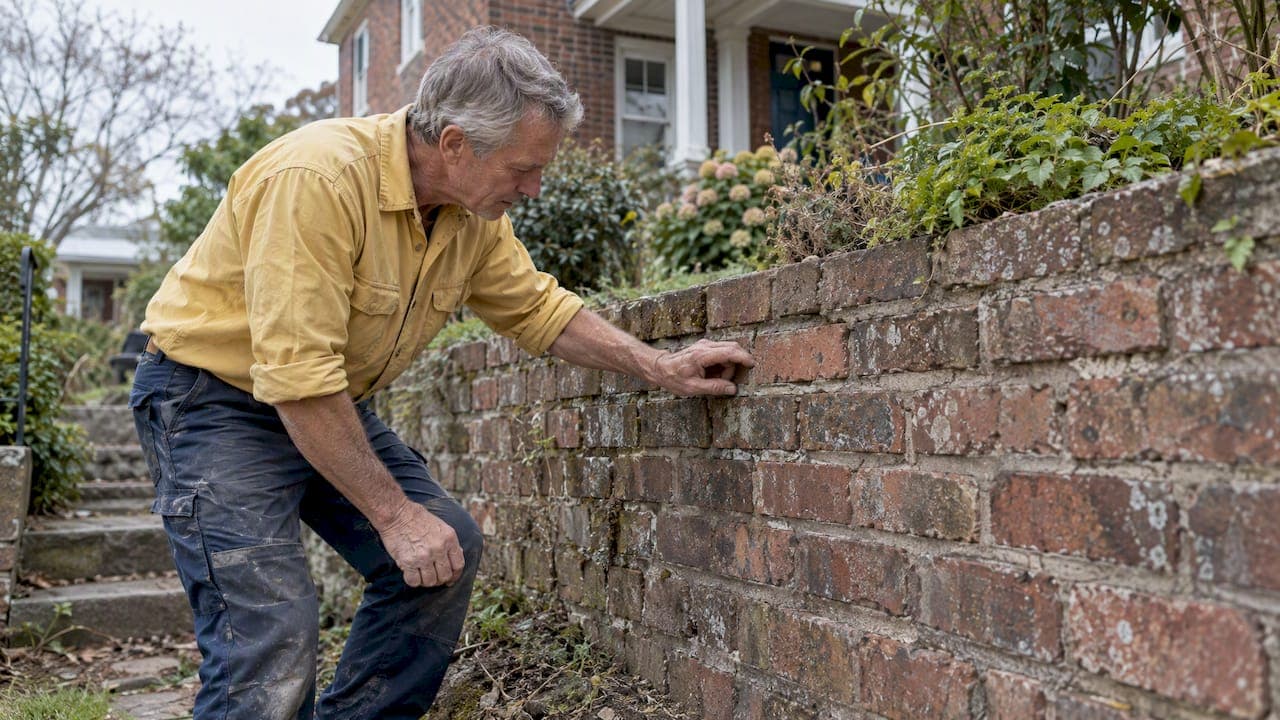
A well-built retaining wall can last 50 years or more, and a poorly drained one can fail in 15. Material matters, but drainage, installation quality and what happens on the land above the wall matter just as much. Below are realistic lifespans by material, the factors that cut them short in Richmond, Virginia, and the signs that tell you it is time to repair rather than wait.
TL;DR
- Timber walls generally last 15 to 40 years. Natural stone and well-built block or brick walls often last 50 years or longer, depending on construction and upkeep.
- Drainage is the biggest single factor. A wall with clogged gravel or blocked weep holes can fail long before its material wears out.
- Adding a patio, driveway or pool above an existing wall can shorten its life if the wall was never designed for that load.
- Bulging, leaning, cracking and soil washing out are signs to call a mason early, when repairs are smaller.
- Free estimates and a 5-year workmanship guarantee are available from us in Richmond: call 804-324-6304.
Table of Contents
- How Long Retaining Walls Last by Material
- Design Life Is Not Actual Life
- What Shortens a Retaining Wall's Life
- Signs Your Wall Is Nearing the End of Its Life
- Repair, Rebuild or Replace?
- Do You Need a Permit in Virginia?
- Our Perspective on Making Walls Last
- Extending the Life of Your Wall
- Retaining Wall Repair and Masonry Restoration in Richmond
- FAQ
- Sources
How Long Retaining Walls Last by Material
There is no single answer, because "retaining wall" covers very different structures. These ranges come from published sources and industry experience, and they assume proper installation. Treat them as ranges, not promises.
| Material | Typical lifespan | What decides it |
|---|---|---|
| Pressure-treated timber | 15 to 40 years | Wood grade, ground contact rating, drainage, upkeep |
| Cedar or redwood timber | About 20 years | Rot resistance fades faster against wet soil |
| Segmental concrete block | 50 to 75 years by design | Base prep, geogrid, drainage, freeze-thaw exposure |
| Poured concrete | 40 to 70 years | Reinforcement, cracking, drainage |
| Brick or natural stone, mortared | 50 to 100+ years | Mortar condition, footing, drainage |
For timber, This Old House reports that pressure-treated pine and fir rated for ground contact can last up to 40 years, while Western red cedar or redwood last about 20. The same guide notes that wood that touches soil is always at risk from moisture.
For segmental block, a Texas A&M study on freeze-thaw testing of segmental retaining wall blocks notes that manufacturers estimate a properly constructed wall's service life at about 75 years. That figure is a design target, and the next section explains why.
Timber: affordable now, maintenance later
Timber is the cheapest wall to build and the one most likely to need replacing within your ownership. Wood in contact with wet soil rots, and it needs ongoing care to reach the top of its range. If you want a wall you will not think about again, masonry or stone costs more upfront and asks far less of you over the decades.
Concrete block and poured concrete
Segmental block walls are popular because they install quickly and can look clean. They also depend on what you cannot see: the compacted base, the reinforcement behind taller walls and the drainage. Poured concrete is strong but can crack, and cracks let water in. Neither is a problem when built correctly. Both show their weak points when corners were cut.
Brick and natural stone
Mortared brick and stone walls have the longest track record. Plenty of historic brick walls in Richmond's older neighborhoods are well over a century old. The catch is that the mortar joints are the sacrificial part of a brick wall. Once joints erode, water gets behind the face and the wall deteriorates faster. Repointing with a compatible mortar is what keeps a masonry wall in service. Our brick retaining wall repair guide covers what that repair involves.
Design Life Is Not Actual Life
You will often see "75 years" quoted for retaining walls. That number comes from engineering standards for permanent structures. The AASHTO bridge design specifications, for example, set a 75-year design life for permanent walls, while structures treated as temporary are designed for far less.
Design life assumes the conditions the wall was engineered for stay the same: soil type, water, and the loads above it. A wall designed to hold back a sloped lawn was not necessarily designed to carry a driveway. When the assumptions change, the real lifespan changes with them.
That is why two walls of the same material, the same age and the same height can have very different futures.
What Shortens a Retaining Wall's Life
In our experience, the same four causes show up again and again.
1. Poor drainage
Soil holds water, and water is heavy. When it cannot escape, it builds pressure behind the wall. That pressure pushes the wall outward, a little more after every storm. Walls fail from this far more often than from weak materials.
A working drainage system has several parts:
- Clean, free-draining gravel directly behind the wall
- A perforated pipe at the base that carries water to a safe outlet
- Weep holes through the wall face where the design calls for them
- Surface grading that sends rain away from the top of the wall
Gravel and pipes can clog with sediment over time. Even highway engineers treat subsurface drains as something to maintain: the Federal Highway Administration's guidance on edgedrain maintenance recommends inspecting outlets and pipe systems at least once a year. The same habit helps a residential wall, even though your pipe is smaller. Walk the wall after a heavy rain and check that water is actually exiting where it should.
For a deeper look at what a system needs, see what a retaining wall drainage system actually needs. If you want a general look at how drainage planning works elsewhere on a property, this under-deck drainage guide explains the same principle of moving water away from structures before it collects.
2. Poor backfill and installation
A wall can look perfect on the day it is finished and still be set up to fail. Native clay soil used as backfill, a base that was never compacted, or gravel layers skipped to save time all lead to leaning later. Richmond sits in clay-heavy soils in many areas, and clay holds water. That makes proper backfill more important here, not less. We explain the mistakes DIY builders make in our backfill guide.
3. Freeze-thaw cycles and moisture
Virginia winters swing above and below freezing. Water that enters cracks or open joints freezes, expands and widens the gap. The Texas A&M research above was built around exactly this problem: block walls can lose performance when freezing and thawing are not accounted for. Mortar joints, block faces and poured concrete all take this punishment. Keeping joints sealed with sound mortar is cheap compared with rebuilding a wall.

4. New loads above the wall
Building a patio, widening a driveway, adding a shed or installing a pool close to the top of a wall adds weight the wall may not have been built to carry. If you plan any change above or near a retaining wall, have the wall assessed first, even if it looks fine. A wall that is quietly working at its limit can start to bulge soon after new weight is added.
Signs Your Wall Is Nearing the End of Its Life
Most walls give warnings. The earlier you act, the smaller the repair.
- Bulging or bowing in the middle of the wall face
- Leaning away from vertical, especially at the top
- Stair-step or horizontal cracks in block, brick or mortar
- Crumbling mortar or spalling brick where the surface is flaking off
- Soil staining or washout at the base or through joints
- Pooling water at the top or bottom of the wall
- Rotting, split or twisted timbers in wood walls
A hairline vertical crack in an older wall may be cosmetic. A horizontal crack or a wall that has moved is a structural issue. Our guide to retaining wall failure signs helps you sort the two. If you are seeing deteriorating brick faces, what a crumbling brick wall means explains the first steps.
If a wall is leaning noticeably, or sits close to a house, a pool, a driveway or a property line, do not wait. Have a mason or a licensed engineer look at it promptly.
Repair, Rebuild or Replace?
Most homeowners ask this once they find a problem. These criteria help.
Repair is usually enough when:
- Damage is limited to mortar joints or a few damaged bricks or blocks
- The wall is still plumb and the footing has not moved
- Drainage is the problem and can be corrected without removing the wall
Partial rebuild makes sense when:
- One section has bulged or shifted while the rest is sound
- Backfill and drainage need to be redone behind a failed section
Full replacement is the better call when:
- The wall is leaning along most of its length
- Timber has rotted through
- The footing or base has failed
- Repair costs begin to approach the cost of doing it right
Cost varies with wall height, access, material and what is behind the wall. For Richmond-specific figures and what drives them, see our guides on retaining wall repair costs in Richmond and what drives retaining wall costs.
Do You Need a Permit in Virginia?
Rebuilding or building a wall can trigger permit and engineering rules. Virginia's building code addresses retaining walls, and the Virginia Uniform Statewide Building Code sets thresholds based on wall height and the amount of unbalanced fill, meaning the soil held back on one side. Exemptions and local requirements differ, so confirm with the City of Richmond or your county building official before work begins. A reputable contractor should raise the question before you do. Tall walls, or walls that carry a driveway or structure above them, may also need a licensed engineer's design.
Our Perspective on Making Walls Last
We are a family-run masonry company that has worked on Richmond brick for over 25 years, and the walls that last share the same traits.
First, they were built with the water in mind. Before we talk about brick or stone, we ask where the water will go. A wall without a drainage plan is only waiting for a wet spring.
Second, the repair matches the original. On historic brick, we carefully match existing brick and mortar and use traditional lime mortar. Lime mortar is softer than the brick around it, so it takes the wear and moisture movement rather than the brick face. Hard modern mortar on old brick can do the opposite and damage the brick.
Third, small repairs beat big ones. Repointing a failing section is a modest job. Letting water work behind that section for five more winters is not.

Fourth, honesty about timber and block. Not every wall is worth saving. If a wall has failed at the base, we will say so rather than sell a patch that will not hold. We would rather give you a fair estimate and a wall that lasts.
We also stand behind the work: free estimates, a 5-year guarantee on materials and workmanship, no deposits and payment on completion.
— Thomas
Extending the Life of Your Wall
A short yearly routine adds years.
- Walk the wall after heavy rain. Look for pooling water, wet patches at the base and water at weep holes.
- Clear weep holes and outlets of dirt, leaves and roots.
- Keep downspouts and grading pointed away from the wall.
- Watch the mortar. Soft, sandy or missing joints are your cue to repoint.
- Keep heavy loads back. Do not stack soil, store materials or park vehicles at the top edge.
- Keep trees in check. Roots can push and open joints.
- Treat timber on the schedule the manufacturer recommends, and replace boards that have softened.
- Photograph the wall each spring. Comparing pictures is the easiest way to see slow movement.
Wood also deteriorates in other parts of the home, and the same principle applies: catch moisture damage early. This wood rot repair page shows how rot progresses on window sills, which is a useful comparison if you are inspecting timber on your property.
Retaining Wall Repair and Masonry Restoration in Richmond
If your wall is bulging, leaking at the joints or simply getting old, we can assess it and give you a clear answer on repair versus rebuild. Our work covers brick repair, repointing and tuckpointing, structural masonry repairs and retaining walls, along with new brickwork for walls that have reached the end of their life.
To schedule a free estimate, visit Heritage Masonry and Brick or call 804-324-6304 today.
FAQ
How long does a retaining wall last?
It depends on the material and the drainage. Timber commonly lasts 15 to 40 years. Block, brick and stone walls can last 50 years or more when built and drained correctly. Neglected drainage can cut any of these short.
How long should a concrete retaining wall last?
Poured concrete walls typically last 40 to 70 years, and segmental concrete block walls are designed for 50 to 75 years. Those figures assume solid footings, reinforcement where needed and working drainage. Cracks that let water in should be sealed or repaired early.
Can I extend the life of an old retaining wall?
Often, yes. Restoring drainage, repointing failing mortar and replacing damaged units can add many years. A wall that is leaning along its whole length or has a failed base usually needs rebuilding instead. A mason can tell you which applies after inspecting it.
Does building a patio or driveway above a wall affect its lifespan?
It can. The extra weight may exceed what the wall was designed to carry and lead to bulging or failure. Have the wall assessed before you add any load near its top edge.
Sources
- This Old House: Retaining Wall Materials
- Texas A&M: Freeze-thaw performance of segmental retaining wall blocks
- AASHTO LRFD Section 11 (Caltrans copy)
- FHWA: Maintenance of Highway Edgedrains
- Virginia Uniform Statewide Building Code, 13VAC5-63-80