
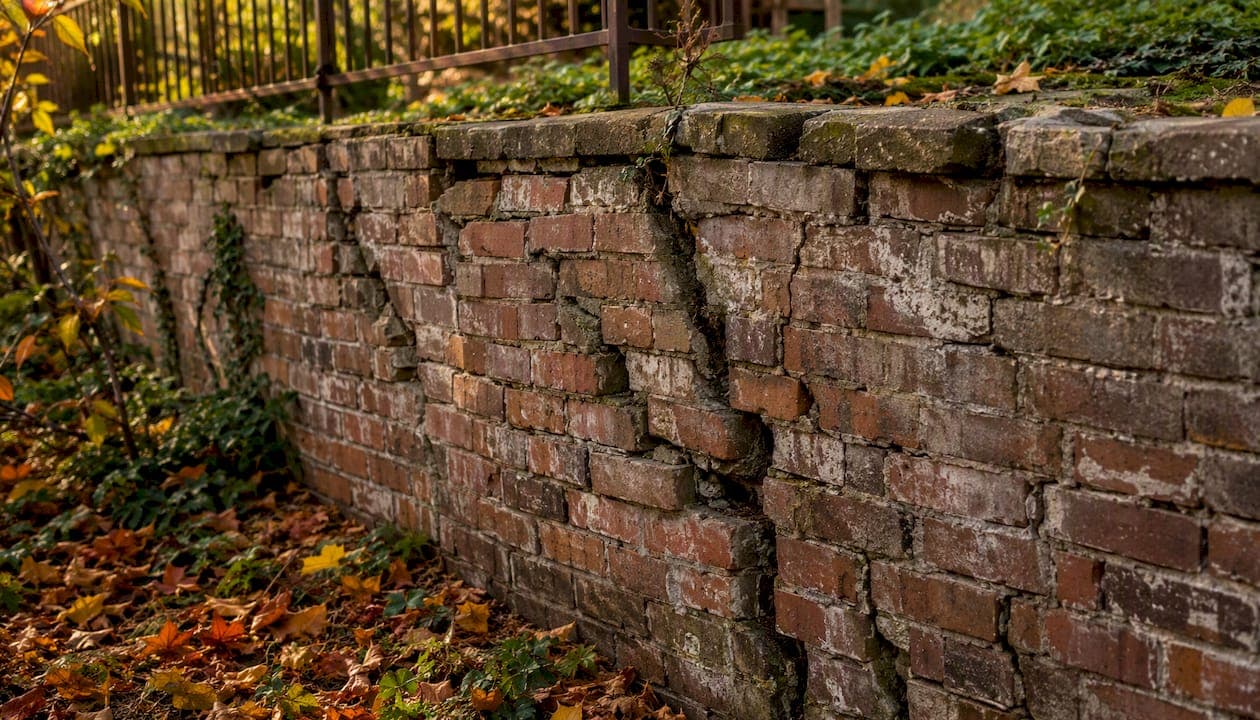
A retaining wall that leans, bulges, or shows a fresh horizontal crack is telling you something urgent: it's losing its fight against the soil behind it. The highest-risk visual signs are forward lean or tilt, bowing or bulging along the face, wide horizontal cracks, exposed or displaced footing blocks, soil slumping or small sinkholes above the wall, and water seeping through the wall long after rain has stopped.
Check for these today:
- Wall leaning or tilting forward more than it used to
- Bulging or bowing sections along the face
- Horizontal cracks
- Loose, shifted, or fallen blocks near the base
- Sunken or slumping soil behind or above the wall
- Water still weeping through joints days after a storm
If you spot any of these, keep people, pets, and vehicles away from the wall and the area below it, and schedule a professional inspection right away. Don't try to push, brace, or patch it yourself in the meantime.
Pro Tip: Stand in the same spot each week and take a photo, then date-stamp it. Small changes are nearly invisible day to day, but obvious over a month of side-by-side pictures.
A wall with a visible forward lean, bulge, or separation at a joint should be treated as a high-risk safety hazard, with the area cleared until a qualified inspector has looked at it.
Key Takeaways
Early, drainage focused repairs almost always cost less and carry less risk than waiting for a retaining wall to fail outright.
| Point | Details |
|---|---|
| Watch the highest-risk signs | Forward lean, bulging, wide horizontal cracks, and exposed footings need urgent attention. |
| Water is usually the root cause | Clogged weep holes and blocked drainage build hydrostatic pressure that face repairs can't fix. |
| Sort signs by urgency | Use a monitor, schedule soon, or urgent framework based on how fast changes are happening. |
| Document everything | Dated photos and a simple level check reveal movement long before it's obvious by eye. |
| Call Heritage Masonry & Brick early | Free estimates, drainage-first diagnosis, and a 5-year workmanship guarantee back every repair. |
Table of Contents
- What do visible cracks, leaning, and bulging really mean?
- Why is water almost always the real cause of a failing wall?
- How do you spot soil and footing problems before they get worse?
- Can roots, moss, or crumbling mortar signal a bigger problem?
- How urgent is each sign, and what should you do right now?
- What happens during a professional inspection and repair?
- Simple maintenance steps that lower your risk
- What happens if you ignore these signs?
- Why Heritage Masonry & Brick treats early signs seriously
- How Heritage Masonry & Brick can help when your wall shows warning signs
- Sources
What do visible cracks, leaning, and bulging really mean?
Not all cracks carry the same weight. Horizontal cracks are the most serious, since they usually mean the wall is bending under soil pressure it can no longer resist. Diagonal or step cracks, common in block and brick walls, often point to uneven settlement at one end. Vertical hairline cracks are frequently cosmetic, tied to normal curing or minor shrinkage, though they're worth watching if they widen.
Leaning and bulging are different animals. A leaning wall tilts as a whole unit, usually from soil pressure pushing at the base. Bowing or bulging means one section is deforming outward while the rest stays put, a sign the wall material itself is failing under load. Watch for these related signs too:
- Capstones that have shifted or rotated out of alignment
- Open or widening joints between blocks or stones
- Loose units you can wiggle by hand
- Blocks that have already fallen away from the face
According to RetWall's field guidance, most failures show visible warning signs for months or even years before a wall actually gives way, which means the window to act is usually longer than homeowners assume.
Pro Tip: Hold a 4-foot level against the wall face each season. If the gap between the level and the wall grows, you have measurable, accelerating movement, not just a static lean.
Why is water almost always the real cause of a failing wall?
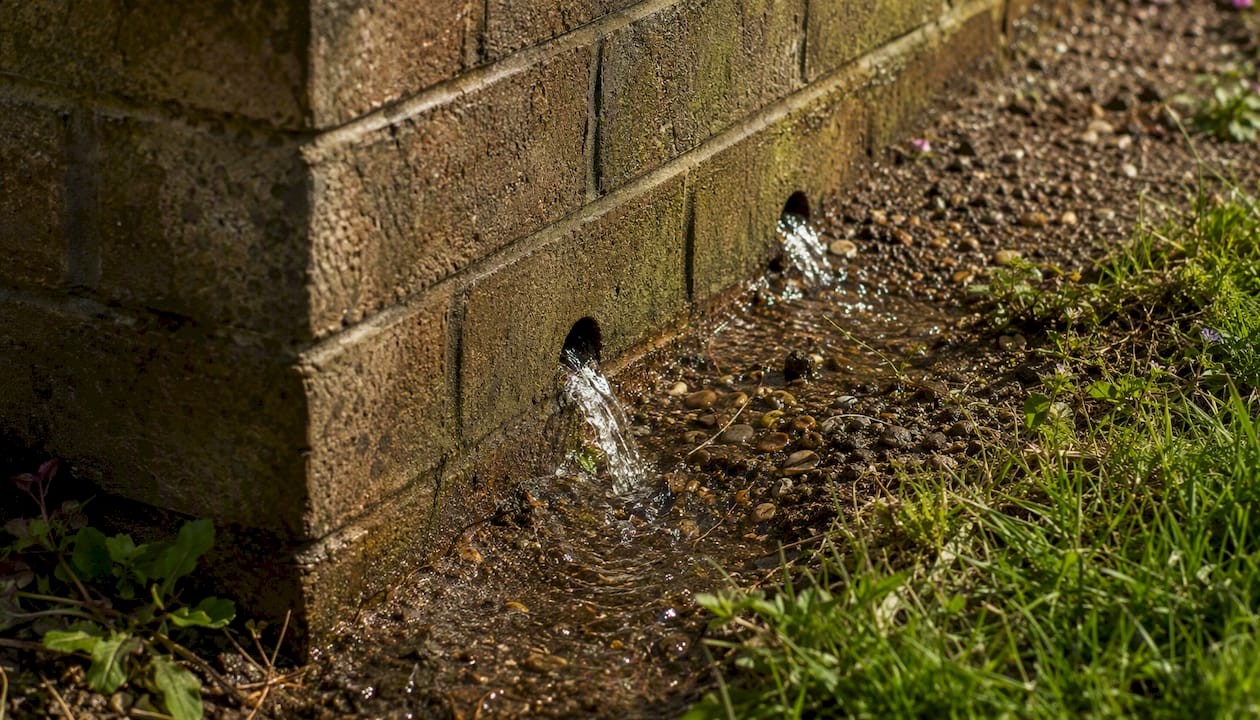
Water is the single biggest driver of retaining wall problems, and the signs often show up long before cracks do. Look for standing water pooling behind the wall, damp patches on the face that linger after rain, weep holes that have gone quiet, and white chalky efflorescence staining the surface.
- Weep holes that used to drip but no longer drain
- Efflorescence or white mineral staining on the face
- Persistent damp patches days after the last storm
- Soggy, saturated ground directly uphill of the wall
Every retaining wall is engineered to hold back soil, not water. When drainage clogs, hydrostatic pressure builds behind the wall like a slow-motion dam, and that pressure is exactly why cosmetic patching so often fails. Engineers note that face-only repairs rarely hold because the water pressure driving the movement never gets addressed.
Pro Tip: Run a garden hose above the wall for ten minutes and watch where the water goes. If it pools instead of draining through weep holes, your drainage system is likely compromised.
How do you spot soil and footing problems before they get worse?
The ground itself often gives you the earliest clues, well before the wall's face shows anything. Watch for cracking in the soil surface above the wall, small sinking or slumping patches, tiny sinkholes or dimples (a sign soil is piping out through gaps), and footings that have become visible where they used to sit buried.
- Cracked or slumping soil in the yard above the wall
- Small sinkholes or dimples forming near the wall's edge
- Exposed footing or base material that should be underground
- Nearby steps, patios, or pavers that have started tilting
Once soil erodes away from the wall's toe, the structure loses the passive resistance holding its base in place, and movement tends to accelerate from there. If a staircase or paver patio near the wall has started shifting too, that's often a sign the soil loss extends further than the wall face suggests. Photograph the distance between visible soil loss and the wall, along with any nearby drainage features, so an inspector has a clear starting point.
Can roots, moss, or crumbling mortar signal a bigger problem?
Vegetation and material wear deserve attention, though not every sign here means structural trouble. Woody roots pushing into joints can pry blocks apart over time, and capstones near mature trees or shrubs sometimes shift as a result. Moss alone is usually cosmetic. Crumbling mortar joints, spalling concrete, and rust colored staining (a signal of corroding rebar inside the wall) point to real material decay.
- Woody roots wedging into joints or under capstones
- Mortar that's crumbling or missing between units
- Spalling, flaking concrete on the wall face
- Rust colored streaks suggesting corroding reinforcement
Pro Tip: Trim small roots and redirect surface water yourself, but hold off on removing large roots or heavy pruning near the wall until an inspector has assessed the base. Pulling a root system out fast can destabilize soil that's already compromised.
How urgent is each sign, and what should you do right now?
Not every sign demands the same response, so it helps to sort what you're seeing into three tiers. Monitor covers minor hairline cracks, light moss, or small mortar wear with no change over recent seasons. Schedule an inspection soon applies to noticeable new cracks, minor lean, or a weep hole that's slowed down. Urgent means rapid new lean, large bulges, wide horizontal cracks, soil sinkholes, or an exposed footing.
- Monitor: hairline cracks, cosmetic moss, no visible change over months
- Schedule soon: new cracks, mild lean, reduced drainage flow
- Urgent: rapid lean, bulging, sinkholes, exposed footing, or a wall supporting a driveway or structure
For anything urgent, rope off or barricade the area, remove parked vehicles or stored materials from above the wall, and stay off the ground below it. Collect dated photos, note any recent storms, and mention if you've added weight nearby, like a new shed or gravel pile.
Pro Tip: A practical triage framework contractors use sorts walls into monitor, inspect soon, and urgent categories based on exactly these signs, so you're not guessing at severity alone.
Forward lean, a visible bulge, or separation at a joint should be treated as high-risk. Clear the area and don't wait for it to worsen before calling someone.
What happens during a professional inspection and repair?
A qualified inspector checks more than the surface. Expect them to evaluate drainage function, backfill soil quality, footing condition, any internal reinforcement, and how the wall connects to adjacent structures or return walls. They're also looking for evidence of ongoing movement, not just a snapshot of current damage.
Repair scope depends on what they find:
- Drainage retrofit alone, when the wall structure is sound but water management has failed
- Local rebuilding of a damaged section, when failure is isolated
- Tiebacks or anchors, when a wall needs added lateral support
- Full rebuild with an engineered design, when the wall has lost structural capacity
A structural engineer typically gets involved for taller walls, walls supporting driveways or structures, or any wall showing active movement; a masonry contractor can usually handle drainage fixes and rebuilds on smaller, non-load-bearing walls. Costs and timelines vary with wall height, access, material, and whether drainage needs a full retrofit, and most jurisdictions require a permit for structural work.
Pro Tip: When comparing quotes, ask each contractor for photos of similar completed projects, whether an engineer was involved in the design, and whether they back the work with a multi-year workmanship guarantee.
Simple maintenance steps that lower your risk
A little seasonal upkeep goes a long way toward preventing the signs above from ever appearing. Direct surface runoff away from the wall, keep downspouts clear, and extend splash blocks so water doesn't pool at the base.
- Clear downspouts and extend splash blocks away from the wall
- Check and clear weep holes so they can still drain
- Control woody roots before they wedge into joints
- Keep light ground cover on slopes to reduce erosion without adding extra weight
- Inspect the wall after major storms and again once a year
Keep a simple movement log with dated photos and a quick level check each season. It costs nothing and gives you (and any inspector you eventually call) a real record of change over time.
What happens if you ignore these signs?
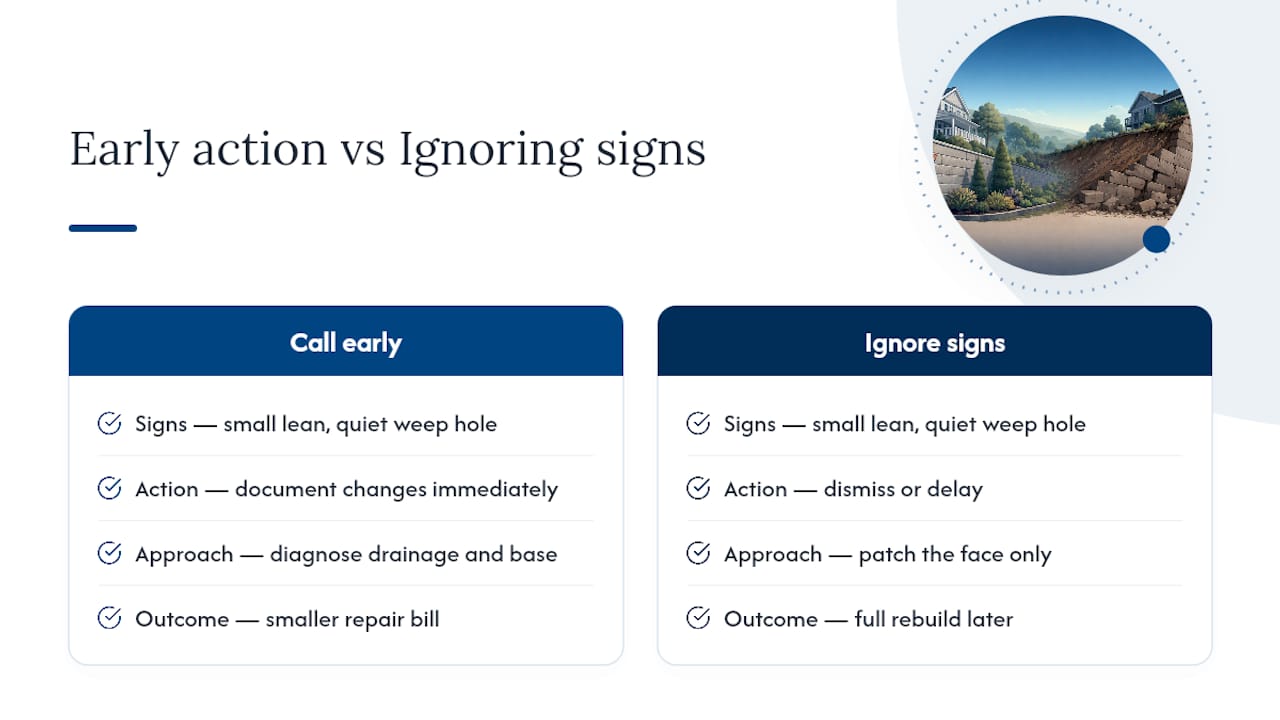
Retaining walls rarely fail without warning. What usually happens is slower and, in some ways, worse: small signs get ignored for months, then movement accelerates fast once soil loss or hydrostatic pressure crosses a threshold the wall can no longer resist. A hairline crack becomes a structural crack. A slight lean becomes a bulge. A quiet weep hole becomes standing water that undermines the footing entirely.
The consequences go beyond the wall itself. A collapsing retaining wall can take out a driveway, patio, fence line, or even part of a foundation if the wall sits close to the house. Soil and debris released in a sudden failure pose a real injury risk to anyone standing nearby, and vehicles parked above a failing wall are at risk if the ground beneath them gives way. Ongoing movement tends to accelerate once it starts, and repeated cosmetic patching rarely stops that trend.
There's also a financial angle worth taking seriously. A drainage retrofit caught early is a fraction of the cost of a full engineered rebuild after collapse, and insurance often treats gradual wear differently than sudden structural failure, sometimes leaving homeowners to cover more of the cost themselves. Acting on early signs isn't just about safety. It's usually the cheaper path too.
Why Heritage Masonry & Brick treats early signs seriously
After 25 years repairing brick and masonry structures around Richmond, we've seen the same pattern play out again and again: a small lean or a quiet weep hole gets dismissed, and a year later it's a full rebuild. Our approach always starts by diagnosing drainage and base conditions first, not just patching the face.
Pro Tip: Document changes as soon as you notice them. The homeowners who call us early almost always end up with a smaller repair bill.
How Heritage Masonry & Brick can help when your wall shows warning signs
Once you've spotted lean, bulging, cracking, or drainage problems, the next move is a real inspection, not a guess. Heritage Masonry & Brick handles the full range of retaining wall issues around Richmond, from drainage retrofits and repointing to partial rebuilds and complete replacements when a wall has gone past the point of patching.

Here's what that typically covers:
- Structural brick and stone repairs, including footing and reinforcement issues
- Repointing and tuckpointing for mortar joint loss and material decay
- Drainage retrofits to relieve hydrostatic pressure at the source
- Partial rebuilds for isolated damage, or full replacement when structural capacity is gone
When you contact us, you get a free estimate, a clear look at what the inspection covers, and a 5-year workmanship guarantee backing the repair. If you've noticed any of the signs covered here, from a new lean to a weep hole that's stopped draining, request an inspection or estimate before the problem grows into a bigger repair than it needs to be.
Sources
- Retaining Wall Damage | InspectAPedia
- 7 Warning Signs of Retaining Wall Failure - ISTA Engineers
- Signs Your Retaining Wall Is Failing | RetWall
- Retaining Wall Leaning: Early Signs | Umbrella Constructions
- How to Fix a Leaning or Bowing Retaining Wall - Retaining Walls Direct