
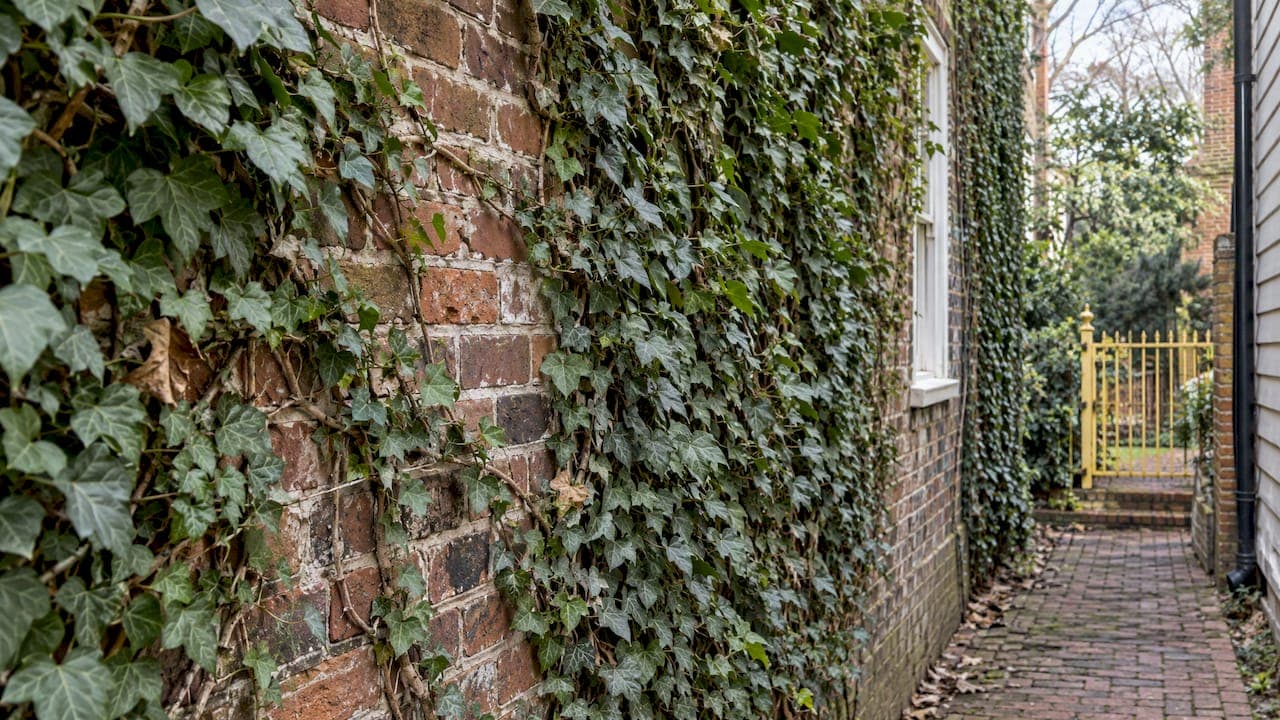
Ivy on brick is neither always harmless nor always destructive. On sound brick with healthy mortar, established ivy can be fairly benign. On older, soft brick with failing mortar, it can widen cracks, trap moisture and hide damage until it is expensive to fix. The bigger risk is often how the ivy comes off. Pulling it from a historic wall can do more harm than the plant did.
This guide explains how to tell which situation you have, how to remove ivy safely, and when the wall underneath needs a mason. It is written for Richmond homeowners, especially those with older brick in the Fan, the Museum District and along Monument Avenue.
TL;DR
- Ivy does not automatically ruin brick. Hard, well-pointed brick often tolerates it. Soft, older brick with weak mortar does not.
- Never rip green ivy off a wall. Cut the stems at the base, let the vine die and dry for 2 to 3 weeks, then remove the remnants gently.
- Skip sandblasting, acids and high-pressure washing. They strip the hard outer surface of old brick and cause faster decay.
- If the mortar is crumbling or the brick is flaking once the ivy is gone, repoint with a compatible lime-based mortar, not hard Portland cement.
- Not sure what is under the leaves? Call us at 804-324-6304 for a free estimate and an honest look at the wall.
Table of Contents
- Is ivy good or bad for brick?
- The out-of-sight problem
- Check the wall before you decide
- How to remove ivy from brick without hurting it
- What not to do
- If you live in a Richmond historic district
- After the ivy: repairs that are often needed
- Our perspective
- Let us look at the wall
- FAQ
- Sources
Is ivy good or bad for brick?
The honest answer from the people who study it is: it depends on the wall. The Brick Industry Association's technical brief on ivy and brickwork notes that ivy can shield a wall from wind-driven rain and act as a thermal blanket, but it can also hold moisture against the surface, hide problems and damage mortar joints in older, under-fired brick.
Historic England, which has researched the question closely, reports that a covering of ivy can moderate temperature extremes and wetting and drying on a wall. The Royal Horticultural Society takes a similar view, and says that ivy's aerial roots attach to walls and that its vigor means it needs control. Both are UK bodies, and our climate is different, but the mechanics of brick and mortar are the same.
Here is how that plays out in practice.
| Wall condition | What ivy tends to do | What we would advise |
|---|---|---|
| Hard brick, full mortar joints, no cracks | Mostly cosmetic; may add some weather protection | Keep it trimmed; inspect each season |
| Soft, older brick with lime mortar | Roots and tendrils grip crumbling joints; moisture lingers | Plan careful removal and a joint inspection |
| Cracked or open joints | Roots can enter and enlarge the cracks over time | Repair the joints, then decide on the ivy |
| Walls near gutters, windows, roofline or chimney | Growth blocks drainage and access | Cut back regardless of wall condition |
Where the damage really comes from
Three mechanisms matter:
- Roots entering gaps. Aerial rootlets find their way into hairline cracks and open joints. They do not drill into sound brick, but they exploit weakness that is already there.
- Trapped moisture. Dense, shaded foliage keeps a wall damp longer after rain. On brick that is already porous, that can speed up freeze-thaw damage and mortar loss.
- Hidden deterioration. This is the one we see most. Leaves cover the wall, so nobody notices the mortar eroding, a crack opening or a lintel rusting until water is coming inside.
English ivy is also a plant to think about beyond your own wall. Virginia Tech's extension notes that English ivy has been documented as an invasive species, so cutting it back from trees and keeping it contained is sensible whatever the brick is doing.
The out-of-sight problem
Conservation guidance keeps returning to the same point: the worst thing about ivy is that it stops you from looking at your wall. Historic England advises against removing ivy purely for looks and recommends managing it by trimming it away from eaves, chimneys and openings so the masonry can still be checked.
That fits what the Brick Industry Association recommends for any brick building: periodic inspections, preferably each season, and finding the moisture source before attempting repairs. Ivy makes that routine nearly impossible.
If you keep ivy, set up a simple routine:
- Trim it back at least twice a year, and keep it 12 inches or more clear of windows, gutters, vents and the roofline.
- Once a year, in winter or early spring, lift a few stems and look at the joints behind them.
- Keep it off the chimney entirely. Chimneys take the worst weather and are hard to inspect.
- Watch for damp patches, stains or musty smells on interior walls below ivy-covered areas.
For a sense of how professionals approach hidden damp and concealed masonry faults, a survey-led approach is worth reading about in these masonry repairs and damp diagnosis notes. The principle is the same on either side of the Atlantic: find out what is happening behind the surface before you decide on a repair.
Check the wall before you decide
Before you commit to full removal, test a small area. The industry guidance is to start with an inconspicuous patch of roughly 5 to 10 square feet and see what the brick and mortar look like once the growth is gone, as described in the Brick Industry Association's maintenance note on brick masonry.
On that patch, look for:
- Mortar that is sandy or crumbles when you press it with a fingertip or the edge of a key.
- Recessed joints, where mortar sits more than a quarter inch behind the brick face.
- Cracks that run through joints or step diagonally across several courses.
- Flaking or powdery brick faces, a sign the protective surface has already failed.
- White deposits, which point to moisture moving through the wall. Our guide to efflorescence on brick explains what they mean.
If you find several of these, the ivy is probably not your only issue. Our article on when to repoint brick offers a way to rate the urgency, and our piece on what a crumbling brick wall means covers what to do first.
How to remove ivy from brick without hurting it
This is the part that matters most for older Richmond homes. The method is slow on purpose.
Step 1: Cut, do not pull
Cut each main stem near the ground and remove a section of a few inches so it cannot reconnect. The Brick Industry Association's guidance for older, soft-fired brick or lime mortar is to never pull vines off the surface. Pulling green, growing ivy can tear the face off the brick or rip out loose mortar.
Step 2: Wait 2 to 3 weeks
Let the vine die and dry in place. Dead tendrils release their grip and become brittle. Resist the urge to tug at them sooner.
Step 3: Remove what has withered
Once everything has dried, lift the remnants away gently by hand. Where a stem resists, leave it and cut it flush instead of forcing it. On very old walls, some conservators prefer to leave established roots in place, since removing them can be more destructive. The RHS makes this point in its advice on ivy on buildings.
Step 4: Treat the stains and rootlets
The small dark patches ivy leaves behind are not permanent. After a couple of weeks, once they have dried and darkened, they can usually be cleaned with a stiff fiber brush and water, possibly with a mild detergent. The City of Petersburg's historic district guidance on materials also warns against chemical or acidic cleaners because they can etch or stain brick. Our walkthrough on cleaning brick safely covers the technique in more detail.

Step 5: Deal with regrowth
Cut any new shoots at ground level as they appear. Dead stems are far easier to remove than living ones, and regrowth from old roots will weaken over a season or two if you keep cutting it.
What not to do
Most permanent damage we see around ivy removal comes from shortcuts.
- Sandblasting. It removes the hard, fired outer surface of the brick. What is left absorbs water and decays faster.
- High-pressure washing. Richmond's own homeowner guidance for historic buildings points to low-pressure washing at garden-hose levels, no more than 200 psi, and cites sandblasting and high-pressure washing as causes of irreversible damage to historic masonry. See also our note on the risks of pressure washing brick.
- Acids and harsh chemicals. These can leave worse marks than the ivy did.
- Scraping with metal tools on soft brick or crumbly mortar.
- Pulling green vines by hand or with a rope or truck. This is the fastest way to turn a cosmetic issue into a masonry repair.
The National Park Service's Preservation Brief 1 on cleaning historic masonry says the same thing in more formal terms: use the gentlest means possible, and decide first whether cleaning is needed at all.
If you live in a Richmond historic district
Many Fan, Museum District and Monument Avenue homes sit in local or national historic districts. Changes that alter exterior masonry can be reviewed, and rules vary by district and by what you are doing. Cutting ivy generally falls under maintenance. Cleaning, repointing or replacing brick is a different matter. Before you start anything beyond trimming, check with the City of Richmond's preservation staff about what applies to your address.
It also helps to know the standards behind those reviews. The Secretary of the Interior's Standards, summarized by the National Park Service, guide repairs to historic buildings. Virginia's design guide for the state's Main Street communities gives similar direction on masonry: retain character-defining masonry features and leave unpainted brick unpainted.
If you plan to claim any historic tax credit, ask the relevant agency before work starts, not after.
After the ivy: repairs that are often needed
Once the wall is clear and dry, you may find damage that was always there. The usual fixes are:
- Repointing. Failed joints are raked out and refilled. On older brick, the mortar must be softer than the brick. The City of Petersburg's guidance on appropriate materials stresses compatibility with the historic masonry. Mortar harder than the brick forces the brick to take the movement, and it cracks and spalls. Read more in our explanation of what tuckpointing means.
- Replacing individual bricks. Damaged units are cut out and replaced with matching brick, so the repair does not stand out.
- Structural repair. Stepped cracks, bulging courses or sagging lintels need a proper assessment, not just cosmetic patching.
- Chimney work. Ivy on a chimney can hide failed crowns, loose bricks and open joints that let water into the house.
If the damage runs low, around steps, foundations or garden walls, our guide on brick retaining wall repair may also help.
Our perspective
We are a family-run masonry company that specializes in historic brick restoration in Richmond, and we see the same pattern again and again. Homeowners blame ivy for damp, and sometimes they are right. But often the ivy has been covering a joint problem for years, and the real damage happens when someone pulls it off in a weekend and takes the brick face with it.
Our view is simple:
- Ivy is not the villain on its own, and it is not a free pass either. It makes the wall impossible to inspect, and that is its real cost.
- If the brick and mortar are sound, trimming and watching is a reasonable choice.
- If the wall is old and soft, removal should be slow, gentle and followed by an honest look at the joints.
- Repairs should match what is already there: the same brick color and texture, and traditional lime mortar for lasting results on historic walls.
We would rather tell you a wall needs nothing than sell you a repair it does not need. That is also why we offer free estimates.
— Thomas
Let us look at the wall
If you have cleared ivy and found loose joints, flaking faces or cracks, our team can assess the wall and match the repair to the building. Our brick repointing and tuckpointing service uses traditional lime mortar, and we also handle brick repair, structural masonry repairs and chimney repairs.
What you can expect:
- Free estimates.
- No deposit required. Payment is due on completion.
- A 5-year guarantee on materials and workmanship.
Call 804-324-6304 today, or visit our masonry advice page for more guidance.
FAQ
Should you let ivy grow on brick?
On sound, hard brick with full mortar joints, it can be acceptable if you trim it and inspect the wall regularly. On older, soft brick or any wall with cracked or crumbling mortar, we recommend against it. Never let it grow on or near a chimney, roofline or gutters.
How do I get ivy off brick?
Cut the stems at the base, let the vine die and dry for 2 to 3 weeks, then gently remove what has withered. Clean any leftover marks with a stiff fiber brush and water. Avoid pulling green vines, acids, sandblasting and high-pressure washing.
Can ivy damage brickwork?
Yes, mainly where the wall is already vulnerable. Roots can exploit cracks and open joints, and dense growth can keep a wall damp and hide deterioration. The removal process often causes more harm than the plant, especially on historic brick.
What kills ivy permanently?
Cutting the stems and repeatedly removing regrowth at ground level weakens the plant over time. Because strong chemicals can stain or damage brick, keep any treatment away from the wall surface and ask a local nursery or your extension office what suits your situation. If the vine has grown into the mortar, call a mason before you do anything else.
Sources
- Ivy on Brickwork, Brick Industry Association
- Maintenance of Brick Masonry, BIA Technical Note 46
- Preservation Brief 1: Cleaning Historic Masonry, National Park Service
- Homeowner's Guide, City of Richmond
- Appropriate Materials, City of Petersburg
- Ivy on Walls, Historic England
- Ivy on buildings and fences, Royal Horticultural Society
- English Ivy, Hedera helix, Virginia Tech
- Secretary of the Interior's Standards for Rehabilitation, National Park Service
- Design Guide 2025, Virginia DHCD