
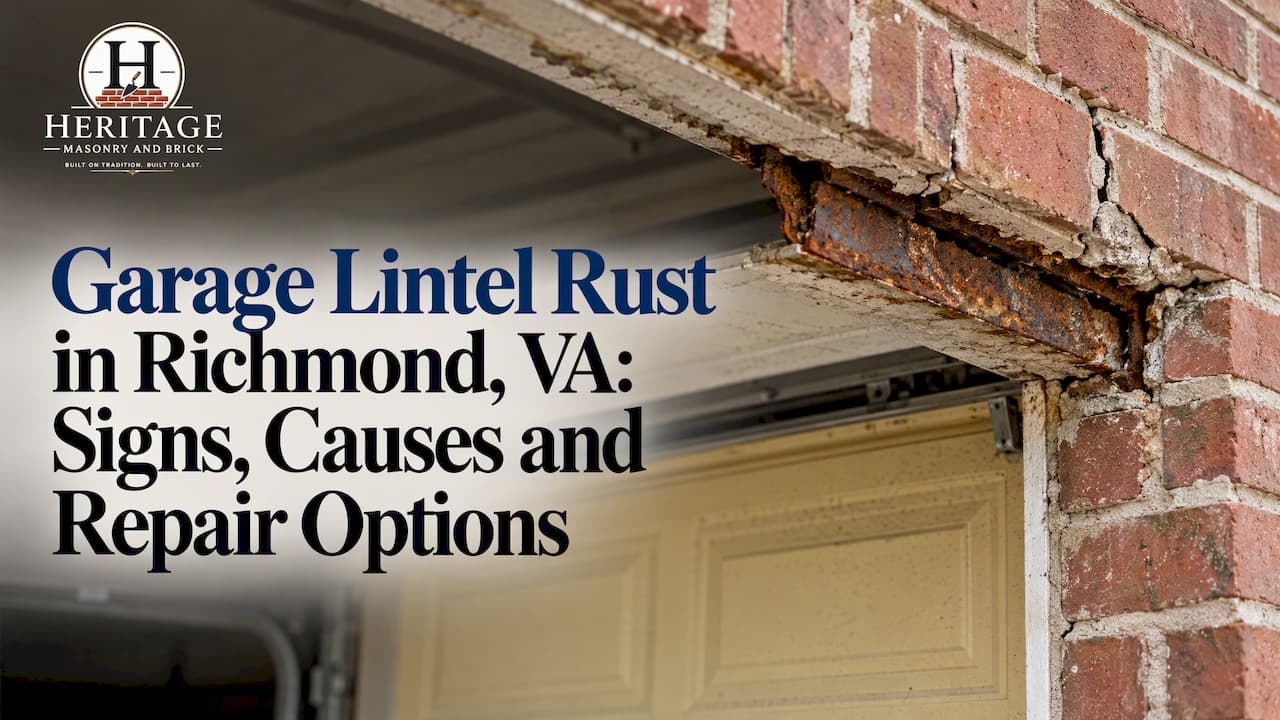
Rust on the steel lintel above a garage door is a moisture problem that grows with time. As the steel corrodes, it swells and pushes against the brick around it. That is why the first sign is usually cracked mortar or brick, not the rust itself. If you see rust stains, stair-step cracks or a sagging brick course above your garage opening, have a qualified mason look at it. Light surface rust on sound steel can sometimes be cleaned and protected. Heavily corroded steel has to be replaced.
We are Heritage Masonry & Brick, a family of traditional masons with over 25 years in the trade in Richmond, Virginia. This guide explains what is happening behind the brick, how to judge how serious it is, and what a proper repair involves, especially on older Richmond homes.
TL;DR
- Rust expands. Corroding lintel steel can push the brick above and beside it outward, which shows up as cracks, displaced brick and widening joints.
- Water is the root cause. Missing or failed flashing and blocked weep holes let moisture sit on the steel, so fixing only the rust leaves the cause in place.
- Light surface rust may be cleaned and coated. Section loss or a sagging opening means the lintel needs to be replaced, with the brick above supported while the work is done.
- On historic Richmond brick, the repair should match the original brick and use a compatible mortar, such as traditional lime mortar.
- We offer free estimates, a 5-year guarantee on materials and workmanship, no deposits, and payment on completion. Call 804-324-6304.
Table of Contents
- What a lintel does and why garage openings are exposed
- Signs that a garage lintel is rusting
- What causes steel lintel corrosion
- When rust on a garage lintel is urgent
- Clean and recoat, or replace?
- How a garage lintel is replaced
- Garage lintels on older Richmond homes
- Brick, lime mortar and why the mix matters
- How to prevent lintel rust from coming back
- Perspective
- Get your garage lintel looked at in Richmond
- FAQ
- Sources
What a lintel does and why garage openings are exposed
A lintel is the horizontal support that carries the brick above a door or window opening. Over a garage door that opening is wide, and the wall above it carries real weight. In most brick homes built from the early 20th century on, the lintel is a steel angle or beam. In older Richmond houses you may also find a flat brick arch or a stone lintel, which behave differently.
Garage openings tend to suffer for three plain reasons:
- Width. A wide span puts more load on the steel, so any loss of strength matters more.
- Exposure. Garage doors face driveways and streets. Rain, splash-back and snow melt hit the wall above them again and again.
- Hidden steel. The part of the lintel that rusts is often buried in the wall, so by the time you can see a problem, corrosion has usually been going on for years.
If you want a broader look at when any lintel needs attention, our article on lintel replacement signs every property owner should know covers the warning signs in more detail.
Signs that a garage lintel is rusting
You rarely see the whole lintel, so you read the wall instead. Look for these signs from the driveway, in daylight, and then again from inside the garage if the steel is exposed there.
Visible on the outside
- Orange or brown rust stains running down the brick below the lintel line.
- Flaking, scaly steel along the bottom edge of the opening.
- Horizontal cracks in the mortar joint that sits just above the steel.
- Stair-step cracks running up from the ends of the lintel, usually at the corners of the opening.
- Brick faces that have popped off or are sitting proud of the wall.
- A brick course that sags or dips in the middle of the opening, or a gap between the garage door frame and the brick.
Why cracking is the clue
The American Institute of Steel Construction explains that corrosion products take up more volume than the steel they came from, so the expansion can produce what is called pack rust or rust jacking. The same guide notes that masonry cracking can point to corrosion in enclosed steel. In practice that means a crack above a garage door deserves a closer look even when you cannot see any rust at all.
One warning from experience: caulk or patching compound smeared over these cracks hides the symptom and traps moisture. It does not stop the steel from expanding.
What causes steel lintel corrosion
Steel rusts when it is wet and exposed to air. AISC describes corrosion as an electrochemical process in which water acts as the electrolyte, and it notes that areas that are often wet or that do not drain well are the most vulnerable. Above a garage door, that usually comes down to a short list of causes.
Missing or failed flashing and weep holes
A well-built brick wall is designed to let some water in and then send it back out. Flashing above the lintel catches that water, and weep holes let it drain. Building envelope guidance from the Illinois Institute of Technology says lintel corrosion generally results from water that is not managed properly, often because flashing or weep holes are improper or missing. Many older homes were built with no flashing at all, and in others it has rusted away or been buried by later repairs. Our guide to through-wall flashing in brick walls explains how it works and how it fails.
Failed mortar joints
When the joints above the opening crumble or crack, rain gets straight into the wall and onto the steel. Repointing the wall is often part of a lintel repair for exactly this reason.
Sealed-up weep holes and caulk
Well-meaning owners sometimes caulk joints or fill weep holes to keep water out. That stops the wall from draining and keeps the steel wet longer.
Hard, incompatible mortar
The same IIT guidance notes that a hard joint below a shelf angle can lead to cracking and more damage. Patching old brick with a modern, hard cement mortar creates the same kind of stress, which we come back to in the lime mortar section below.
When rust on a garage lintel is urgent
Not every rust stain is an emergency, but some signs should move the job up your list. Have the opening assessed soon if you see any of the following:
- A visible sag or dip in the brick course above the door.
- Cracks that are wider than a hairline or that keep growing.
- Brick that has shifted, dropped or fallen.
- A garage door that binds, rubs or no longer closes evenly.
- Steel that is flaking in layers or has visible holes.
A garage door opening carries the wall, and often a roof or a room, above it. Do not stand under or work beneath a sagging opening, and do not pull out loose brick yourself. A mason may need to take out part of the wall to see the lintel properly. IIT guidance says that distress can require removing wall segments around the lintel to inspect it. If the structure looks compromised, a structural engineer should be involved along with the mason.
Clean and recoat, or replace?
The honest answer is that it depends on how much steel is left.
When cleaning and coating can work
IIT guidance supports cleaning the steel to bare metal and applying a corrosion inhibitor when the loss of section is not significant and calculations confirm the steel can still carry the load and limit deflection. This is a repair for early-stage rust on a lintel that is still thick and straight. It only holds up if the water source is fixed at the same time. AISC's view is that treating corrosion effectively means understanding its mechanism and moisture source, and that a specialist should be consulted when the cause is unclear, rather than simply painting over visible rust.
When replacement is the right call
The same IIT guidance states that extensive corrosion, or a cross-section weakened beyond acceptable capacity, requires replacement with a new structural member, along with proper connections, flashing, backer rod, sealant and moisture barriers at the ends of the flashing.
Here is a simple way to think about the choice:
| Condition of the lintel | Typical path |
|---|---|
| Light surface rust, steel straight, no cracking in the brick | Inspect, clean, coat, and correct the water source |
| Heavy scaling, pitting or lost thickness | Replace the lintel |
| Cracked or displaced brick above the opening | Open up the wall, assess the steel, usually replace |
| Sagging course over the door | Treat as urgent: support the wall and replace |
The call between these rows should be made after the steel is exposed and inspected. A mason can tell you what the wall is showing. Only the steel itself tells you how much strength it has left.
How a garage lintel is replaced
A proper replacement is a controlled sequence, not a quick patch. The steps below describe how we approach it, and they follow the same principles as published preservation work.
- Inspect and plan. We look at the cracking pattern, the span, what sits above the opening, and the condition of the surrounding mortar.
- Support the wall. The brick above the opening has to be held up before anything comes out. The National Park Service's Governors Island case study describes replacing a cracked, failing lintel while keeping the masonry above supported during removal. The same thinking applies to a house. If you want to read more about holding up a wall while an opening is worked on, this explanation of safe load bearing wall removal covers the temporary support principles.
- Remove the damaged brick and the old steel. Brick is taken out carefully and set aside so it can be reused where it is sound. Cleaning and reuse keep the colour and texture of the wall consistent.
- Install the new lintel. The new steel must be properly sized for the span and the load, and it must bear on solid masonry at each end. Rust-protected steel, such as galvanized or properly coated, is the sensible choice.
- Add flashing and drainage. Flashing, weep holes, backer rod and sealant go in with the lintel, because the repair is incomplete without them. IIT's building envelope perspective is that these water-management parts are part of the structural repair.
- Rebuild the brick and repoint. The wall above is rebuilt with matching brick, and the joints are repointed so the repair blends in with the rest of the house.
This is structural work, and it is not a DIY project. Our structural brick and masonry repairs cover this kind of opening work, and our brick repair service handles the finish brickwork around it.
Garage lintels on older Richmond homes
Richmond has a huge stock of older brick: rowhouses and detached homes in the Fan District, the Museum District and along Monument Avenue, plus mid-century homes with attached or detached garages across the city. Many of these walls are soft historic brick laid in lime mortar, and a lintel repair there needs more care than it does on a recent house.
Three principles guide that work.
- Repair before replacing. Virginia's 2025 Design Guide says deteriorated historic features should be repaired rather than replaced, and that necessary replacements should match the old in design, color, texture and, where possible, materials. Virginia's Department of Historic Resources takes the same line, treating replacement as a last resort for distinctive features.
- Use the gentlest methods. The 2025 guide also says that chemical or physical treatments that damage historic materials should be avoided, and that cleaning should use the gentlest means possible. That rules out aggressive grinding or harsh blasting on old brick faces.
- Match the original construction. The Virginia Transportation Research Council's best practices report says repair planning must account for the original masonry's materials, construction methods and compatible mortar.
If your home is in a historic district, check with the city before you start work on the exterior. Our page on historic brick repair in the Fan and Museum District explains how we approach these neighborhoods.
Brick, lime mortar and why the mix matters
The brick around a garage lintel does a lot of the work of keeping water out, so the brick and mortar you use in the repair matter as much as the steel.
Old brick is softer than you think
Much of the brick in Richmond's older neighborhoods was fired at lower temperatures than modern brick. It is more porous and softer. It was designed to work together with a soft mortar, which takes up movement and moisture first and is meant to be the part of the wall that wears and can be renewed.
What lime mortar does
Lime mortar is a mix of lime, sand and water. It is softer and more vapor-permeable than modern Portland cement mortar, so a wall laid in it can release moisture through the joints. The VTRC report warns that incompatible, overly hard mortar can damage historic masonry. When a hard mortar is used with soft brick, water and stress tend to go through the brick instead of the joint, and the faces of the brick can spall.
This matters directly for lintel work. The brick directly above the garage door is already under stress. A hard mortar patch there can make cracking worse and trap water against the new steel.

Matching the mix
On every repair we match the existing brick and mortar so the work blends in. For mortar, that means looking at the colour, the sand, the joint profile and the hardness of the original, and mixing lime mortar to suit. It is slower than opening a bag of cement mix, and it is the reason a repair can look like it was always there and last for decades. For the wider wall, repointing and tuckpointing done in lime mortar protects the joints that keep water away from the lintel.

If you want to understand the term, read our explainer on what tuckpointing means. Arches over doors and windows come with their own issues, and our guide to brick arch repair explains why matching the mortar beats rebuilding.
How to prevent lintel rust from coming back
Once the repair is done, a few habits keep the opening healthy.
- Keep gutters and downspouts clear, so roof water does not run down the wall above the garage.
- Keep soil, mulch and planting away from the base of the wall.
- Do not caulk over weep holes or fill open head joints at the top of the opening.
- Have failing joints repointed before water gets into the wall.
- Look at the opening each spring and fall for new stains, cracks or movement.
- Ask us to look at other openings as well. Windows and doors on the same wall often share the same flashing problem.
Perspective
We see the same pattern on garage openings in Richmond again and again. A homeowner notices a rust stain or a crack, someone caulks it or paints it, and a few years later the opening has dropped. The steel was never the whole story. Water was getting in, and nothing was letting it out.
That is why we do not treat a lintel as a single piece of steel. We treat it as part of a wall. The brick, the mortar, the flashing and the drainage all have to work together, and the repair is done when the water has a way out and the wall is carrying its load again.
On older Richmond homes we also hold ourselves to the traditional methods the brick was built with. We match the existing brick, we use lime mortar where the wall calls for it, and we aim to leave a repair that blends in. We would rather open the wall once and do it right than come back to the same opening in five years.
Thomas
Get your garage lintel looked at in Richmond
If you have rust, cracking or a dip above your garage door, we will come to look at it. Heritage Masonry & Brick repairs brick on homes and businesses across Richmond, Virginia, including structural repairs, repointing and matching historic brick. We offer free estimates, a 5-year guarantee on materials and workmanship, no deposits, and payment on completion.

See our structural brick and masonry repairs or call 804-324-6304 today. For more general guidance, browse our masonry advice page.
FAQ
Is rust on a garage lintel dangerous?
It can be. Rust expands, and corroded steel carries less load, so cracks, displaced brick or a sagging course above the door call for prompt inspection. Light surface rust on straight, sound steel is less urgent, but it still points to a moisture problem. A mason or structural engineer can tell you which one you have.
Can I just paint over a rusted lintel?
Only in limited cases. Cleaning to bare metal and applying a corrosion inhibitor is supported when the steel has lost little section and can still carry the load. Painting over rust without removing it, or without fixing the water source, tends to leave the problem in place. Most of the steel is also buried in the wall, where paint cannot reach.
How do I know if the lintel needs replacing?
Look for heavy scaling, pitting, a sagging brick course, or cracks that keep growing. The final decision comes once the steel has been exposed and checked, since extensive corrosion or a weakened cross-section requires a new member. We will tell you what we find and show you before we recommend replacement.
Does a lintel repair on an older Richmond house need special materials?
Usually, yes. Historic brick is often soft and laid in lime mortar, so the repair should use matching brick and a compatible mortar. Hard modern mortar can damage old brick, which is why we match the mix to the original wall.
Who should I call for a rusted garage lintel in Richmond?
A masonry contractor with structural repair experience, and an engineer if the opening is visibly sagging. We handle the masonry side and offer free estimates in Richmond, VA. Call 804-324-6304.
Sources
- AISC Design Guide 16: Assessment and Repair of Structural Steel in Existing Buildings (2025)
- 7.5 Shelf Angle and Lintel Damage Issues, Illinois Institute of Technology
- Brick and Stone Preservation, Governors Island National Monument, National Park Service
- Virginia Design Guide 2025, Department of Housing and Community Development
- Best Practices for Historic Masonry, Virginia Transportation Research Council
- A Handbook and Resource Guide for Owners of Virginia Historic Homes, Virginia Department of Historic Resources