
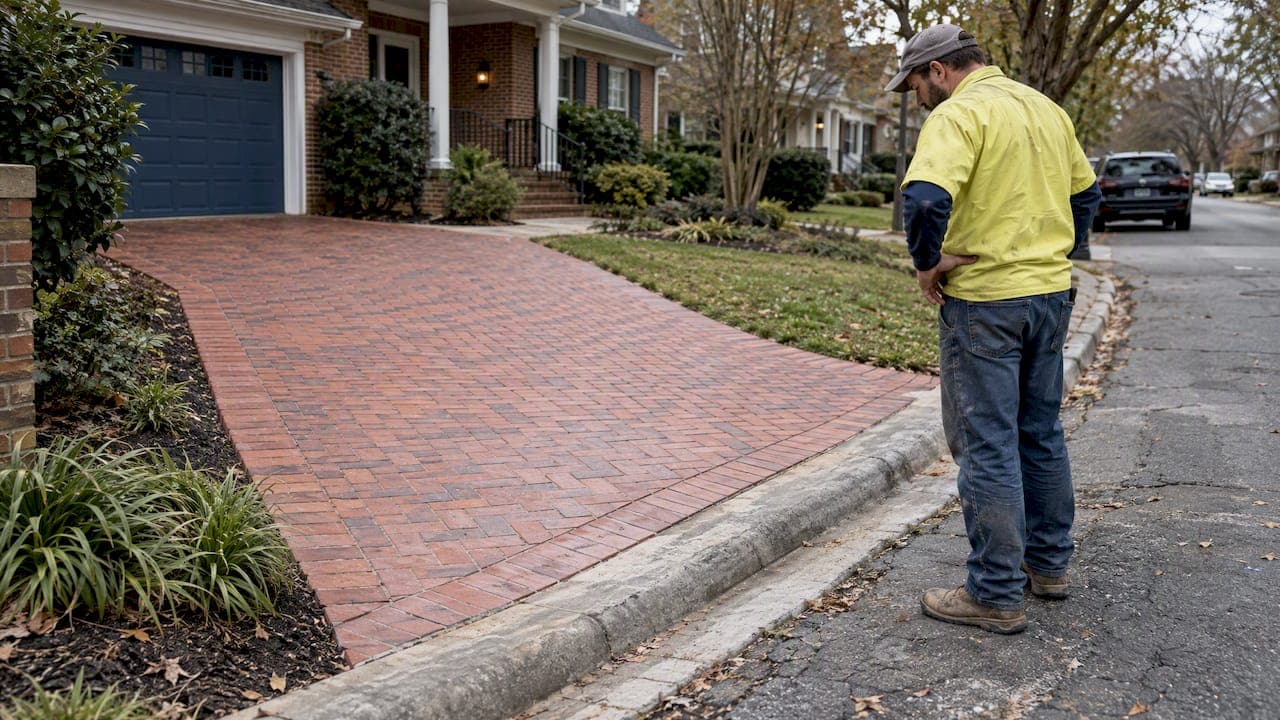
A driveway brick apron is the brick transition between your driveway and the street. It is the first piece of masonry anyone sees from the curb, and it takes more abuse than almost any other brick on your property. Done well, it adds period character and holds its shape for decades. Done badly, it sinks, sprouts weeds and loosens within a few winters. This guide covers what an apron is, what brick versions cost, what Richmond requires before you build, and how we approach new aprons and repairs.
TL;DR
- A driveway apron connects your driveway to the public street. Brick aprons suit historic and traditional homes, but they need a vehicle-rated base, not just a good pattern.
- Nationally, brick paver work often runs $25 to $40+ per square foot installed. A typical single-car apron is small, so the total is manageable.
- In Richmond, any driveway work across the city right-of-way needs a Work in the Streets permit. Confirm the rules before you tear anything out.
- Most failed aprons fail underneath. Settling, pooling water and loose edges point to a base or drainage problem, not a brick problem.
- We offer free estimates, a 5-year workmanship guarantee, no deposits, and payment on completion. Call 804-324-6304.
Table of Contents
- What a driveway apron is, and what it is called
- Why brick works at the curb
- Common brick apron designs
- What a brick driveway apron costs
- Richmond rules to check before you build
- How a brick apron is built to last
- Repairing an existing brick apron
- Our perspective: build it like it belongs to the house
- Getting a brick apron quote from Heritage Masonry & Brick
- Questions to ask any mason before you sign
- FAQ
- Sources
What a driveway apron is, and what it is called
The apron is the section of driveway where it meets the road. Angi describes it as the transition from a private driveway to the public street, typically 8 to 18 feet long. The same source says it is sometimes officially called a driveway approach or entrance, and it often flares at the street so vehicles can turn in.
That flare matters when you plan brick. A flared apron means cut bricks, curved edges and more waste than a rectangle. It also means more places where a poorly set edge can lift.
Two other terms come up often:
- Driveway entrance or approach: the official term for the same area in many municipal documents.
- Apron border or band: a brick strip framing a concrete or asphalt apron. This is a popular budget version, where only the visible edge is brick.
If you measure a driveway for any kind of work, measure the apron separately. It is flared and often a different width from the rest of the drive, as one measuring guide points out.
Why brick works at the curb
Brick gives a driveway entrance a warmth that poured concrete does not. On a brick rowhouse, a Fan District foursquare or a Colonial Revival near Monument Avenue, it ties the street edge to the house. It also repeats materials you already have: the steps, the walkway, the foundation, the chimney.
There are honest trade-offs:
- Cost: brick costs more than plain concrete, which is typically the lowest-cost option.
- Maintenance: joints can need attention, and a poorly built field will shift.
- Load: a street-facing apron takes the full weight of cars turning, braking and sometimes delivery trucks. It needs real engineering underneath.
For homes where the original architecture matters, we think the trade is worth it. Matching the home's materials is also what Richmond's own design guidance leans toward in historic settings (more on that below).
Common brick apron designs
Full brick apron
The entire apron is laid in brick, usually in a herringbone, running bond or basket-weave pattern. Herringbone is the strongest choice for vehicle traffic because the interlocking angle resists the sideways push of turning tires. Running bond looks traditional but can creep under repeated turning.
Brick border on a concrete apron
A concrete center with a brick band or soldier course on each side. This lowers material and labor cost and gives a clean, durable driving surface. Many homeowners pair red brick with grey or charcoal concrete, a combination that comes up often in design guidance on color pairings.
Brick-edged apron on an asphalt drive
A brick strip separates asphalt from the street or sidewalk. It looks tidy, but the edge is the weak point. If you already have loose edge bricks, our guide to fixing loose driveway brick edging explains what causes it and what a proper repair involves.
Wheel tracks
Two brick or paver strips for the tires with grass or gravel between. It is a lighter look, but it is not always suited to the public-facing section of an entrance, and the city has its own rules there.
What a brick driveway apron costs
We do not publish set prices, because every apron differs in size, flare, base condition and access. Here is how to size it yourself using published national numbers.

HomeGuide's 2026 driveway cost guide puts paver driveways at roughly $10 to $50 per square foot installed, with brick pavers often landing at $25 to $40 or more because of the labor in building the base and laying the pattern. Those are national figures, not Richmond quotes or ours.
A worked example using that national range:
| Apron size | Square feet | At $25 per sq ft | At $40 per sq ft |
|---|---|---|---|
| 10 ft wide x 8 ft long | 80 | $2,000 | $3,200 |
| 12 ft wide x 12 ft long | 144 | $3,600 | $5,760 |
| 16 ft wide x 18 ft long | 288 | $7,200 | $11,520 |
This is arithmetic on the national range, so treat it as a planning range. What moves a real quote:
- Demolition and haul-off of the old surface.
- Base depth. A vehicle-rated base is deeper than a patio base.
- Pattern. Herringbone and curves take more cuts and more labor than running bond.
- Flare and curves. More cut brick, more waste.
- Drainage fixes. If water already sheets across the apron, the grade may need correcting.
- Matching brick. Salvaged or reclaimed brick for a historic house can cost more than new.
For a sense of how brick flatwork is priced when it is not at the street, see our breakdown of brick patio cost. A driveway apron costs more per square foot than a patio because of the load.
Richmond rules to check before you build
This is the step many homeowners skip. The part of the apron between the sidewalk and the street, or between the property line and the curb, generally sits in the public right-of-way. In Richmond, the city's Right-of-Way Management page states that all work in the public right of way requires a Work in Streets Permit, and it lists driveways among the types of work covered. If a contractor applies, the city asks for items such as a certificate of insurance and contractor license information.
The city's Right-of-Way Design and Construction Standards Manual adds detail. It says driveways crossing the right-of-way to a city street must be built under that permit, and that location and width are subject to the city's driveway policy. For residential driveways on streets with curb and gutter, it calls for a 6 in. thick apron built with 2 ft. 6 in. radii. Read the current manual before you finalize a design, because standards are updated.
Two practical consequences:
- Decorative brick in the right-of-way is not guaranteed to survive. Angi cautions that a municipality may not be obligated to replace non-standard materials like brick if it has to dig up the apron for utility or drainage work. Ask the city what it requires, and plan for the possibility that you will pay to restore the brick.
- Historic districts add a layer. If your home is in a Richmond historic district, exterior changes visible from the street can involve the Commission of Architectural Review. Our post on avoiding CAR delays with sample panels explains how a mortar and brick sample can head off questions.
Call the city before design, not after. We can talk through scope with you, but the permit and any city requirements need to be confirmed for your specific address.
How a brick apron is built to last
The visible brick is maybe 10 percent of the job. The rest is below it.
1. Excavate and correct the grade
The old surface comes out, along with any soft or organic soil. The finished surface must shed water toward the street or a designed drain path, never toward the house or into a low spot. If the apron pools water, read our guide to diagnosing brick drainage problems. The same logic applies at the curb.
2. Build a vehicle-rated base
Patio-depth gravel is not enough where cars turn. Driveway aprons need a deeper compacted aggregate base, installed in lifts and compacted at each lift. For comparison, our patio base preparation guide covers the 4 to 6 in. gravel base that suits foot traffic. Treat that as the minimum for a patio and not a spec for a driveway. Where an apron sits on or beside an existing concrete slab, a mortared brick surface over a structural slab is another route, and it is where traditional mortar work matters.
3. Choose the bedding and joint system
There are two broad approaches:
- Dry-laid (sand-set) brick with edge restraint and polymeric sand in the joints. It is flexible and repairable. Research on apron materials notes that polymeric sand or specific mortar helps prevent shifting and weed growth.
- Mortar-set brick on a concrete slab. It is rigid, tidy and well suited to a traditional look, but it needs a sound slab and expansion joints, and cracks if the slab moves.
4. Lock the edges
Edges are where aprons start to fail. A restraint on every free side keeps the field from spreading under tire load. Where the apron meets the street, the edge detail also has to meet the city's standard.
5. Match the brick
On a historic house, the apron should not look like it came from a catalog. Matching the color, size and texture of the home's existing brick is what makes the entrance look like it was always there.
Repairing an existing brick apron
Not every apron needs replacing. Start by reading the symptoms:
| What you see | Likely cause | Typical fix |
|---|---|---|
| Loose or tilting edge bricks | Missing or failed edge restraint | Reset edge, add restraint |
| Low spot or ruts in wheel path | Base settlement | Lift, rebuild base, relay brick |
| Weeds in joints | Joint sand washed out | Clean and re-sand or repoint |
| Crumbling mortar | Age, water, wrong mortar | Repoint with matching mortar |
| Cracked bricks | Overload or freeze damage | Replace individual units |
| Water pooling | Grade or drainage fault | Regrade, correct drainage |
A few loose bricks can be reset in an afternoon. A sunken wheel path is a base failure, and resetting only the top will fail again. A good contractor tells you which one you have before quoting.
For mortared aprons and adjoining brick walls or steps, we use repointing and tuckpointing to restore joints, and brick repair to replace damaged units with matching material.
Our perspective: build it like it belongs to the house
We are a family-run masonry company specializing in historic brick restoration across Richmond. Over 25 years, the pattern we see most is simple: homeowners spend on the brick they can see and skimp on what they cannot. An apron is the clearest example.

Our approach rests on three habits. First, we match the existing brick and mortar, because a new apron beside a 1920s house should look like it belongs to the 1920s. Second, we use traditional lime mortar where the original masonry calls for it, since a mortar harder than the brick damages the brick over time. Third, we are plain about what is wrong. If your apron is sinking, we will say the base is the problem and quote that, not a cosmetic patch that fails in two winters.
We also tell homeowners about the permit and right-of-way questions up front, because nobody wants to learn about them after the old apron is gone. And we stand behind the work with a 5-year guarantee on materials and workmanship, no deposit, and payment when the job is complete.
— Thomas
Getting a brick apron quote from Heritage Masonry & Brick
If you are planning a new apron, a brick border, or a repair to a failing entrance, our new brickwork team can walk the site, check the drainage and base, and give you a written estimate at no charge. For a connected walkway or entry path, see our brick patios and walkways work. You pay on completion, with no deposit.
Call 804-324-6304 today to schedule your free estimate.
Questions to ask any mason before you sign
- Who confirms the permit requirements for the right-of-way portion, and who pays the fee?
- How deep is the base, and how is it compacted?
- Dry-laid or mortar-set, and why for this site?
- How will water leave the apron?
- Will the brick match my house, and can I see a sample?
- What does the guarantee cover, and for how long?
A contractor who answers these clearly and in writing has probably built an apron before.
FAQ
What is an apron on a driveway?
It is the section of driveway where your private drive meets the public street. It is often flared so vehicles can turn in, and some cities call it a driveway approach or entrance. Typical lengths run about 8 to 18 feet, according to Angi.
How much does a brick driveway apron cost?
Nationally, brick paver work often runs $25 to $40 or more per square foot installed. A 12 ft by 12 ft apron is 144 square feet, so that range implies roughly $3,600 to $5,760. Your actual price depends on demolition, base depth, pattern and drainage. We provide free estimates in Richmond.
Do I need a permit for a driveway apron in Richmond?
If the work crosses the public right-of-way, yes. The city says all work in the right of way needs a Work in Streets Permit, and driveways are on its list. Check with the city for your address before work begins.
Is brick a good material for a driveway apron?
Yes, when it sits on a proper base with locked edges. It suits historic and traditional homes and holds its look well. Concrete costs less, so some homeowners choose a concrete center with a brick border for a balance of cost and character.
Sources
- Angi: 10 Driveway Apron Ideas to Elevate Your Entrance
- HomeGuide: How Much Does a Driveway Cost?
- City of Richmond: Right-of-Way Management
- City of Richmond: Right-of-Way Design and Construction Standards Manual, Part 2
- SurfaceMeasure: How to Quote a Driveway Pressure Washing Job
- Paramount Stone: Explore the Best Materials for Stunning Driveway Aprons