
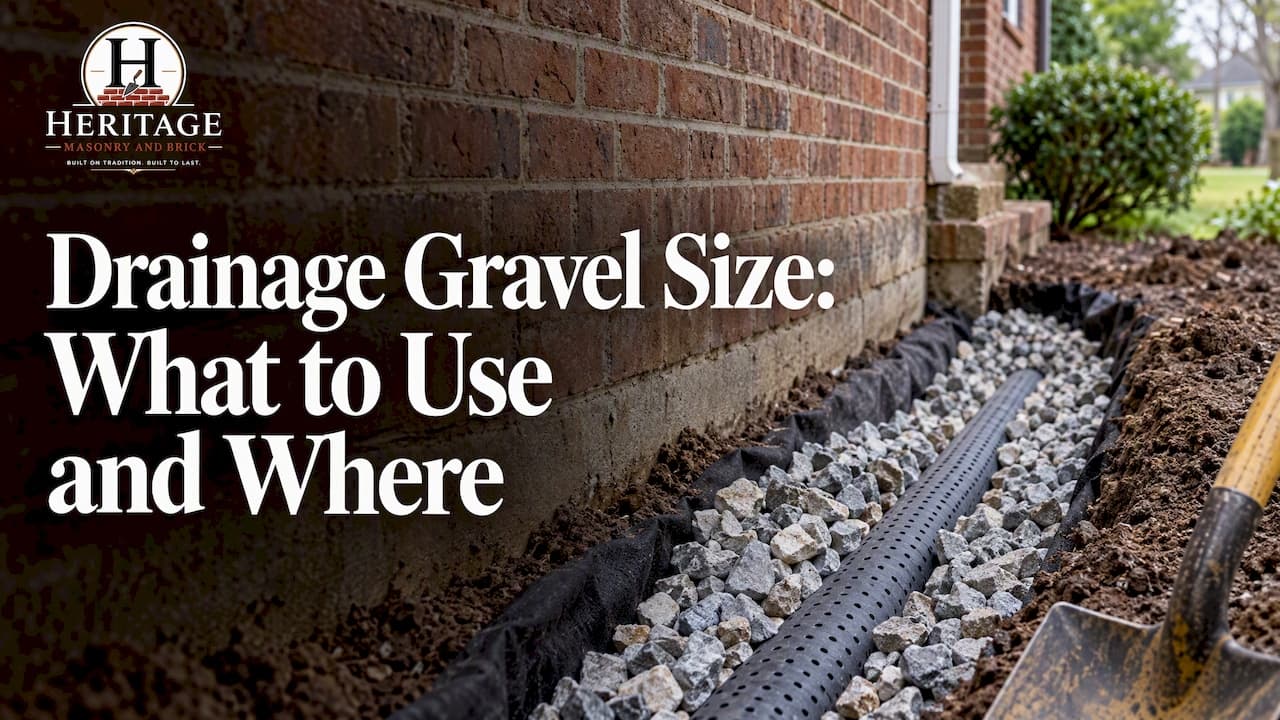
For most home drainage jobs, the answer is clean, washed, angular stone between 3/4 inch and 1-1/2 inches. Smaller stone clogs and larger stone suits bigger systems. The right size depends on what the gravel has to do: wrap a French drain, back a retaining wall, sit under a patio, or fill a trench. How clean the stone is matters as much as its size.
We repair and build brick and stone structures in Richmond, Virginia, so we see what happens when drainage is done wrong. Water that cannot leave a wall, a step or a foundation ends up in the brick and the mortar joints. Below is a practical guide to choosing drainage gravel, backed by public agency and university sources.
TL;DR
- Clean (washed) stone of 3/4 inch to 1-1/2 inches is the safe range for most residential drainage: French drains, downspout trenches and wall backfill.
- "Clean" matters more than the label. Gravel with fines (dust and small particles) compacts and blocks water, even when the stone size is right.
- #57 stone, 3/8 to 1 inch, is widely used in stormwater work. Larger 2 to 4 inch stone is for underdrains and high-volume systems.
- Septic drain fields follow local county rules, so check with your health department before buying stone.
- Behind a brick or stone retaining wall in Richmond, drainage is a structural issue. Poor drainage is a common reason walls lean.
Table of Contents
- Why Gravel Size Changes How Water Moves
- The Short List: Common Drainage Stone Sizes
- Is 3/4-Inch Gravel Good for Drainage?
- Is #57 gravel good for drainage?
- What Size Gravel for a French Drain?
- Round Gravel or Angular Stone?
- Gravel Size Behind a Retaining Wall
- Gravel Under Patios, Walkways and Steps
- What Size Gravel for a Drain Field?
- Why Fines and Clogging Matter
- Drainage and Brick: Why We Care in Richmond
- Our Perspective: Drainage Comes Before the Brick
- Choosing Gravel for Your Project: A Quick Checklist
- When to Call a Masonry Contractor
- FAQ
- Sources
Why Gravel Size Changes How Water Moves
Gravel drains because of the empty spaces between stones, called voids. Water moves through those voids to a pipe or to the soil below. Two things control how well that works: the size of the stone and how much fine material is mixed in.
Bigger stone makes bigger voids. Fine material does the opposite. Drainage rock is described as clean, washed stone with the fines screened out, and unwashed stone has fines that fill the gaps and reduce open void space. That is why a load that is the "right size" on paper can still fail.
There is also a ceiling. Stone that is too large leaves voids so big that soil particles wash down into them. That is the job of fabric, covered below.
The Short List: Common Drainage Stone Sizes
These are the sizes homeowners and contractors run into most often.
| Stone | Typical size | Common use |
|---|---|---|
| #57 stone | 3/8 to 1 inch | Stormwater and drainage construction, French drain backfill |
| Clean 3/4-inch crushed rock | About 3/4 inch | French drains, wall backfill |
| Washed drain rock | 3/4 to 1-1/2 inches | Roof drip lines, downspout and erosion areas |
| #2 stone | 1-1/2 to 2-1/2 inches | Stone reservoirs, stabilized construction entrances |
| AASHTO 1 stone | 2 to 4 inches | Constructed stone underdrains |
The pattern is simple. Residential work lives in the 3/4-inch to 1-1/2-inch range. Larger stone shows up where the volume of water, or the need to store it, is greater.
Is 3/4-Inch Gravel Good for Drainage?
Yes, with one condition. Three-quarter-inch gravel works for drainage when it is clean or washed. A product sold as 3/4-inch "minus" includes fines that make it compact and restrict water flow, which suits a driveway base but not a drain.
When you order, ask for "clean," "washed" or "drain rock" and avoid anything labeled "minus," "crusher run" or "road base." The names vary by quarry and supplier, so ask what percentage of fines the product contains. If the supplier cannot tell you, choose a different product.
Is #57 Gravel Good for Drainage?
Yes. #57 is a washed, angular, open-graded stone, and it is widely used in stormwater management construction. Its range is a little smaller than the NRCS range for drip-line protection, so it makes a good fill around a French drain pipe and under a patio or walkway where a free-draining base helps.
For surface use, such as a gravel strip along a downspout where rain hits hard, stone near the top of the range (1 inch and up) stays put better. Smaller stone can shift under falling water.

What Size Gravel for a French Drain?
A French drain is a trench with a perforated pipe, surrounded by clean stone, usually wrapped in fabric. For most yards, the stone is 3/4-inch clean rock. In Western Washington, French drains use 3/4-inch clean rock and non-woven geotextile fabric to keep fine soil out. The same logic applies in Virginia: the stone has to be clean, and the soil has to be kept out.
A few practical points:
- Use the fabric. The NRCS advises non-woven geotextile fabric beneath drainage rock to reduce maintenance, control weeds and make the drainage layer work better.
- Do not skip washing. Failure to use clean aggregate can cause French drains to silt up within 18 months, according to one supplier's guide. Treat that as a warning about shortcuts, not a guaranteed timeline.
- Size the stone to the pipe. Perforations are small. Stone that is too fine can enter the pipe, which is another reason to avoid anything below about 1/2 inch.
- Choose an outlet first. The best gravel does nothing if the water has no place to go. The pipe needs a downhill exit.
Pipe choice matters too. Our own piece on PVC versus corrugated pipe explains what we have learned over 25 years in masonry.
Round Gravel or Angular Stone?
Pea gravel and river rock are rounded. Crushed stone is angular. For drainage, both can pass water, but they behave differently under load.
Maryland's stormwater guide notes that stone usually means manufactured, angular, rough material that interlocks more stably than naturally rounded gravel. An Iowa State University pavement design manual likewise prefers equi-dimensional aggregate with a rough surface texture. Angular stone locks together, so it will not roll or settle as much beneath paving or behind a wall.

Rounded stone is fine for decorative drainage strips and light-duty areas. Where something sits on top of the gravel, choose angular.
Gravel Size Behind a Retaining Wall
This is where drainage becomes structural. Water that builds up behind a wall pushes on it. This is called hydrostatic pressure, and it is a common reason walls bow, crack and lean. Clean 3/4-inch crushed rock is used behind retaining walls because it drains freely, while fine-containing gravel does not.
A typical drainage layer behind a wall includes:
- A compacted base at the footing.
- A perforated pipe at the bottom of the wall, sloped to daylight.
- A zone of clean, angular stone, often 3/4 inch, running up the back of the wall.
- Fabric between the stone and the native soil.
- Soil cap at the top to keep surface runoff out of the stone.
We cover the full system in what a retaining wall drainage system actually needs, the backfill mistakes in why walls start leaning, and depth requirements in our guide to retaining wall footing depth for Richmond homeowners.
Surface water matters as well as water in the soil. Slope is part of the design on every hard surface, and it is just as true around pools as around walls. This guide to pool deck drain slope shows how a small, steady fall moves water where you want it.
Gravel Under Patios, Walkways and Steps
A brick patio or walkway needs a base that drains. If water sits under the pavers or brick, it softens the base, freezes in winter and lifts the surface. A clean, compacted, angular stone base lets water pass through rather than pool.
For permeable surfaces, Kentucky's extension service says to use cleaned, washed stone that meets municipal roadway standards to prevent clogging. Iowa State notes that pavement subbase fines are usually limited to 10% for normal construction and 6% where free drainage is needed. Those figures come from road design, but they show how strictly drainage layers are held to a low fines limit.
We lay out base depth and preparation in patio base prep with 4 to 6 inches of gravel. Brick steps need the same attention: water collecting behind or under a step is how they settle and pull away from the house.
What Size Gravel for a Drain Field?
Septic drain fields are not a do-it-yourself decision. Local health departments set the rules, and they differ by county. Lewis County, Washington, for example, requires washed drain rock between 1/2 inch and 2-1/2 inches and rejects unwashed rock. Its standard also calls for at least 6 inches of clean gravel under the perforated pipe and 2 inches over it.
Those numbers are one county's rules, not a national standard. In Howard County, Maryland, trench length can change with the depth of gravel below the pipe. If you have a septic system in or near Richmond, contact the local health department and a licensed septic designer. Do not choose stone from a general guide.
Why Fines and Clogging Matter
A drain that works at installation can fail later. Research on stormwater gravel systems at Monash University found that physical clogging mainly comes from sediment particles smaller than 6 micrometers moving through the system. These particles are far too small to see, which is why fabric and clean stone are not optional extras.
The same research suggests clogging is slower where water levels stay constant than where they rise and fall. In practice, a drain that stays free-flowing and outlets well is less likely to build up a plug.
Some guidance also warns against choosing by name alone. Soils.com argues that drainage aggregate should be chosen by gradation, fines content and surroundings rather than the word "gravel" or "stone." That matches what we see on job sites.
Drainage and Brick: Why We Care in Richmond
In Richmond, VA, brick is everywhere: rowhouses in the Fan District, older homes around the Museum District and Monument Avenue, and brick garden walls, steps and chimneys across the city. Brick is durable, but it takes in water, and the mortar joints are usually where moisture gets in first.
When drainage is poor, we see the same results again and again:
- Mortar joints that erode and open up near grade.
- Efflorescence, the white powder left as water moves out of masonry.
- Steps and walkways that settle or tilt.
- Retaining walls that bow or lean.
- Foundation walls that stay damp.
Fixing the brick without fixing the water gives you a repair that fails again. That is why drainage is part of how we plan masonry work in Richmond, Virginia.
Our Perspective: Drainage Comes Before the Brick
We are a family-run masonry company, and most of our Richmond calls begin with brick that looks damaged. Often the real cause is water: a downspout that dumps against a wall, a backfill that traps moisture, or a patio base that holds water instead of shedding it.
Our view is simple. Choose clean, angular stone. Keep the fines out. Use fabric. Give the water an outlet. Then build the masonry on a base that will not move.
We also match the repair to the building. On historic Richmond brick, we match the existing brick and use traditional lime mortar, because the mortar should be a little softer than the brick around it so that the wall can handle moisture and movement. Lime mortar repointing is a lasting repair, but it does not replace good drainage. Good drainage protects both the brick and the repointing.
If you are unsure what size stone your project needs, the answer depends on the wall, the soil and the slope. A short site visit usually settles it.
— Thomas
Choosing Gravel for Your Project: A Quick Checklist
Before you order stone, run through this list:
- Define the job. French drain, wall backfill, patio base, downspout or septic field?
- Match the size. Start with clean 3/4-inch to 1-1/2-inch stone for most home projects. Go larger only for underdrains, dry wells or storage.
- Ask about fines. Order washed stone, not "minus."
- Prefer angular. Crushed stone interlocks and stays put.
- Plan the fabric. Non-woven geotextile between stone and soil.
- Plan the outlet. Water needs to leave by gravity, in a spot that does not cause problems for you or your neighbors.
- Check local rules. Septic work and some stormwater work need permits and inspections.
When to Call a Masonry Contractor
Drainage gravel on its own is a small purchase. The risk is in the work around it. If the project involves a brick or stone retaining wall, a patio, steps, a foundation, or masonry that already shows water damage, the stone choice is only one piece.
Heritage Masonry & Brick works throughout Richmond, VA on new brickwork, brick patios and walkways, brick steps and step repair, and structural brick and masonry repairs. We offer free estimates, no deposits and payment on completion, and we back our work with a 5-year guarantee on materials and workmanship. To talk through a drainage or masonry problem, call 804-324-6304 or visit Heritage Masonry & Brick.
FAQ
What is the best size gravel for drainage?
For most home projects, clean, washed, angular stone from 3/4 inch to 1-1/2 inches is the best choice. The NRCS recommends this range for drain rock at roof drip lines. Larger 2 to 4 inch stone is for underdrains and high-volume systems.
Is 3/4 gravel good for drainage?
Yes, if it is clean or washed. Three-quarter-inch "minus" contains fines that pack down and block water, so it is wrong for drains. Check the product description and ask the supplier about fines.
Is #57 gravel good for drainage?
Yes. #57 stone is washed and angular, typically 3/8 to 1 inch, and is widely used in stormwater construction. It works well around French drain pipes and under patios or walkways.
What size gravel is used for a drain field?
It depends on your county. Some health departments require washed rock in a range such as 1/2 inch to 2-1/2 inches, with set depths below and above the pipe. Ask your local health department and a licensed septic designer before ordering stone.
Do I need fabric with drainage gravel?
In most cases, yes. Non-woven geotextile fabric keeps soil from moving into the stone and clogging the voids. The NRCS recommends it beneath drainage rock.
Sources
- Slow it. Spread it. Sink it! Home Drainage Guide (USDA NRCS)
- Guide to Common Construction Materials and Components (Maryland Department of the Environment)
- Constructed Stone Underdrains (Penn State)
- Section 6F-1, Pavement Subbase Design and Construction (Iowa State University)
- AEN-108: Permeable Pavement for Stormwater Management (University of Kentucky)
- Lewis County Conventional (Gravity) Septic System Construction Standards
- How to Design a Residential Septic System (Howard County, Maryland)
- Clogging of stormwater gravel infiltration systems and filters (Monash University)
- 3/4 Gravel Guide: Clean vs Minus, Uses & Cost (Harbor Soils)
- Drainage Rock and French Drain Gravel (Mulch Mound)
- Best Gravel & Aggregate for Drainage (Soils.com)