
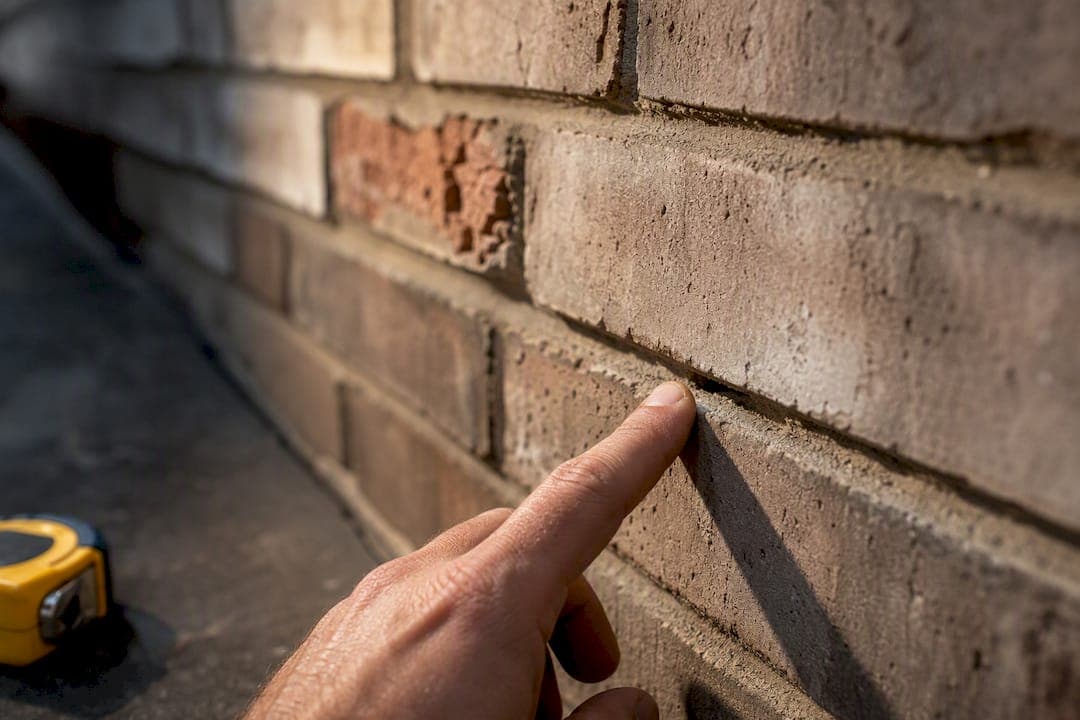
A masonry workmanship warranty is a contractor's written promise to fix defects caused by their labor, not problems with the brick, mortar, or stone itself. Most workmanship warranties run multiple years, and the strongest ones spell out exclusions and remedies in plain language. Before any mason breaks ground, get that promise in writing and keep the signed contract somewhere safe.
TL;DR:
- Most masonry workmanship warranties last between one and five years, with longer coverage indicating a contractor's confidence and stability.
- The warranty should clearly specify the scope, start date, exclusions, remedies, and procedures, including response timelines, to ensure enforceability.
- Common exclusions involve damage from de-icers, alterations, or acts of nature; clarifying vague terms like "normal wear" is essential before signing.
- Proper documentation such as photos, invoices, and written transferability clauses strengthens your claim if issues arise later.
- Contractor reliability and documented warranty terms are more important than warranty length when ensuring proper repairs and coverage.
Table of Contents
- What a Workmanship Warranty Covers (and What It Doesn't)
- How Long Should a Masonry Workmanship Warranty Last?
- Reading (and Negotiating) Your Warranty Clause
- Filing a Masonry Warranty Claim: What to Do First
- Can a Masonry Warranty Transfer to a New Homeowner?
- How Heritage Masonry & Brick Approaches Warranty Backing
- The Warranty Question Homeowners Get Backwards
- Ready to Get Your Warranty Terms in Writing?
- Sources
- FAQ
What a Workmanship Warranty Covers (and What It Doesn't)
A workmanship warranty covers mistakes made during installation, not flaws baked into the materials before the crew ever showed up. That distinction decides who you call first when something goes wrong, and it trips up more homeowners than any other part of the contract.
Labor defects are the contractor's responsibility. Material defects belong to the manufacturer. A workmanship warranty specifically covers labor related failures like improper installation, while a manufacturer's warranty deals strictly with product flaws.
Here's how that split shows up on an actual masonry job:
- Workmanship defects: improperly mixed mortar that crumbles early, sloppy repointing joints, gaps around flashing or sealant that let water in
- Material defects: bricks that crack from a manufacturing flaw, pavers that spall because of a bad batch, mortar mix that was defective before it left the supplier
Telling the two apart usually comes down to timing and pattern. If mortar joints are failing in one localized area where a crew worked, that points to labor. If bricks across an entire batch are cracking or discoloring the same way regardless of who installed them, that points back to the manufacturer. When you're not sure, a reputable contractor will inspect the site and tell you honestly which category applies, even when the answer means directing you elsewhere for the fix.
How Long Should a Masonry Workmanship Warranty Last?
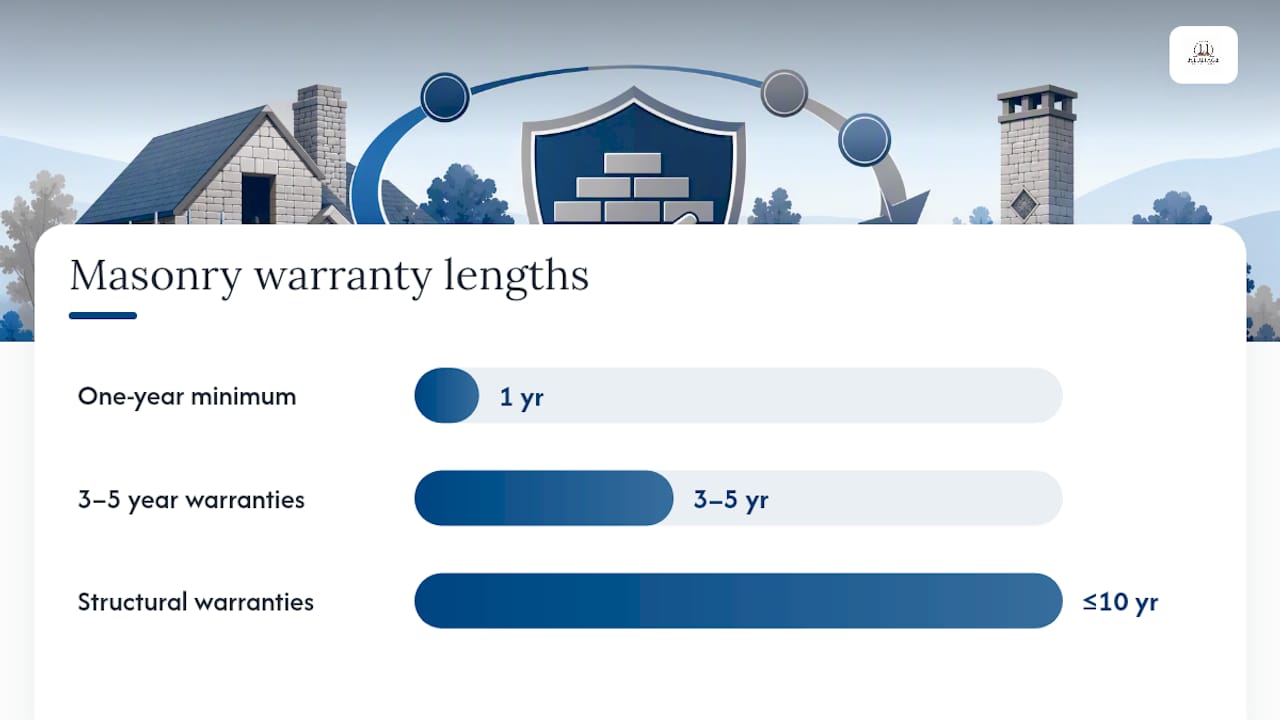
Warranty length in residential construction generally follows a pattern known as 1-2-10: one year for workmanship, two years for major systems, and up to ten years for structural defects. Masonry work usually falls into that first bracket, though many contractors extend it well past the one-year minimum.
Common ranges you'll see in the field:
- One-year workmanship warranties, the bare industry minimum
- Three to five-year workmanship warranties from established contractors who stand behind their crews
- Structural warranties running much longer, sometimes a decade, when foundational or load-bearing masonry is involved
A five-year workmanship guarantee is longer than what many masonry contractors offer, and it usually signals a company confident enough in its crews to back the work well past the industry floor.
Why do some contractors go longer than others? Company stability is the biggest factor. A contractor who controls the whole project and documents installation standards can afford to extend coverage because they know exactly how the work was done. Firms juggling subcontractors on every job have a harder time making that same promise with confidence.
Reading (and Negotiating) Your Warranty Clause
A warranty is only as good as what's written on the page. Before you sign anything, walk through the contract line by line and confirm these items are spelled out, not implied:
- Exact scope of coverage — which repairs, which materials, which parts of the structure
- Start date — does the clock begin at project completion, final payment, or final inspection?
- Duration — one year, five years, or longer for structural elements
- Exclusions — what voids coverage
- Remedies — repair, replacement, or refund, and who decides which applies
- Claims procedure — how you notify the contractor and what proof they require
- Response timeline — how many business days the contractor has to inspect and respond
Watch closely for exclusions around de-icing chemicals, altered work, and "acts of nature." Salt-based de-icers accelerate spalling and freeze-thaw damage in ways that can look identical to a workmanship failure years later, which is exactly why many contractors carve that damage out of coverage. Ask for clarification on any exclusion that sounds vague. "Normal wear" means nothing without a defined boundary.
Pro Tip: Ask the contractor to put a specific response window, like five or ten business days, directly into the warranty text. A vague promise to "respond promptly" gives you nothing to hold them to if a claim goes quiet.
Push for transferability language and, where the contractor offers it, third-party backing. A written commitment beats a verbal assurance every time a dispute arises.
Filing a Masonry Warranty Claim: What to Do First
Discovering a crack or a failing mortar joint feels urgent, but a methodical approach protects your claim better than a frantic phone call. Follow this sequence:
- Send written notice to the contractor describing the defect and referencing your warranty terms
- Document everything with dated, timestamped photos from multiple angles
- Preserve the area rather than attempting your own repair, which can void coverage
- Gather your paperwork: the signed contract, original scope of work, invoices, and any maintenance records
- Allow inspection and give the contractor reasonable access to assess the defect firsthand
A defect that shows up on brick steps built two years ago is a much easier case with dated photos and the original invoice in hand than without them. If a contractor drags its feet or ignores your notice entirely, you have escalation paths. Some warranties are backed by surety bonds or third-party warranty administrators who step in when a contractor fails to perform. Beyond that, local code enforcement and small claims court remain options, though protections vary by state and by what your specific contract says.
Can a Masonry Warranty Transfer to a New Homeowner?
Transferability determines whether the warranty dies with the original owner or survives a sale, and it's one of the most overlooked details in any masonry contract.
- Confirm it in writing. Some contractors transfer warranties automatically; others require notification within a set window after closing, and a few don't allow transfer at all.
- Transferable coverage adds resale value. A warranty that follows the property rather than the person gives buyers real peace of mind, and savvy sellers highlight it during negotiations.
- Implied warranties exist even without a written promise. Under common law, contractors can be held to an implied warranty of good workmanship requiring them to meet local industry standards, even when the contract itself is silent on the subject.
If a dispute arises and your contract doesn't address the situation directly, that implied warranty may still give you standing. For anything beyond a straightforward repair disagreement, especially involving a home sale, a construction attorney or a third-party warranty program is worth the conversation.
How Heritage Masonry & Brick Approaches Warranty Backing
A warranty is a promise, and the value of that promise rests on the company standing behind it. That's the piece homeowners underweight most, and it's backed by a straightforward reality: a warranty's practical value depends heavily on the contractor's reputation and ongoing ability to perform repairs, not just the number of years printed on the page.
This company has worked on residential and commercial masonry projects for more than 25 years, and backs its projects with a 5-year workmanship guarantee, well past the industry's one-year floor. That kind of coverage tends to go hand in hand with practices that make claims rare in the first place: careful matching of existing brick and mortar for repairs, documented inspections before and after the work, and warranty terms put in writing rather than promised verbally. Free estimates give homeowners a chance to ask these questions before signing anything, not after a problem surfaces.
The Warranty Question Homeowners Get Backwards
Most homeowners fixate on warranty length as if five years automatically beats one year on every measure that matters. It doesn't. A five-year warranty from a contractor who folds in year two is worth less than a one-year warranty from a company that's been doing this for two decades and will still answer the phone.
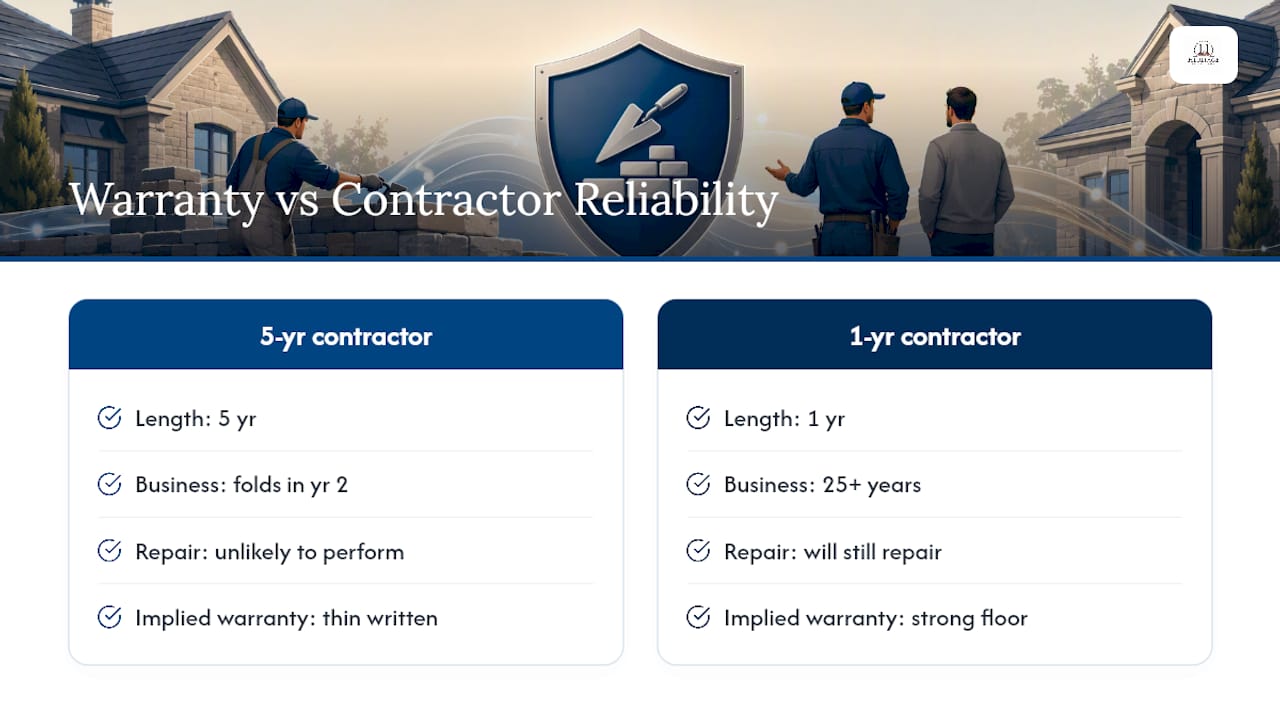
The conventional advice, "get the longest warranty you can," misses the actual risk. The real risk is a contractor who can't or won't perform the repair when you call, regardless of what the paper says. That's why implied warranties matter more than most contract templates suggest. Even a thin written warranty sits on top of a legal floor requiring competent work, which gives you leverage you might not know you have.
If you take one thing from this, prioritize documentation over duration. Photograph the finished work, keep every invoice, and confirm transferability in writing before you need it. Warranty length is a number. Contractor reliability is the thing that actually determines whether that number means anything when a mortar joint fails three winters from now.
— Thomas
Ready to Get Your Warranty Terms in Writing?
The company handles brick repair, repointing, chimney work, and custom masonry installations, and typically provides a 5-year workmanship guarantee spelled out before work begins, not promised after the fact. That's the real difference between hiring a crew and hiring a contractor who plans to still be around if something needs a second look.

When you schedule a free estimate, ask for the warranty terms in writing: duration, exclusions, and a transferability clause if you're planning to sell down the road. Request a documented scope of work too, since that paperwork becomes your strongest evidence if you ever need to file a claim. Browse Heritage Masonry & Brick's repointing and tuckpointing services to see the kind of work typically covered, or head straight to request an estimate for brick repair in Richmond and get your warranty terms locked in before the first brick moves.
Sources
For more on warranty law and contractor obligations, see LegalClarity on construction warranties and Heritage Masonry & Brick's guidance on diagnosing water intrusion.
- Warranty claims in construction projects: contractor vs. manufacturer liability | Putterman Law
- What your residential construction contract won't tell you: implied warranties | Allen Law Firm
- Construction warranties: types, scope & contractual requirements | LegalClarity
FAQ
How long is a typical workmanship warranty?
Most masonry workmanship warranties run one to five years, following the industry's broader 1-2-10 framework where the "1" typically applies to labor. Heritage Masonry & Brick backs its work with a 5-year workmanship guarantee.
What should a workmanship warranty clause include?
It needs the exact scope of coverage, a clear start date, duration, listed exclusions, the remedy the contractor will provide, and a defined claims and response process.
How long is a contractor liable for their work?
Liability depends on the written warranty term plus any applicable implied warranty under state law, which can hold a contractor to local workmanship standards even without an explicit written promise.
How long does a builder have to honor a warranty on their work?
A builder must honor whatever duration is stated in the signed contract, and separately, implied warranty protections under common law can extend liability for defective work even after an express warranty period ends.
What's the difference between a workmanship warranty and a manufacturer warranty?
A workmanship warranty covers installation errors, while a manufacturer warranty covers defects in the materials themselves, so a cracked brick and a crumbling mortar joint often get routed to two different parties entirely.