
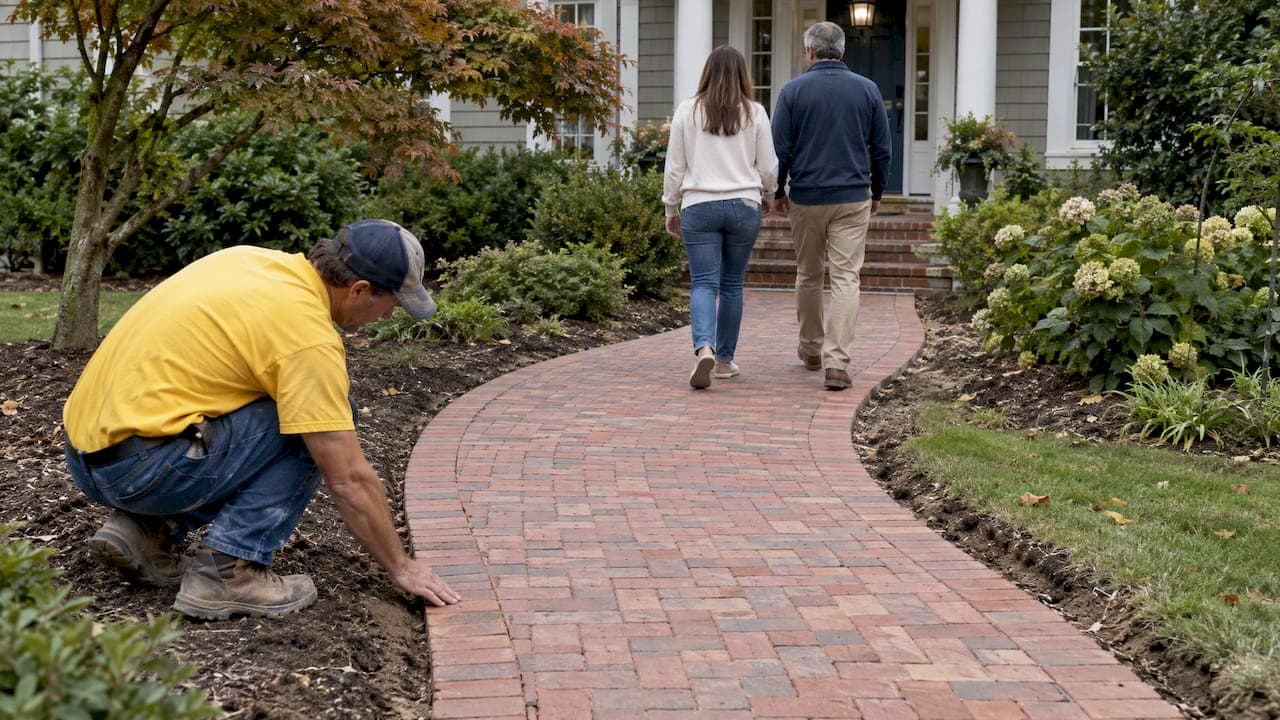
A curved brick walkway that lasts depends on three things working together: a gentle, well-chosen radius, a pattern suited to curves, and a solid base with proper edge restraint. Skip any one of these and the path either looks awkward or starts shifting within a season or two. Pattern choice also drives labor and cost, since some designs demand far more cutting than others.
TL;DR:
- Use a gentle radius to prevent excessive cutting, reduce waste, and ensure a natural appearance in curved brick walkways.
- Choose running bond for long, sweeping curves to minimize labor, while reserving herringbone patterns for short, high-traffic sections.
- Properly establish a solid base with a gravel substrate, edge restraints, and correct grading to enhance the walkway's durability and prevent shifting.
- Incorporate consistent edging materials like soldier course or stone to reinforce curves, define transitions, and keep bricks in position over time.
- Regularly inspect and maintain joints, drainage, and brick stability, and address issues promptly to avoid costly repairs or adjustments later.
Table of Contents
- Design ideas that bring a curved walkway to life
- Which brick patterns work best for curves and why
- How to lay out a smooth, consistent curve
- Durability essentials: base, edge restraint, and drainage
- Edging and transitions that keep the design finished
- Routine care and signs you need a professional repointing
- What years of masonry work teach us about curved walkways
- Ready to build a curved brick walkway that lasts
- FAQ
- Sources
Design ideas that bring a curved walkway to life
A sweeping S-curve works well in larger yards where it can wind past planting beds or trees, while a single gentle arc suits smaller spaces that need a softer alternative to a straight line. Compound arcs, where the curve tightens and loosens along its length, create a more natural feel but require more careful layout. Variable-width paths, narrowing near a garden bed and widening near a seating area, add visual interest without sacrificing function.
Width shapes how a path gets used. A 3-foot walkway feels intimate and suits a side yard or a secondary route, while a 5-foot path comfortably fits two people walking side by side, which matters for a main entry or a path used often by guests.
- Mix brick colors or tones along the curve to draw the eye toward a focal point.
- Insert a contrasting material, like stone or a soldier course, at a bend to mark a transition.
- Use a widened landing at a curve's midpoint as a natural pause for a bench or planter.
Which brick patterns work best for curves and why
Pattern choice affects both the look of a curved walkway and how much cutting it demands. Running bond lays bricks in parallel rows and bends relatively easily, which is why it allows curves with fewer cuts and lower labor, according to Landscaping Network. Herringbone, set at 45 or 90 degrees, delivers a strong interlock that resists shifting under wheeled traffic, but it requires significantly more cutting on a curve, as explained by HGTV. Basketweave and stack bond offer distinct visual textures but are harder to adapt smoothly to a bend.
- Running bond: easiest to curve, lowest labor, good for long sweeping paths.
- Herringbone: strongest interlock, best for driveways or high-traffic curves, but cut-heavy.
- Basketweave: decorative, best kept to straight sections or landings.
- Soldier course: ideal as a border or edge treatment rather than a field pattern.
Pattern orientation also changes how a path feels to walk. A pattern that runs with the direction of travel speeds up perceived movement, while one set across the path slows people down, a detail HGTV points to as a real design lever. We recommend saving decorative patterns like basketweave for wide, straight landings and letting running bond carry the curved sections.
Pro Tip: Reserve herringbone for short, high-traffic stretches near doorways and let running bond handle the long curves to cut labor costs.

How to lay out a smooth, consistent curve
Getting the radius right before any digging begins saves time and material. A radius that is too tight forces excessive cutting and looks unnatural in a landscape, while a gentler arc both reads better and reduces waste, a point echoed in trade layout guidance from JLC Online.
- Test the curve visually first. Lay a garden hose or rope along the planned path and walk it before committing to a radius.
- Build a template. Professional masons often use a beam compass, dividers, or a plywood template pinned at a pivot point to draw a full-scale arc directly on the ground, according to JLC Online.
- Calculate border offsets. Using the brick's length, figure the inside and outside border radii so edge bricks taper correctly through the curve instead of leaving uneven gaps.
- Mark both edges before cutting. Spray paint or string along both borders keeps the width consistent and shows exactly where cuts will fall.
Choosing a gentler radius wherever the site allows is the single easiest way to keep cutting, and cost, under control, as professional paver and patio installation experts demonstrate.
Durability essentials: base, edge restraint, and drainage
The part of a curved brick walkway nobody sees determines how long it lasts. A compacted gravel base, edge restraint, and correct grading matter more to longevity than the brick pattern on top.
- Compact a crushed stone base thoroughly before setting bricks, with depth adjusted for soil type and expected traffic.
- Install edge restraint, metal, plastic, or a mortared border, to stop pavers from creeping outward over time, a common failure point on curves where lateral pressure is uneven.
- Choose mortared joints for a more formal, rigid path, or sand-set joints for a walkway that's easier to repair but needs more frequent joint maintenance.
- Keep the main walking corridor firm, stable, and slip-resistant, saving decorative texture for the edges rather than the primary route, consistent with pedestrian access guidance from the Access Board.
Impervious walkways within 10 feet of a house should slope at roughly a 2% grade away from the foundation, per guidance cited by the Building America Solution Center. Getting this grading right during initial construction avoids the far more expensive job of regrading later. For width planning, our guide on walkway width standards breaks down what the Access Board recommends for comfortable passage.
Edging and transitions that keep the design finished
Edging does double duty: it holds the base in place and gives a curved path a finished look. A soldier course, bricks set on end along the border, is a classic choice that reinforces the curve's line while framing the field pattern. Stone or Belgian block edging adds contrast and weight, while metal edging disappears visually but still restrains the base effectively. Concrete curbs suit a more formal, permanent installation.
- Use a border course to cleanly separate two different field patterns, such as running bond transitioning into a basketweave landing.
- Choose edging material based on how visible you want the transition to be.
- Solid edging prevents cut bricks along the curve from gradually shifting out of position.
Routine care and signs you need a professional repointing
A well-built curved walkway needs little upkeep beyond regular sweeping, topping up joint sand as it settles, and clearing debris from drainage paths so water keeps moving away from the house. Check periodically for bricks that have settled, loosened, or developed uneven edges, since these are early signs of base failure rather than cosmetic issues.
- Sweep polymeric or regular sand into joints once or twice a year to keep bricks locked together.
- Watch for pooling water after rain, which usually signals a drainage or grading problem rather than a brick issue.
- Address loose or rocking bricks quickly before they widen gaps and invite more water underneath.
When joints crumble, bricks sink in sections, or a border starts separating from the field, that typically calls for repointing or a partial reset rather than a quick patch. Our brick walkway repair guide walks through what that process usually involves. We provide estimates and a workmanship guarantee for homeowners who'd rather have a professional handle the diagnosis.
Pro Tip: Check for standing water near your walkway after the next heavy rain. Our guide to diagnosing brick patio drainage can help you spot the cause in minutes.

What years of masonry work teach us about curved walkways
The most common mistake we see is a radius pulled too tight to save space, which forces heavy cutting and still looks forced underfoot. The second is skipping drainage planning entirely, treating grading as an afterthought instead of the first decision. Good masons balance appearance against durability by matching brick color and size to existing work while never compromising on edge restraint, since a beautiful curve with no restraint is a short-term result.
— Thomas
Ready to build a curved brick walkway that lasts
We design and install custom brick patios and walkways throughout Richmond, VA, matching curve, pattern, and material to your yard and your budget. Whether you need new brickwork from scratch or repairs to an existing path, our estimates are free and every project carries a 5-year workmanship guarantee.

If your current walkway has settled or needs repointing before a redesign, our brick repair team can assess it alongside any new work. Reach out for a free estimate and we'll walk the site with you before anything gets dug.
FAQ
How do I make a curved brick walkway?
Start by testing the radius on-site with a hose or rope, then transfer it to the ground using a beam compass or plywood template, a method detailed by JLC Online. Build a compacted gravel base, install edge restraint along both borders, and lay bricks in a pattern like running bond that curves with minimal cutting.
What are curved bricks called?
There's no special name for bricks used in curves. Standard rectangular bricks are cut and arranged in a curving pattern, most often running bond, to follow the arc without needing a specialty shape.
What is the best paver pattern for a curved walkway?
Running bond is generally the easiest pattern to curve since it requires fewer cuts and lower labor, according to Landscaping Network. Herringbone offers stronger interlock for high-traffic areas but demands significantly more cutting on bends.
What is the best brick pattern for a walkway?
The best pattern depends on traffic and budget: running bond suits long, curving paths with lower labor costs, while herringbone provides the strongest interlock for busy, high-traffic walkways, as outlined by HGTV. Many homeowners combine the two, using running bond for the main curve and herringbone or basketweave at landings.
How wide should a curved brick walkway be?
A primary walkway works best at a minimum of four feet, with five feet preferred for two people to walk comfortably side by side, per Access Board guidance. Our walkway width standards guide covers how this applies to different yard layouts.
Sources
- A Guide to Brick Patterns for Walkways | HGTV
- Laying Out a Curved Brick Walk | JLC Online
- Chapter 5 - Model Sidewalks | Access Board
- Patio slabs, porch slabs, walkways and driveways slope away from house | Building America Solution Center
- Brick Walkway Ideas - Landscaping Network